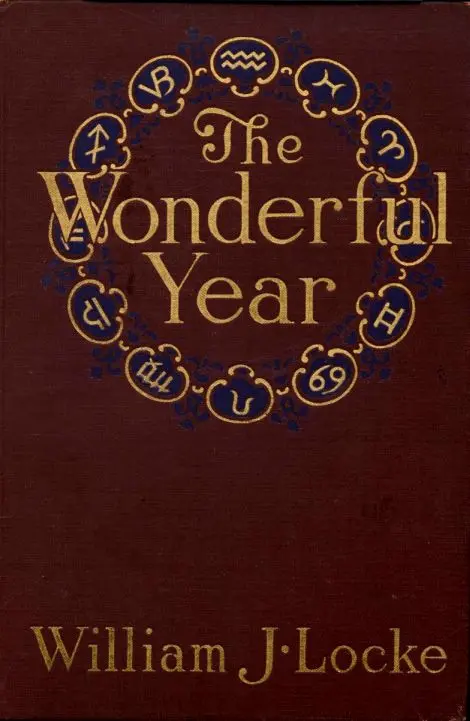
The Wonderful Year
William John Locke
THE CLASSIC COLLECTION · 1905
"Idols" by William John Locke is a novel written in the late 19th century. The story revolves around the complex relationships between three main characters: Irene Merriam, her husband Gerard, and his close friend Hugh Colman. As the narrative begins, it explores themes of love, loyalty, jealousy, and the societal pressures that accompany personal choices. At the start of the novel, two men commit a crime that sets off a chain of events affecting four seemingly unrelated lives. We are introduced to Irene Merriam, a content woman reflecting on her happy life with Gerard and Hugh, both of whom share a deep connection with her. As they engage in conversation and display their differing natures, tensions begin to emerge, particularly with Irene's compassionate concern for a Jewish girl named Minna Hart, who quickly becomes tied to them as her character unfolds. The early chapters lay the groundwork for dramatic developments and moral conflicts rooted in love, friendship, and societal constraints, hinting at deeper struggles to come.
Introduction adapted from the source catalogue; source summaries may be automatically generated.
Free to read · English · 80,379 words · No account needed
MAKE TIME FOR A GOOD BOOK
On by default. Untick to stop anonymous reading totals. Each page counts after 10 seconds in view. How this works.
Anonymous counting is on unless you have switched it off.
She went upstairs to her bedroom with anger and foreboding at her heart, and put on hat and jacket, casting mere mechanical glances at the mirror, for the sake of adjustment. Six months before, her dressing to meet Hugh had been a matter of sweet and import and coquetry. She looked, however, very pretty in her dark-blue costume, with dainty ruffle at her throat when she met him three-quarters of an hour later in Kensington Gardens. He was walking moodily up and down the broad walk, near their appointed meeting place; but when he caught sight of her he quickened his step.
“I am sorry I’m late,” she said, with some petulance; “but when you will make me take these long journeys----”
“It is not my fault, dear,” he said, casually. “I told you I was lunching at Lancaster Gate and was going to put in a call near by before dinner. It was my only hour.”
“Oh, well, never mind. I’m here now. It was papa who kept me. I’ve been discussing matrimony with him.”
“In the abstract, or----”
“Both. It began with the all too concrete Goldberg. Refusing him, I’m to marry an abstract Jew or the curse of Abraham will fall upon me.”
“Be more precise, if you don’t mind,” he said seriously.
She gave him a detailed account of the conversation, picturesquely satiric. Hugh listened sombrely, holding his stick with both hands behind his back, as they strolled slowly down among the fallen leaves.
“So he’ll never consent,” she concluded. “I suppose we’ll have to wait until--well--the ordinary way of nature. He’s an old man.”
“We mustn’t think of that, my child,” said Hugh, with some gentleness.
“I don’t see why not. It will solve all our difficulties.”
“What a mixture of flint and flesh you are, Minna,” he said, regarding
her curiously.
“I never pretend to love where I don’t,” she replied. “And when people thwart me I begin to dislike.”
They walked on a little in silence, turned and retraced their steps. The dusk began to gather round them and the autumn mist to hang upon the thinning branches. Minna shivered a little and took his arm.
“Why don’t you say something kind to me, Hugh dear?” she said,
plaintively.
He stooped and kissed her, and they went on their way less far apart than before. Presently she asked him where he was going to dine.
“At the Merriams.”
“I wish to goodness you wouldn’t!” she exclaimed, petulantly.
“My dear girl, because I am secretly married to you, I am not going to give up my dearest and oldest friends.”
Your reading position is saved on this browser. Take it to another device with a library code. Reading pages adapt to text, rather than matching a printed edition.
William John Locke
William John Locke
William John Locke
William John Locke
BEHIND THE BOOK
This eBook is for the use of anyone anywhere in the United States and most other parts of the world at no cost and with almost no restrictions whatsoever. You may copy it, give it away or re-use it under the terms of the Project Gutenberg License included with this eBook or online at www.gutenberg.org. If you are not located in the United States, you will have to check the laws of the country where you are located before using this eBook. Read the source licence.
The original source file, including credits and licence, is retained by this library. Request an original-format copy at no charge. Please include the book title and Project Gutenberg identifier #56015.
KEEP YOUR CURIOSITY GOING
Coulson Kernahan

Maurice Baring
Frances Wright
Cécile Tormay

Frederic Jesup Stimson

W. H. P. (William Henry Pope) Jarvis