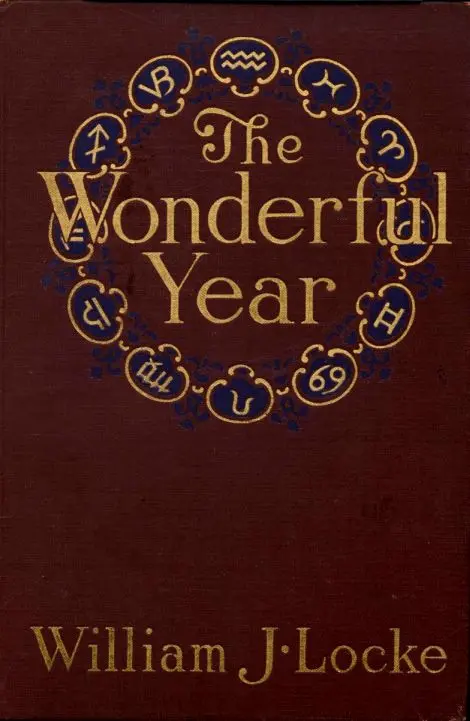
The Wonderful Year
William John Locke
THE CLASSIC COLLECTION · 1905
"Idols" by William John Locke is a novel written in the late 19th century. The story revolves around the complex relationships between three main characters: Irene Merriam, her husband Gerard, and his close friend Hugh Colman. As the narrative begins, it explores themes of love, loyalty, jealousy, and the societal pressures that accompany personal choices. At the start of the novel, two men commit a crime that sets off a chain of events affecting four seemingly unrelated lives. We are introduced to Irene Merriam, a content woman reflecting on her happy life with Gerard and Hugh, both of whom share a deep connection with her. As they engage in conversation and display their differing natures, tensions begin to emerge, particularly with Irene's compassionate concern for a Jewish girl named Minna Hart, who quickly becomes tied to them as her character unfolds. The early chapters lay the groundwork for dramatic developments and moral conflicts rooted in love, friendship, and societal constraints, hinting at deeper struggles to come.
Introduction adapted from the source catalogue; source summaries may be automatically generated.
Free to read · English · 80,379 words · No account needed
MAKE TIME FOR A GOOD BOOK
On by default. Untick to stop anonymous reading totals. Each page counts after 10 seconds in view. How this works.
Anonymous counting is on unless you have switched it off.
“But you needn’t have risked your own life by taking off your sealskin and coming home in that flimsy thing,” he said, with a smile. “Even St. Martin didn’t do that.”
“Do you know,” she replied, with a charming viciousness, and leaning over the table, “I consider St. Martin one of the meanest characters in history!”
Some time after lunch, the servant came into the smoking-room and announced that Mr. Jackson had called.
“He’s a very horrid-looking man, ma’am,” she remarked.
“I’ll go and settle him,” said Hugh, rising.
“No. Let me. I shall enjoy it,” replied Irene.
And she departed, with the light of battle in her eyes. She met the man in the hall. He began to bluster. Hugh, by a turn of the passage, stood an unobserved spectator.
“You’re not going to have the child back,” said Irene.
“Then I’ll have compensation,” said the man.
“I’m not going to give up my wife’s flesh and blood for nothing. ’Tain’t likely--we’re poor folks and the kid earns a little.”
“More shame for you--a great hulking brute like you.”
“I don’t mind taking five pounds.”
“You won’t get a half-penny.”
“Then out I goes to fetch a policeman.”
He moved towards the door. Irene took a step forward.
“You dare threaten me!” she cried. “You! Get out of my house and never let me hear of you again, or, as there’s a Lord in heaven, I’ll put the Children’s Protection Society on your tracks and you’ll see the inside of a gaol.”
Whether it was the threat or Irene’s shining eyes that cowed the man, Hugh could not tell. He slunk away with muffled maledictions and banged the street door after him. Hugh ran to meet her, his heart aglow with her. It was the eternal combat of Mithra and Ahriman. He broke into boyish eulogies. She laughed a little excitedly and wiped her lips with her handkerchief.
“Let us go back to the smoking-room. The foul beast! The whole air
tastes of him.”
“You have a delicious way of setting the law of England at defiance,” he
said, laughing.
“Bad laws ought to be defied,” she retorted, full of the flush of victory. Which exquisitely feminine conviction he had not the heart to disturb.
A little later she claimed his assistance in another matter.
“It’s the extension of premises for the Institution,” she said. “The plans came in yesterday and I can’t make head or tail of them.”
Your reading position is saved on this browser. Take it to another device with a library code. Reading pages adapt to text, rather than matching a printed edition.
William John Locke
William John Locke
William John Locke
William John Locke
BEHIND THE BOOK
This eBook is for the use of anyone anywhere in the United States and most other parts of the world at no cost and with almost no restrictions whatsoever. You may copy it, give it away or re-use it under the terms of the Project Gutenberg License included with this eBook or online at www.gutenberg.org. If you are not located in the United States, you will have to check the laws of the country where you are located before using this eBook. Read the source licence.
The original source file, including credits and licence, is retained by this library. Request an original-format copy at no charge. Please include the book title and Project Gutenberg identifier #56015.
KEEP YOUR CURIOSITY GOING
Coulson Kernahan

Maurice Baring
Frances Wright
Cécile Tormay

Frederic Jesup Stimson

W. H. P. (William Henry Pope) Jarvis