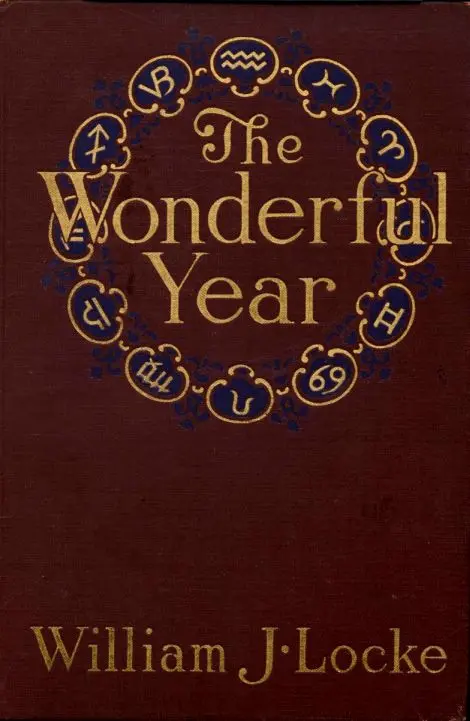
The Wonderful Year
William John Locke
THE CLASSIC COLLECTION · 1905
"Idols" by William John Locke is a novel written in the late 19th century. The story revolves around the complex relationships between three main characters: Irene Merriam, her husband Gerard, and his close friend Hugh Colman. As the narrative begins, it explores themes of love, loyalty, jealousy, and the societal pressures that accompany personal choices. At the start of the novel, two men commit a crime that sets off a chain of events affecting four seemingly unrelated lives. We are introduced to Irene Merriam, a content woman reflecting on her happy life with Gerard and Hugh, both of whom share a deep connection with her. As they engage in conversation and display their differing natures, tensions begin to emerge, particularly with Irene's compassionate concern for a Jewish girl named Minna Hart, who quickly becomes tied to them as her character unfolds. The early chapters lay the groundwork for dramatic developments and moral conflicts rooted in love, friendship, and societal constraints, hinting at deeper struggles to come.
Introduction adapted from the source catalogue; source summaries may be automatically generated.
Free to read · English · 80,379 words · No account needed
MAKE TIME FOR A GOOD BOOK
On by default. Untick to stop anonymous reading totals. Each page counts after 10 seconds in view. How this works.
Anonymous counting is on unless you have switched it off.
Mrs. Delamere did not reply. She rose and gathered her gloves and fan from a table where they were lying, and then came calmly up to Minna’s chair. “You are overdone. It is time for bed.”
She was not without kindly instincts. In her placid, well-bred way, she stooped and put her arm beneath Minna’s and helped her to rise. She stood for a moment without withdrawing her arm.
“You are leading a weary life, my poor child,” she said.
Minna looked at her for a minute. Her lips quivered.
“Oh! a hell of a life,” she whispered.
And to Mrs. Delamere’s consternation, the girl gave one or two little convulsive sobs and, turning swiftly, burst into miserable crying upon her shoulder.
“I wish I were dead. I can’t find peace or happiness anywhere. It is a
hell of a life!”
The elder woman soothed her as best she could. Eventually Minna dried her eyes, kissed, for the first time, her friend’s faded cheek, and went out of the room.
“Why is it,” said Mrs. Delamere to herself, “that when a woman wants to go to the devil, she always does so by water?”
Gerard was up early the next morning, and after enquiries went in search of a respectable turn-out for the proposed drive. He found a high American phaeton and a pair of Irish ponies which the livery stable keeper had recently purchased from a dissipated young Englishman who, having ruined himself at the tables, had hurriedly hastened to England to enlist in a foot regiment. On returning towards the Public Gardens, he encountered his club acquaintance sitting outside the Café de la Victoire. He joined him in an apéritif, described his recent hire. The friend smiled indulgently.
“I suppose it’s for the Queen of Sheba.”
Gerard frowned surprise. “Who’s that?”
“The girl I’ve seen you with several times. They call her that, I suppose, because she’s wealthy, dusky, and indiscreet.”
“I used to know her in London long ago,” said Gerard, stiffly.
Suddenly the man remembered, flushed, and apologised.
“I’m awfully sorry. A thousand pardons. But one gets into a bad way of talking of public characters--and unfortunately every one talks of the lady by that name.”
Gerard sipped his vermouth coolly.
“What do you know about her?”
“Oh, nothing much. Really--I----”
“It would rather interest me to learn,” insisted Gerard.
Your reading position is saved on this browser. Take it to another device with a library code. Reading pages adapt to text, rather than matching a printed edition.
William John Locke
William John Locke
William John Locke
William John Locke
BEHIND THE BOOK
This eBook is for the use of anyone anywhere in the United States and most other parts of the world at no cost and with almost no restrictions whatsoever. You may copy it, give it away or re-use it under the terms of the Project Gutenberg License included with this eBook or online at www.gutenberg.org. If you are not located in the United States, you will have to check the laws of the country where you are located before using this eBook. Read the source licence.
The original source file, including credits and licence, is retained by this library. Request an original-format copy at no charge. Please include the book title and Project Gutenberg identifier #56015.
KEEP YOUR CURIOSITY GOING
Coulson Kernahan

Maurice Baring
Frances Wright
Cécile Tormay

Frederic Jesup Stimson

W. H. P. (William Henry Pope) Jarvis