THE CLASSIC COLLECTION✦The claims of decorative artCLASSIC FREE BOOKS
The claims of decorative art
Walter Crane
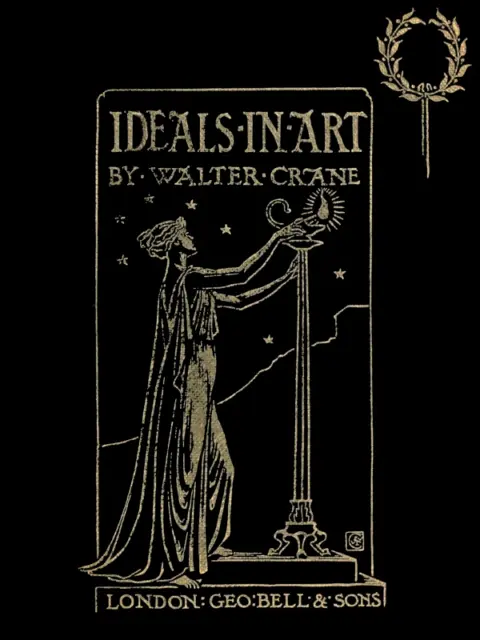
THE CLASSIC COLLECTION · 1905
"Ideals in Art: Papers Theoretical, Practical, Critical" by Walter Crane is a collection of essays written in the early 20th century. The work reflects Crane's thoughts and observations as an artist and designer, discussing the intersection of art with social, economic, and aesthetic issues of his time. The essays cover various topics, including the Arts and Crafts movement, the teaching of art, and the social implications of artistic expression, aiming to elevate the understanding of beauty in art and its relation to life. The opening of this collection establishes Walter Crane's objectives in discussing the revival of handicrafts and the broader implications of art in society. He emphasizes the historical context of the Arts and Crafts movement, covering its rise from earlier decorative art traditions. The text showcases his reflections on how social and economic conditions affect artistic expression and beauty, drawing attention to the need for genuine and sincere design in a modern world dominated by industrialization. Crane suggests that understanding art must encompass its historical evolution as well as its social responsibilities, setting a critical tone for the essays that follow.
Introduction adapted from the source catalogue; source summaries may be automatically generated.
Free to read · English · 45,302 words · No account needed
MAKE TIME FOR A GOOD BOOK
On by default. Untick to stop anonymous reading totals. Each page counts after 10 seconds in view. How this works.
Anonymous counting is on unless you have switched it off.
It seems curious, then, that the courses of study from the antique and the life usual at our art schools do not have a greater effect upon taste and choice in costume than they appear to have.
We must remember, however, the many crossing influences that come in, the many motives and hidden causes that bear, in the complexity of modern existence, upon the question, and the stronger social motive powers which determine the forms of modern dress.
Fundamentally, we may say dress is more or less a question of climate.
Pure utility would be satisfied if the warmth is fairly distributed, and the action of the body and limbs is free. The child with a loose tunic, leaving arms and legs bare and free, still represents primitive and classic man; and he also often satisfies the artist.
But the child is free to grow, to get as much joy out of life as it can. It does not feel under the necessity of pleasing Mrs. Grundy, except perhaps when mud-pies are “off.”
Primitive, again, and picturesque is the dress of the labourer, ploughman, fisherman, navvy; though purely adapted to use and service. Concessions to aestheticism, if any, only come in by way of a coloured neckerchief, the broidery of a smock frock, or the pattern of knitted jersey.
Yet each and all are constant and favourite subjects of the modern
painter. Why?
Fundamentally, I think, because their dress is expressive of their
occupation and character, as may be said of the dress of all working
people.
The peasantry in all European countries alone have preserved anywhere national and local picturesqueness and character in their dress; often, too, where it still lingers unspoiled, as in Greece, and in Hungary and Bohemia, adorned with beautiful embroidery worked by the women themselves.
The last relics of historic and traditional costume must be sought therefore among the people, and for picturesqueness we must still seek the labourer.
This seems a strange commentary upon all modern painstaking, conscious efforts to attain the natural, simple, beautiful, and suitable in dress, to be at once healthy and artistic. There really ought not to be so much difficulty about it.
If we lived simple, useful, and beautiful lives, we could not help being picturesque in the highest sense.
There is the modern difficulty.
We are driven back from every point to the ever-present social
question.
Therefore, it seems to me that, though highly valuable and educational, we must not rely entirely upon conscious cultivation and conscious effort to lift the question of dress above vulgarity and affectation.
Your reading position is saved on this browser. Take it to another device with a library code. Reading pages adapt to text, rather than matching a printed edition.
Walter Crane
Walter Crane
Walter Crane
Walter Crane
BEHIND THE BOOK
This eBook is for the use of anyone anywhere in the United States and most other parts of the world at no cost and with almost no restrictions whatsoever. You may copy it, give it away or re-use it under the terms of the Project Gutenberg License included with this eBook or online at www.gutenberg.org. If you are not located in the United States, you will have to check the laws of the country where you are located before using this eBook. Read the source licence.
The original source file, including credits and licence, is retained by this library. Request an original-format copy at no charge. Please include the book title and Project Gutenberg identifier #57852.
KEEP YOUR CURIOSITY GOING

David Patterson (Spirit) Hatch

David Patterson (Spirit) Hatch

David Patterson (Spirit) Hatch

Ralph Waldo Emerson

Maurice Baring

Oscar Wilde & James McNeill Whistler