THE CLASSIC COLLECTION✦The Countess FannyCLASSIC FREE BOOKS
The Countess Fanny
Marjorie Bowen
THE CLASSIC COLLECTION · 1910
"I Will Maintain" by Marjorie Bowen is a historical novel written in the early 20th century. The story revolves around John de Witt, a prominent figure in the politics of the Dutch Republic, as he navigates the complexities of governance while mentoring the young Prince William of Orange. The narrative explores themes of loyalty, ambition, and the struggles of a republic at odds with its royal lineage, as tensions arise from competing political factions. The opening of the novel presents John de Witt in a moment of deliberation with Sir William Temple, discussing the precarious state of the young prince's position and the intrigues that threaten their republic. De Witt expresses his deep sense of responsibility and commitment to the ideals of the republic, while grappling with the rising influence of the Orange party, represented by a prince whom he is both educating and safeguarding. The scene is marked by a palpable tension as the secretary Florent van Mander observes the intricate dynamics between De Witt and the prince, reflecting his ambitions and doubts about the future of their political landscape. The reader is introduced to a world teetering on the brink of conflict, underscoring each character's motivations and the overarching struggle for power within a fragile state.
Introduction adapted from the source catalogue; source summaries may be automatically generated.
Free to read · English · 152,377 words · No account needed
MAKE TIME FOR A GOOD BOOK
On by default. Untick to stop anonymous reading totals. Each page counts after 10 seconds in view. How this works.
Anonymous counting is on unless you have switched it off.
A radiant look came into John de Witt’s eyes.
“I can hardly bring myself to do without such precious company, but they are better with my sister. This house is too quiet, and I so seldom here.”
Both were silent, thinking of Wendela de Witt. Regrets were not in their religion; believing, they could not repine.
The firelight, showing more strongly as the grey day faded, warmed the sombre, dark room into a more cheerful aspect, glittering redly in the brass fireirons and bellows, the nails in the leather chairs, the Ruard’s embroidered dress and sword-hilt; showing, too, the Grand Pensionary’s tall and stately figure in his quiet black with the plain linen collar tied with silk tassels, and the brown hair falling either side the melancholy, composed face.
There was a great likeness between the two brothers, though Cornelius was of a larger make, a freer carriage, haughtier perhaps and more fiery, but with a glance as dignified and a bearing as noble.
“Since you must go----” John de Witt was saying, when Van Ouvenaller
opened the door.
“Mynheer, His Highness the Prince of Orange.”
The brothers exchanged a quick glance.
“He is here?”
“In the library, Mynheer.”
“Alone?”
“He rode up with one of his gentlemen, Mynheer, who remains with the
horses.”
John de Witt laid his hand on his brother’s sleeve.
“Desire the Prince to come in here if he wishes to see me, Van
Ouvenaller.”
When the secretary had gone, the Ruard spoke.
“You did not know he was at the Hague?”
“No; he must have ridden from Honsholredyck to-day.”
“What does this move mean?”
The Grand Pensionary’s lips were sternly set, his brows slightly
frowning.
“I do not know, Cornelius.”
“He hath heard of what passed in the Assembly yesterday.”
“Will you stay?”
“Nay, he would not speak before me--we never loved one another.”
“He must speak before whomsoever I choose to question him since he is still under my tutelage,” answered John de Witt sternly.
“Yet I will not remain, lest your patience and his presumption should
anger me.”
M. Van Ouvenaller entered again, announcing the Prince, who followed
him.
The secretary withdrew, closing the door, and William of Orange stood facing the brothers. He was in riding costume, and wore over it a dark velvet mantle. His whip was in his boot, he carried his gloves and his hat in his right hand, purposely to cover the fact that he did not offer it to M. de Witt.
There was a colour in his face, and his bright hair was tumbled over his falling lace collar. He had ridden a long way in a keen wind.
Your reading position is saved on this browser. Take it to another device with a library code. Reading pages adapt to text, rather than matching a printed edition.
Marjorie Bowen
Marjorie Bowen
Marjorie Bowen
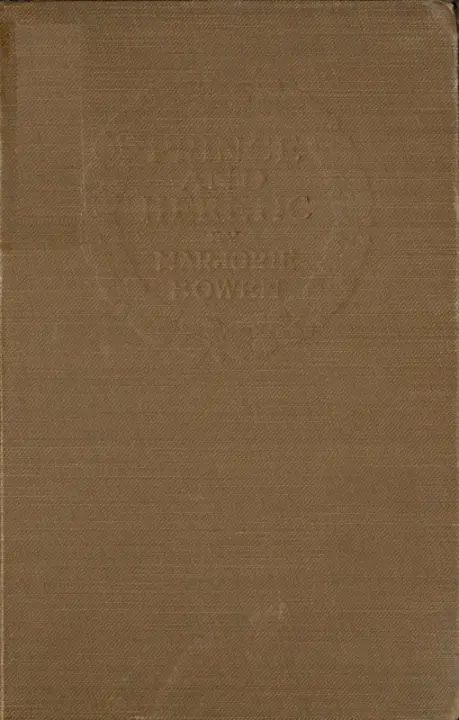
Marjorie Bowen
BEHIND THE BOOK
This eBook is for the use of anyone anywhere in the United States and most other parts of the world at no cost and with almost no restrictions whatsoever. You may copy it, give it away or re-use it under the terms of the Project Gutenberg License included with this eBook or online at www.gutenberg.org. If you are not located in the United States, you will have to check the laws of the country where you are located before using this eBook. Read the source licence.
The original source file, including credits and licence, is retained by this library. Request an original-format copy at no charge. Please include the book title and Project Gutenberg identifier #53549.
KEEP YOUR CURIOSITY GOING
Cécile Tormay

Moritz Busch
Coulson Kernahan
John L. Ransom

Maurice Baring
Frances Wright