
Last letters from the living dead man
David Patterson (Spirit) Hatch
THE CLASSIC COLLECTION · 1916
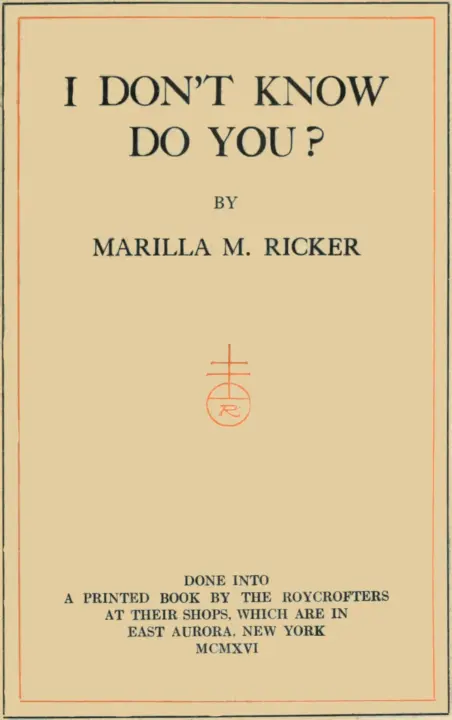
"I Don't Know, Do You?" by Marilla M. Ricker is a philosophical treatise written in the early 20th century. The work delves into the critique of religious doctrines and practices, exploring themes of agnosticism, freethought, and the questioning of traditional beliefs. Through her writing, Ricker addresses the limitations imposed by organized religion and advocates for individual reason and inquiry. The opening of the work features a foreword dedicated to Ralph Washburn Chainey, commendating his contributions to the cause of freethought. Ricker presents her perspective on religion, highlighting her skepticism towards creeds and dogmas. She reflects on historical events and societal changes, arguing that as knowledge and intellectual advancement grow, the rigid structures of religious beliefs may become obsolete. Ricker's tone conveys both a sense of urgency and a call for liberation from outdated beliefs, setting the stage for a broader discussion on the implications of faith and reason throughout the text.
Introduction adapted from the source catalogue; source summaries may be automatically generated.
Free to read · English · 24,950 words · No account needed
MAKE TIME FOR A GOOD BOOK
On by default. Untick to stop anonymous reading totals. Each page counts after 10 seconds in view. How this works.
Anonymous counting is on unless you have switched it off.
Upo' this tree there grows sic fruit,
Its virtues a' can tell, man;
It raises man aboon the brute,
It maks him ken himsel', man;
Gif ance the peasant taste a bite,
He's greater than a lord, man,
And ni' the beggar shares a mite
Of a' he can afford, man.
And so we exclaim in the words of one of our own true poets:
Always in thine eyes, O Liberty!
Shines that high light whereby the world is saved,
And though thou slay us, we will trust in thee.
You have all heard of the man who refused to open his eyes for a year, and who declared that during that time nothing could be seen on account of the darkness. But the endeavor to perpetuate old errors by keeping the eyes closed to the facts of science, the truths of philosophy, and the progress of the human race, has not been crowned with success. The further attempt to convert the world to what James Parton calls a "kitchen religion" is merely waste of power.
The preaching of Christianity is making "much ado about nothing." What we want is manhood and womanhood.
It is said by the Church that the man who lives for his family and brings all that he can win of what is fair and bright and glad to those he loves, may be a good man, but he is not a Christian, and therefore has no religion.
Give me then the man who is not a Christian, and who has no religion, for if the man who loves his wife and children, who gives to them the strength of his arm, the thought of his brain, the warmth of his heart, has not religion, the world is better off without it, for these are the highest and holiest things which man can do.
There is only one thing worth praying for: to be in the line of
evolution.--Elbert Hubbard.
Jesus as Savior of the world is a theological creation, and not a
historical character.
SO HERE THEN ENDETH THAT GREAT AND GOOD BOOK "I DON'T KNOW--DO YOU?" WRITTEN BY MARILLA M. RICKER, AND PRINTED AND BOUND FOR HER BY THE ROYCROFTERS AT THEIR SHOP, WHICH IS IN EAST AURORA, ERIE COUNTY AND STATE OF NEW YORK, MCMXVI.
Born Jan 29, 1737.
Friend and adviser of Washington, Jefferson, Franklin, Monroe,
etc., etc.
Author of Common Sense, The Crisis, Rights of Man, and The
Age of Reason;
Editor of Pennsylvania Magazine;
Enlisted in Continental Army; appointed Aide-de-Camp to General
Nathaniel Greene;
Secretary of Committee on Foreign Affairs, Congress and
Pennsylvania Assembly;
Your reading position is saved on this browser. Take it to another device with a library code. Reading pages adapt to text, rather than matching a printed edition.
BEHIND THE BOOK
This eBook is for the use of anyone anywhere in the United States and most other parts of the world at no cost and with almost no restrictions whatsoever. You may copy it, give it away or re-use it under the terms of the Project Gutenberg License included with this eBook or online at www.gutenberg.org. If you are not located in the United States, you will have to check the laws of the country where you are located before using this eBook. Read the source licence.
The original source file, including credits and licence, is retained by this library. Request an original-format copy at no charge. Please include the book title and Project Gutenberg identifier #64568.
KEEP YOUR CURIOSITY GOING
David Patterson (Spirit) Hatch

David Patterson (Spirit) Hatch

David Patterson (Spirit) Hatch
Coulson Kernahan

Ralph Waldo Emerson
Frances Wright