THE CLASSIC COLLECTION✦The school and societyCLASSIC FREE BOOKS
The school and society
John Dewey
THE CLASSIC COLLECTION · 1922
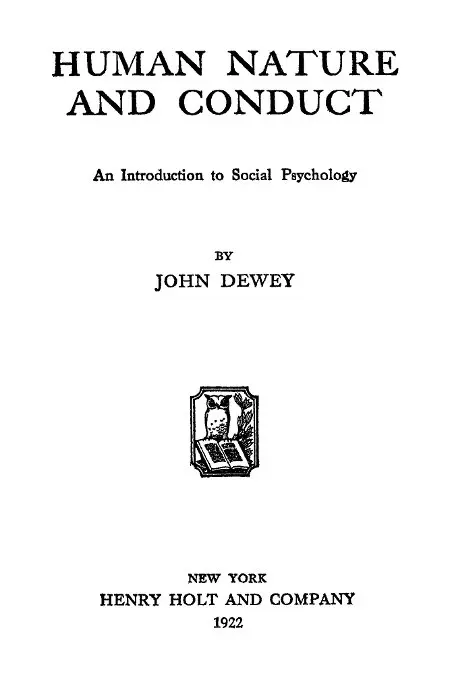
"Human Nature and Conduct: An Introduction to Social Psychology" by John Dewey is a philosophical treatise focusing on social psychology, likely written in the early 20th century. The work explores the intricate relationship between human behavior, moral principles, and social environments, emphasizing how habits shape personal and societal conduct. Dewey's engagement with the concept of habit as a central element in human interaction sets the stage for a deeper examination of morality's connection to human nature and social conditions. The opening of Dewey's work introduces the premise that traditional moral views often regard human nature with suspicion, leading to a disconnection between morality and the realities of human behavior. He critiques the historical pathologizing of human nature by moralists and explores how societal structures influence individual actions. Dewey argues that understanding habits—a synthesis of impulses and intelligence—is crucial for a more realistic approach to social psychology, positing that moral principles should be grounded in an empirical study of human nature and societal conditions rather than abstract ideals. Through this exploration, he suggests a more integrated and practical framework for discussing morality within the context of human conduct.
Introduction adapted from the source catalogue; source summaries may be automatically generated.
Free to read · English · 83,723 words · No account needed
MAKE TIME FOR A GOOD BOOK
On by default. Untick to stop anonymous reading totals. Each page counts after 10 seconds in view. How this works.
Anonymous counting is on unless you have switched it off.
The family into which one is born is a family in a village or city which interacts with other more or less integrated systems of activity, and which includes a diversity of groupings within itself, say, churches, political parties, clubs, cliques, partnerships, trade-unions, corporations, etc. If we start with the traditional notion of mind as something complete in itself, then we may well be perplexed by the problem of how a common mind, common ways of feeling and believing and purposing, comes into existence and then forms these groups. The case is quite otherwise if we recognize that in any case we must start with grouped action, that is, with some fairly settled system of interaction among individuals. The problem of origin and development of the various groupings, or definite customs, in existence at any particular time in any particular place is not solved by reference to psychic causes, elements, forces. It is to be solved by reference to facts of action, demand for food, for houses, for a mate, for some one to talk to and to listen to one talk, for control of others, demands which are all intensified by the fact already mentioned that each person begins a helpless, dependent creature. I do not mean of course that hunger, fear, sexual love, gregariousness, sympathy, parental love, love of bossing and of being ordered about, imitation, etc., play no part. But I do mean that these words do not express elements or forces which are psychic or mental in their first intention. They denote ways of behavior. These ways of behaving involve interaction, that is to say, and prior groupings. And to understand the existence of organized ways or habits we surely need to go to physics, chemistry and physiology rather than to psychology.
There is doubtless a great mystery as to why any such thing as being conscious should exist at all. But if consciousness exists at all, there is no mystery in its being connected with what it is connected with. That is to say, if an activity which is an interaction of various factors, or a grouped activity, comes to consciousness it seems natural that it should take the form of an emotion, belief or purpose that reflects the interaction, that it should be an "our" consciousness or a "my" consciousness. And by this is meant both that it will be shared by those who are implicated in the associative custom, or more or less alike in them all, and that it will be felt or thought to concern others as well as one's self. A family-custom or organized habit of action comes into contact and conflict for example with that of some other family. The emotions of ruffled pride, the belief about superiority or being "as good as other people," the intention to hold one's own are naturally our feeling and idea of our treatment and position. Substitute the Republican party or the American nation for the family and the general situation remains the same. The conditions which determine the nature and extent of the particular grouping in question are matters of supreme import. But they are not as such subject-matter of psychology, but of the history of politics, law, religion, economics, invention, the technology of communication and intercourse. Psychology comes in as an indispensable tool. But it enters into the matter of understanding these various special topics, not into the question of what psychic forces form a collective mind and therefore a social group. That way of stating the case puts the cart a long way before the horse, and naturally gathers obscurities and mysteries to itself. In short, the primary facts of social psychology center about collective habit, custom. In addition to the general psychology of habit--which is general not individual in any intelligible sense of that word--we need to find out just how different customs shape the desires, beliefs, purposes of those who are affected by them. The problem of social psychology is not how either individual or collective mind forms social groups and customs, but how different customs, established interacting arrangements, form and nurture different minds. From this general statement we return to our special problem, which is how the rigid character of past custom has unfavorably influenced beliefs, emotions and purposes having to do with morals.
Your reading position is saved on this browser. Take it to another device with a library code. Reading pages adapt to text, rather than matching a printed edition.
John Dewey
John Dewey

John Dewey
John Dewey
BEHIND THE BOOK
This eBook is for the use of anyone anywhere in the United States and most other parts of the world at no cost and with almost no restrictions whatsoever. You may copy it, give it away or re-use it under the terms of the Project Gutenberg License included with this eBook or online at www.gutenberg.org. If you are not located in the United States, you will have to check the laws of the country where you are located before using this eBook. Read the source licence.
The original source file, including credits and licence, is retained by this library. Request an original-format copy at no charge. Please include the book title and Project Gutenberg identifier #41386.
KEEP YOUR CURIOSITY GOING

David Patterson (Spirit) Hatch
Coulson Kernahan

Ralph Waldo Emerson
Frances Wright

Edwin Abbott Abbott

Joseph Droz