THE CLASSIC COLLECTION✦The school and societyCLASSIC FREE BOOKS
The school and society
John Dewey
THE CLASSIC COLLECTION · 1922
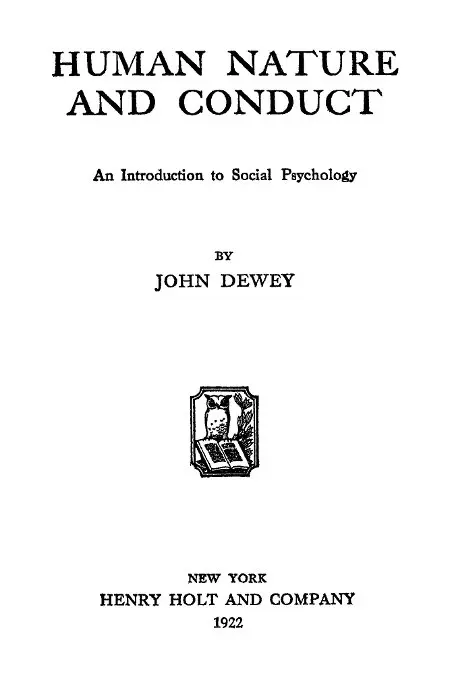
"Human Nature and Conduct: An Introduction to Social Psychology" by John Dewey is a philosophical treatise focusing on social psychology, likely written in the early 20th century. The work explores the intricate relationship between human behavior, moral principles, and social environments, emphasizing how habits shape personal and societal conduct. Dewey's engagement with the concept of habit as a central element in human interaction sets the stage for a deeper examination of morality's connection to human nature and social conditions. The opening of Dewey's work introduces the premise that traditional moral views often regard human nature with suspicion, leading to a disconnection between morality and the realities of human behavior. He critiques the historical pathologizing of human nature by moralists and explores how societal structures influence individual actions. Dewey argues that understanding habits—a synthesis of impulses and intelligence—is crucial for a more realistic approach to social psychology, positing that moral principles should be grounded in an empirical study of human nature and societal conditions rather than abstract ideals. Through this exploration, he suggests a more integrated and practical framework for discussing morality within the context of human conduct.
Introduction adapted from the source catalogue; source summaries may be automatically generated.
Free to read · English · 83,723 words · No account needed
MAKE TIME FOR A GOOD BOOK
On by default. Untick to stop anonymous reading totals. Each page counts after 10 seconds in view. How this works.
Anonymous counting is on unless you have switched it off.
We are forced therefore to consider the nature and origin of that control of human nature with which morals has been occupied. And the fact which is forced upon us when we raise this question is the existence of classes. Control has been vested in an oligarchy. Indifference to regulation has grown in the gap which separates the ruled from the rulers. Parents, priests, chiefs, social censors have supplied aims, aims which were foreign to those upon whom they were imposed, to the young, laymen, ordinary folk; a few have given and administered rule, and the mass have in a passable fashion and with reluctance obeyed. Everybody knows that good children are those who make as little trouble as possible for their elders, and since most of them cause a good deal of annoyance they must be naughty by nature. Generally speaking, good people have been those who did what they were told to do, and lack of eager compliance is a sign of something wrong in their nature.
But no matter how much men in authority have turned moral rules into an agency of class supremacy, any theory which attributes the origin of rule to deliberate design is false. To take advantage of conditions after they have come into existence is one thing; to create them for the sake of an advantage to accrue is quite another thing. We must go back to the bare fact of social division into superior and inferior. To say that accident produced social conditions is to perceive they were not produced by intelligence. Lack of understanding of human nature is the primary cause of disregard for it. Lack of insight always ends in despising or else unreasoned admiration. When men had no scientific knowledge of physical nature they either passively submitted to it or sought to control it magically. What cannot be understood cannot be managed intelligently. It has to be forced into subjection from without. The opaqueness of human nature to reason is equivalent to a belief in its intrinsic irregularity. Hence a decline in the authority of social oligarchy was accompanied by a rise of scientific interest in human nature. This means that the make-up and working of human forces afford a basis for moral ideas and ideals. Our science of human nature in comparison with physical sciences is rudimentary, and morals which are concerned with the health, efficiency and happiness of a development of human nature are correspondingly elementary. These pages are a discussion of some phases of the ethical change involved in positive respect for human nature when the latter is associated with scientific knowledge. We may anticipate the general nature of this change through considering the evils which have resulted from severing morals from the actualities of human physiology and psychology. There is a pathology of goodness as well as of evil; that is, of that sort of goodness which is nurtured by this separation. The badness of good people, for the most part recorded only in fiction, is the revenge taken by human nature for the injuries heaped upon it in the name of morality. In the first place, morals cut off from positive roots in man's nature is bound to be mainly negative. Practical emphasis falls upon avoidance, escape of evil, upon not doing things, observing prohibitions. Negative morals assume as many forms as there are types of temperament subject to it. Its commonest form is the protective coloration of a neutral respectability, an insipidity of character. For one man who thanks God that he is not as other men there are a thousand to offer thanks that they are as other men, sufficiently as others are to escape attention. Absence of social blame is the usual mark of goodness for it shows that evil has been avoided. Blame is most readily averted by being so much like everybody else that one passes unnoticed. Conventional morality is a drab morality, in which the only fatal thing is to be conspicuous. If there be flavor left in it, then some natural traits have somehow escaped being subdued. To be so good as to attract notice is to be priggish, too good for this world. The same psychology that brands the convicted criminal as forever a social outcast makes it the part of a gentleman not to obtrude virtues noticeably upon others.
Your reading position is saved on this browser. Take it to another device with a library code. Reading pages adapt to text, rather than matching a printed edition.
John Dewey
John Dewey

John Dewey
John Dewey
BEHIND THE BOOK
This eBook is for the use of anyone anywhere in the United States and most other parts of the world at no cost and with almost no restrictions whatsoever. You may copy it, give it away or re-use it under the terms of the Project Gutenberg License included with this eBook or online at www.gutenberg.org. If you are not located in the United States, you will have to check the laws of the country where you are located before using this eBook. Read the source licence.
The original source file, including credits and licence, is retained by this library. Request an original-format copy at no charge. Please include the book title and Project Gutenberg identifier #41386.
KEEP YOUR CURIOSITY GOING

David Patterson (Spirit) Hatch
Coulson Kernahan

Ralph Waldo Emerson
Frances Wright

Edwin Abbott Abbott

Joseph Droz