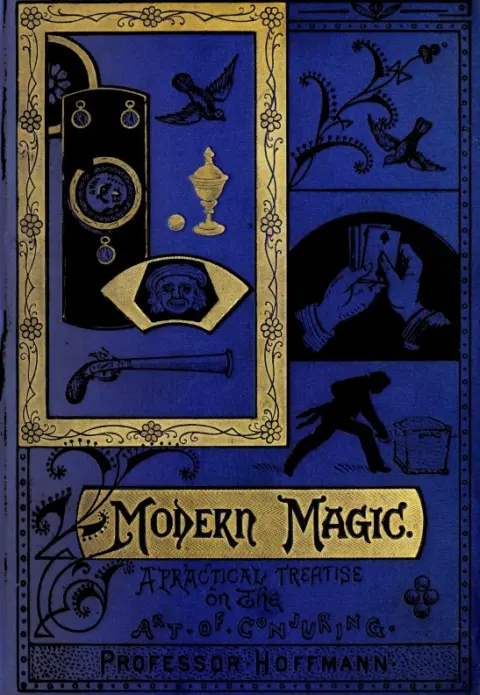
Modern Magic: A Practical Treatise on the Art of Conjuring
Professor Hoffmann
THE CLASSIC COLLECTION · 1907
"Hoyle's Games Modernized" by Professor Hoffmann and Edmond Hoyle is a comprehensive collection of card games and their rules, written in the early 20th century. This volume serves as a revised and updated follow-up to the original works of Edmond Hoyle, who laid down initial formal rules for various card games in the 18th century. The book covers a wide array of games including classic favorites like Whist, Cribbage, and Poker, as well as newer games such as Auction Bridge. It aims to both preserve Hoyle's teachings and provide modern players with clear, updated instructions. The opening of the book offers a brief history of Edmond Hoyle and the evolution of his gaming publications, highlighting the significance of his contributions to card play standards. It explains his transition from private lessons to published works, encapsulating the context in which his methodologies became widely accepted. The introduction sets up the actual content of the book, which includes detailed rules and strategies for various games, along with tips for improving play. The reader is invited to explore the structure and objectives of each game, making it an accessible guide for both novices and seasoned players looking to enhance their gaming experience.
Introduction adapted from the source catalogue; source summaries may be automatically generated.
Free to read · English · 116,848 words · No account needed
MAKE TIME FOR A GOOD BOOK
On by default. Untick to stop anonymous reading totals. Each page counts after 10 seconds in view. How this works.
Anonymous counting is on unless you have switched it off.
In conclusion, the student is strongly advised to study and master the theory and practice of the play embraced in the First, Second, Third, and Fourth Positions (see post). These endings, in different forms, are of very frequent occurrence, and should be thoroughly mastered.
1. The "Ayrshire Lassie" is formed by the first four moves (counting the play on both sides): 11 to 15, 24 to 20, 8 to 11, 28 to 24. {434}
2. The "Bristol" is formed by the first three moves: 11 to 16, 24 to 20, 16 to 19. It was so named in compliment to the players of that city for services rendered to the late Andrew Anderson, one of the greatest masters of the game.
3. The "Cross" is formed by the first two moves: 11 to 15, 23 to 18. It is so named because the second move is played across the direction of the first.
4. The "Defiance" is formed by the first four moves: 11 to 15, 23 to 19, 9 to 14, 27 to 23. It is so named because it defies or prevents the formation of the "Fife" game.
5. The "Dyke" is formed by the first three moves: 11 to 15, 22 to 17, 15 to
19.
6. The "Fife" is formed by the first five moves: 11 to 15, 23 to 19, 9 to 14, 22 to 17, 5 to 9. It has been so called since 1847, when Wyllie, hailing from Fifeshire, played it against Anderson.
7. The "Glasgow" is formed by the first five moves: 11 to 15, 23 to 19, 8 to 11, 22 to 17, 11 to 16. It has been known by this name since Sinclair, of Glasgow, played it against Anderson at a match in 1828.
8. The "Laird and Lady" is formed by the first five moves: 11 to 15, 23 to 19, 8 to 11, 22 to 17, 9 to 13. It was so called from its having been the favourite opening of Laird and Lady Cather Cambusnethan, Lanarkshire.
9. "The Maid of the Mill" is formed by the first five moves: 11 to 15, 22 to 17, 8 to 11, 17 to 13, 15 to 18. It was so named in compliment to a miller's daughter, who was an excellent player, and partial to this opening. {435}
10. The "Old Fourteenth" is formed by the first five moves: 11 to 15, 23 to 19, 8 to 11, 22 to 17,4 to 8. It was so named through being familiar to players as the fourteenth game in Joshua Sturge's Guide to the Game of Draughts, published in 1800, which for many years was the leading authority on the game.
11. The "Second Double Corner" is formed by the first two moves: 11 to 15, 24 to 19. It is so named because the first move of the second player is from the one double corner towards the other.
12. The "Single Corner" is formed by the first two moves: 11 to 15, 22 to 18. It is so named from the fact of each of these moves being played from one single corner towards the other.
Your reading position is saved on this browser. Take it to another device with a library code. Reading pages adapt to text, rather than matching a printed edition.
Professor Hoffmann
Professor Hoffmann
BEHIND THE BOOK
This eBook is for the use of anyone anywhere in the United States and most other parts of the world at no cost and with almost no restrictions whatsoever. You may copy it, give it away or re-use it under the terms of the Project Gutenberg License included with this eBook or online at www.gutenberg.org. If you are not located in the United States, you will have to check the laws of the country where you are located before using this eBook. Read the source licence.
The original source file, including credits and licence, is retained by this library. Request an original-format copy at no charge. Please include the book title and Project Gutenberg identifier #39445.
KEEP YOUR CURIOSITY GOING

Charles G. (Charles Griffith) Ross
Hannah Webster Foster

Emily Lawless
Edwin Hamlin Carr

Charles De Lano Hine
Andrew Ure