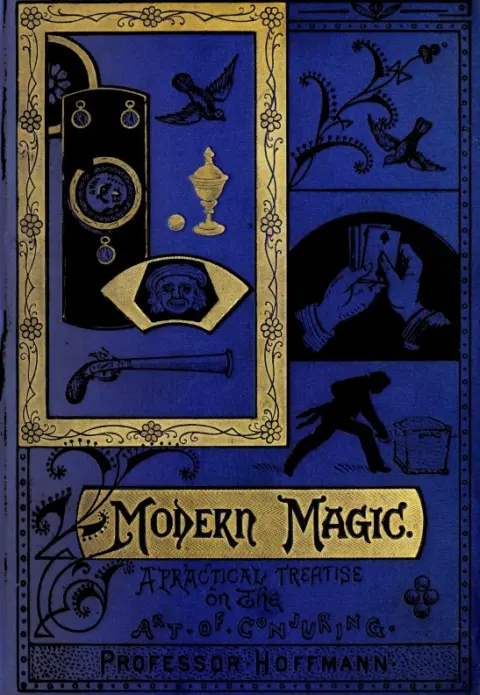
Modern Magic: A Practical Treatise on the Art of Conjuring
Professor Hoffmann
THE CLASSIC COLLECTION · 1907
"Hoyle's Games Modernized" by Professor Hoffmann and Edmond Hoyle is a comprehensive collection of card games and their rules, written in the early 20th century. This volume serves as a revised and updated follow-up to the original works of Edmond Hoyle, who laid down initial formal rules for various card games in the 18th century. The book covers a wide array of games including classic favorites like Whist, Cribbage, and Poker, as well as newer games such as Auction Bridge. It aims to both preserve Hoyle's teachings and provide modern players with clear, updated instructions. The opening of the book offers a brief history of Edmond Hoyle and the evolution of his gaming publications, highlighting the significance of his contributions to card play standards. It explains his transition from private lessons to published works, encapsulating the context in which his methodologies became widely accepted. The introduction sets up the actual content of the book, which includes detailed rules and strategies for various games, along with tips for improving play. The reader is invited to explore the structure and objectives of each game, making it an accessible guide for both novices and seasoned players looking to enhance their gaming experience.
Introduction adapted from the source catalogue; source summaries may be automatically generated.
Free to read · English · 116,848 words · No account needed
MAKE TIME FOR A GOOD BOOK
On by default. Untick to stop anonymous reading totals. Each page counts after 10 seconds in view. How this works.
Anonymous counting is on unless you have switched it off.
Two fives, two fours, and a six } Fifteen eight, two
Two fives, two sixes, and a four } pairs, and a run
Two fours, two sixes, and a five } of three four times
Two sevens, two eights, and a } repeated 24
nine }
{41}
Four threes and a nine (Fifteen twelve and a double pair-royal) 24
Three fives, a four, and a six (Fifteen eight, a pair-royal, and run of three thrice repeated) 23
Three fours, a five, and a six } Three sixes, a four, and a five } Fifteen six, a Three sevens, an eight, and a } pair-royal, and nine } run of three Three eights, a seven, and a } thrice repeated 21 nine }
Four twos and a nine } Fifteen eight and a double Four threes and a six } pair-royal 20
Two sixes, two sevens, and an }
eight } Fifteen four, two
Two sevens, an eight, and two } pairs, and run
nines } of three four
Two eights, a seven, and two } times repeated 20
nines }
Three tens, or court cards of }
like denomination, and two } Fifteen twelve,
fives } pair-royal, and
Three threes and two nines } pair 20
Three sevens and two aces }
Three threes and two sixes[17] (Fifteen ten, pair, and pair-royal) 18
Three fours, three, and five (Fifteen two, pair-royal, and run of three thrice repeated) 17
Three tenth cards in sequence and two fives (Fifteen twelve, pair, and run of three)[18] 11
Any three cards in sequence, with duplicates of two of them, but no "fifteen" (Two pairs and run of three four times repeated) 16
Any three cards in sequence, with one of them thrice repeated, but no "fifteen" (Pair-royal and run of three thrice repeated) 15
As for combinations of minor value, their name is legion.
With four cards only, the general average is very much lower, as will have been seen from the table on p. 39.
A comparison of the foregoing tables show that the crib at five-card Cribbage is likely to be much more important than the hand, and this furnishes us with a safe principle for the guidance of the player in laying out. In the case of the dealer, he should lay out for crib such cards as are most likely to form valuable combinations, even though he may, to some extent, sacrifice the scoring value of his hand. Conversely, it is to the interest of the non-dealer to lay out such cards as are likely to "baulk the crib," as it is termed, even though he may to some extent injure his own hand in doing so. On close examination of the tables, it will be found that the cards most likely to help the crib are pairs. If the other three cards chance to be in sequence, they are worth, standing alone, three only, but the addition of duplicates of either of the series will bring their value (for runs and pair-royal) up to fifteen, independently of any other points they may contain. Or suppose, with six as start, that the dealer has thrown out a four and a five, these are worth five only; but if the non-dealer had been rash enough to throw out a pair, either of fours or sixes, the score would run up to twenty-one. If the non-dealer had thrown out a pair of fives, it would have been twenty-three.
Your reading position is saved on this browser. Take it to another device with a library code. Reading pages adapt to text, rather than matching a printed edition.
Professor Hoffmann
Professor Hoffmann
BEHIND THE BOOK
This eBook is for the use of anyone anywhere in the United States and most other parts of the world at no cost and with almost no restrictions whatsoever. You may copy it, give it away or re-use it under the terms of the Project Gutenberg License included with this eBook or online at www.gutenberg.org. If you are not located in the United States, you will have to check the laws of the country where you are located before using this eBook. Read the source licence.
The original source file, including credits and licence, is retained by this library. Request an original-format copy at no charge. Please include the book title and Project Gutenberg identifier #39445.
KEEP YOUR CURIOSITY GOING

Charles G. (Charles Griffith) Ross
Hannah Webster Foster

Emily Lawless
Edwin Hamlin Carr

Charles De Lano Hine
Andrew Ure