
The Writing of News A Handbook with Chapters on Newspaper Correspondence and Copy Reading
Charles G. (Charles Griffith) Ross
THE CLASSIC COLLECTION · 1877
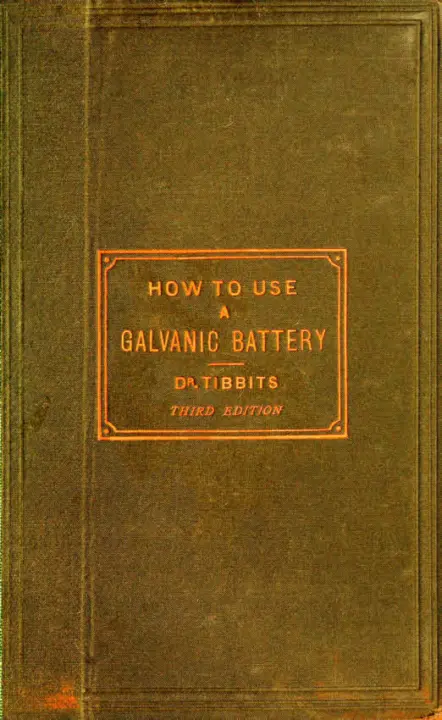
"How to Use a Galvanic Battery in Medicine and Surgery" by Herbert Tibbits is a scientific publication written in the late 19th century. This work addresses the therapeutic applications of galvanic electricity in medical practice, detailing its use in diagnosis, treatment, and the operation of various electrical apparatus. The text aims to provide practitioners with knowledge on how to effectively and safely use galvanic batteries for a range of medical conditions. The opening of the text introduces the author’s motivation to present practical knowledge on electro-therapeutics to medical practitioners. Tibbits acknowledges the growing interest and importance of electricity in medicine while addressing the lack of adequate training in medical schools regarding its application. He contrasts the responsible use of electricity in a medical setting against careless applications by the lay public, emphasizing the need for practitioners to familiarize themselves with the instruments and methods of application. The initial lecture focuses on the different types of electrical instruments, their construction, and the importance of proper handling, establishing a foundation for future discussions on applications and therapeutics in subsequent chapters.
Introduction adapted from the source catalogue; source summaries may be automatically generated.
Free to read · English · 25,039 words · No account needed
MAKE TIME FOR A GOOD BOOK
On by default. Untick to stop anonymous reading totals. Each page counts after 10 seconds in view. How this works.
Anonymous counting is on unless you have switched it off.
In all cases of traumatic lesion--as by section of a nerve--the paralysis is atrophic, and the treatment I have recommended in infantile paralysis should be assiduously employed. Mitchell, of Philadelphia, whose experience of military surgery is unrivalled, commences electrical treatment and shampooing within a fortnight of the wound, unless there are special circumstances to contra-indicate it. Lead palsy requires similar treatment; so does, perhaps, the commonest form of peripheral palsy--facial palsy from neuritis of the facial nerve. [SN: Caution necessary in Electrizing Facial Muscles.] In electrizing the facial muscles there is one caution necessary--especially to observe the rule of electrizing the muscles equally--for I have several times met with a contraction resulting from a too energetic Faradization of some individual facial muscle, to the neglect of the group with which it is in correlative action. Such a contraction may sometimes be removed by localizing in it for about five minutes a constant Voltaic current from eight or ten cells; but in the most favourable cases an unnatural expression of countenance will generally persist for a long time, from the non-recovery by the muscles of their perfect “tone,” that quality which imprints upon each face its characteristic features, and which has been called the “Gymnast of the Soul.”
[SN: Wasting Palsy.]
In that most distressing disease, Cruveilhier’s atrophy or wasting palsy, medication is altogether useless, and our one hope--not invariably a forlorn one--is in electricity. Localized Faradization to the muscles, alternately with Radcliffe’s Positive Charge, together with galvanization of the sympathetic or of the spinal cord, admit of trial.
[SN: Hemiplegia.]
In non-atrophic paralysis--of which hemiplegia may be taken as a type--the propriety of electrization, and especially the proper moment for its application, requires careful consideration. In both brain and spinal cord disease muscular electrization is not advisable until some time after the attack, or until the muscles exhibit signs of impairment of nutrition from disuse. As long as there is rigidity--especially with increased reflex action--any stimulant application of electricity is not likely to do good, and may do harm; but in older cases--both hemiplegic and paraplegic--cases of from six to eighteen months’ duration--the immediate benefit to be derived from localized electrization is often remarkable, especially in those cases where, after a partial return of voluntary movement, the patient suddenly stops short, and for weeks or months makes no progress. As the sequel of electrization, the hemiplegic patient able to use the arm slightly, but not to feed himself, may regain this power, to his infinite comfort, and the paraplegic patient, able with difficulty to drag himself along by crutches, is enabled to walk by the aid of a stick. Some improvement is usually soon obtained, and it is progressive for, perhaps, two or three months, after which continued electrization fails to increase it; but at a subsequent period--six months afterwards--a renewed electrization may give rise to a new improvement; but be this as it may, whenever in these old-standing cases we see signs of impaired nutrition, it is wise to occasionally stimulate the muscles by Faradism. We should endeavour--in the words of the late Nestor of modern medicine, Sir Thomas Watson--“to preserve the muscular part of the locomotive apparatus in a state of health and readiness, until peradventure that part of the brain from which volition proceeds having recovered its functions, or the road by which its messages travel having been repaired, the influence of the will shall again reach and reanimate the palsied limbs.”[19] [SN: Direct application of Voltaic Current to Brain.] In hemiplegia the propriety of a direct application of the constant Voltaic current to the brain must be thoughtfully considered. In selected cases, where the clot or softening is of limited extent, its removal may be accelerated by a carefully localized current--two or three cells--for two or three minutes to the injured hemisphere, followed by Voltaization of the cervical sympathetic (so-called) for four or five minutes. After such an application there follows--according to Althaus--“greater ease in the head, as well as in the limbs, and if there has been pain this is relieved.” [SN: Electricity in Spinal Paraplegia.] Similarly the absorption of the inflammatory products may be promoted in the earlier stages of spinal disease, by localizing the Voltaic current in the parts affected, especially where pain is present, and we have reason to suppose that the myelitis is circumscribed. The daily application of the positive pole for about five minutes, and with from ten to fifteen cells, to the painful spot--the negative pole being held to an indifferent part of the body--is likely to promote absorption. At any rate it will sometimes relieve the pain. In the later stages of paraplegia, as soon as there is diminution of electro-irritability in the paralyzed muscles they should be sponged with the Voltaic current, or Faradized; and where anæsthesia is present, a good painting with the wire brush will often be of service. [SN: Paraplegic Constipation.] Paraplegic constipation may frequently be relieved by Faradization of the abdominal muscles, and the troublesome dribbling of urine, so often present, by external Faradization of the bladder--one pole to the pubes, and two sponges from the second pole--one to the sacrum and the other to the perineum. Incontinence of urine in children may be similarly treated. [SN: Emotional Paralysis.] Cases of hysterical or emotional paralysis may frequently be benefited by the application of the wire brush, which also sometimes acts like a charm in removing anæsthesia, which, although originally of central origin, continues after the removal of its cause. Anæsthesia from section of a nerve is sometimes persistent in this way after repair of the nerve lesion. [SN: Locomotor Ataxy.] The wire brush is also useful in sometimes removing the anæsthesia present in locomotor ataxy, some cases of which may be largely benefited also by the constant current to the spine--one pole to nape of neck, and the other to the lower lumbar vertebræ.[20]
Your reading position is saved on this browser. Take it to another device with a library code. Reading pages adapt to text, rather than matching a printed edition.
BEHIND THE BOOK
This eBook is for the use of anyone anywhere in the United States and most other parts of the world at no cost and with almost no restrictions whatsoever. You may copy it, give it away or re-use it under the terms of the Project Gutenberg License included with this eBook or online at www.gutenberg.org. If you are not located in the United States, you will have to check the laws of the country where you are located before using this eBook. Read the source licence.
The original source file, including credits and licence, is retained by this library. Request an original-format copy at no charge. Please include the book title and Project Gutenberg identifier #59543.
KEEP YOUR CURIOSITY GOING
Charles G. (Charles Griffith) Ross
Hannah Webster Foster

Emily Lawless
Edwin Hamlin Carr

Charles De Lano Hine
Andrew Ure