
The Writing of News A Handbook with Chapters on Newspaper Correspondence and Copy Reading
Charles G. (Charles Griffith) Ross
THE CLASSIC COLLECTION · 1877
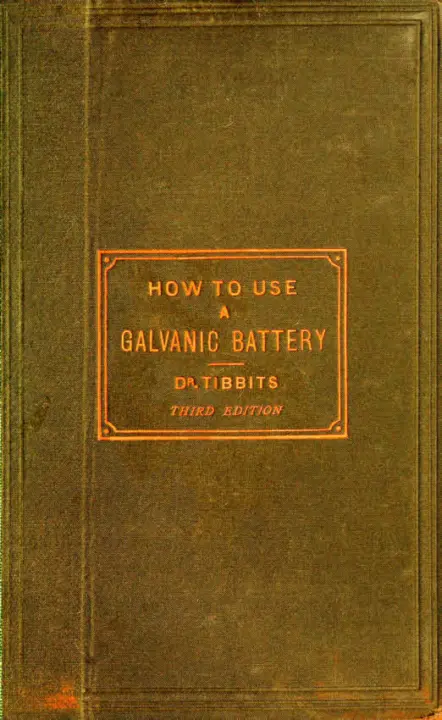
"How to Use a Galvanic Battery in Medicine and Surgery" by Herbert Tibbits is a scientific publication written in the late 19th century. This work addresses the therapeutic applications of galvanic electricity in medical practice, detailing its use in diagnosis, treatment, and the operation of various electrical apparatus. The text aims to provide practitioners with knowledge on how to effectively and safely use galvanic batteries for a range of medical conditions. The opening of the text introduces the author’s motivation to present practical knowledge on electro-therapeutics to medical practitioners. Tibbits acknowledges the growing interest and importance of electricity in medicine while addressing the lack of adequate training in medical schools regarding its application. He contrasts the responsible use of electricity in a medical setting against careless applications by the lay public, emphasizing the need for practitioners to familiarize themselves with the instruments and methods of application. The initial lecture focuses on the different types of electrical instruments, their construction, and the importance of proper handling, establishing a foundation for future discussions on applications and therapeutics in subsequent chapters.
Introduction adapted from the source catalogue; source summaries may be automatically generated.
Free to read · English · 25,039 words · No account needed
MAKE TIME FOR A GOOD BOOK
On by default. Untick to stop anonymous reading totals. Each page counts after 10 seconds in view. How this works.
Anonymous counting is on unless you have switched it off.
The chief use of electricity in diagnosis is dependent upon its power of evolving muscular contraction. We have seen--as I demonstrated to you upon my left forearm--that both muscles and nerves, when in a normal condition, respond to the stimulus of electricity. In disease this response, or irritability, may remain unaltered, or it may be increased, decreased, or abolished; and our first step in electro-diagnosis should therefore be to ascertain the exact condition of electro-contractility. As in practically almost all our cases we have to do with altered reaction existing only in one nerve or muscle, or in one of two symmetrical groups of nerves or muscles, we possess a ready means of testing irritability by ascertaining its relative condition upon opposite sides of the body, as, for example, in an ordinary case of hemiplegia. [SN: Test of Farado-Irritability.] In examining such a case electrically--and the principles of procedure are the same in all cases--it is convenient to commence our investigation with the Faradaic current, and to ascertain the lowest power which will call into action any one of the muscles of the healthy side, and then to apply this same strength of current to identical points of the corresponding muscle on the diseased side, noting whether it causes contraction. If so, we decrease the power of the current, when if contraction still occurs there is increased irritability, or vice versá, as the case may be. Having ascertained the condition of the muscle we proceed similarly to test its motor nerve, for we shall see hereafter that in certain diseased conditions muscle and nerve irritability are affected unequally. One conductor being held to an indifferent part of the body we apply a fine-pointed conductor to the most superficial point in the course of the nerve, in the way that, as you will recollect, I electrized my left median nerve. [SN: Test of Voltao-Irritability.] We next submit the muscle and nerve to similar examination with the Voltaic current. Holding both conductors immovable, we interrupt the current for a moment by moving the “key” of our battery, or if it is not provided with a key, while one conductor is stationary, we break the current by lifting and reapplying the other. It is essential that on both sides there should be exact similarity in the application, and that the electrodes should be placed on identical points of the muscle, and this is especially important with the Voltaic current, for healthy muscle responds to it more readily when it flows down the limb, that is, with the positive pole nearest to the spine, and the negative farther from it than when it flows up, and consequently a reversal of the poles will influence the result. [SN: Rule for strength of Current.] In testing a case in which there is equal disease upon both sides--as in some cases of paraplegia--we must be guided by a knowledge of the strength of current usually required to induce contraction. As a general rule, unless a current that causes energetic and painful action in the muscles of the ball of the thumb produces some contraction, irritability is impaired. If, in our examination of the muscle, we find irritability normal to both currents, we have proof of the integrity of the muscular tissue. If the muscle also responds by contraction to electrization of its nerve, we have further proof that the nerve is healthy, and also the spinal cord at the point of origin of the nerve. [SN: Electro-Irritability diminished.] If we find the irritability lessened, there is disease of either muscular tissue, nerve or cord; and, as a rule, this will be in direct proportion to the amount of diminished irritability. [SN: Electro-Irritability increased.] Increased irritability points to increased vascularity or irritative lesion; but in such cases we very seldom require the aid of electricity to complete our diagnosis. [SN: Voltao-Irritability increased.] The reactions of Faradism and Voltaism are usually equal, but in some cases in which muscular response to Faradism is diminished or abolished the muscular reaction to an interrupted Voltaic current is not only preserved but increased. The diseased muscle will respond much more readily to the Voltaic current than the corresponding muscle of the healthy side; while at the same time it will be found on examining the nerve that there is equal diminution to both currents. [SN: Diagnosis of Peripheral from Central Disease.] This increased muscle reaction is due to the special irritability of muscular tissue, and is quite independent of any nerve influence. It exists only in peripheral and never in central lesion, and by it we obtain an absolute diagnosis of such cases as local paralysis of the facial nerve from facial hemiplegia, paralysis of the extensors of the wrist and fingers, due to lead poisoning, from commencing muscular atrophy, or progressive muscular atrophy from paralysis from section of a nerve--all important questions as affecting treatment. [SN: “The Degenerative Nerve Reaction.”] It is known as the “degenerative nerve reaction,” as it always follows when a nerve trunk is involved in the lesion. There is then diminution of Faradaic irritability through both nerve and muscle, diminution of reaction to the Voltaic current when the rheophores are applied over the nerve, and increase of reaction when they are applied over the muscle; but there is no relation between these interesting variations in the electrical condition of nerve and muscle, and the degree of paralysis to the will, for there may be perfect muscular paralysis, as in hemiplegia, when the electrical condition of both nerve and muscle is unchanged; but, on the other hand, in muscles equally paralyzed we may find absolute electrical changes in some, and none in others. We may often positively predict that these latter will rapidly recover--one instance of the use of electricity in prognosis.
Your reading position is saved on this browser. Take it to another device with a library code. Reading pages adapt to text, rather than matching a printed edition.
BEHIND THE BOOK
This eBook is for the use of anyone anywhere in the United States and most other parts of the world at no cost and with almost no restrictions whatsoever. You may copy it, give it away or re-use it under the terms of the Project Gutenberg License included with this eBook or online at www.gutenberg.org. If you are not located in the United States, you will have to check the laws of the country where you are located before using this eBook. Read the source licence.
The original source file, including credits and licence, is retained by this library. Request an original-format copy at no charge. Please include the book title and Project Gutenberg identifier #59543.
KEEP YOUR CURIOSITY GOING
Charles G. (Charles Griffith) Ross
Hannah Webster Foster

Emily Lawless
Edwin Hamlin Carr

Charles De Lano Hine
Andrew Ure