
The Writing of News A Handbook with Chapters on Newspaper Correspondence and Copy Reading
Charles G. (Charles Griffith) Ross
THE CLASSIC COLLECTION · 1877
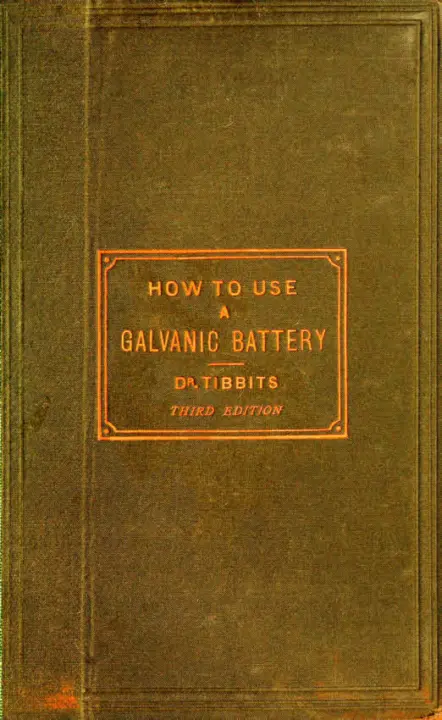
"How to Use a Galvanic Battery in Medicine and Surgery" by Herbert Tibbits is a scientific publication written in the late 19th century. This work addresses the therapeutic applications of galvanic electricity in medical practice, detailing its use in diagnosis, treatment, and the operation of various electrical apparatus. The text aims to provide practitioners with knowledge on how to effectively and safely use galvanic batteries for a range of medical conditions. The opening of the text introduces the author’s motivation to present practical knowledge on electro-therapeutics to medical practitioners. Tibbits acknowledges the growing interest and importance of electricity in medicine while addressing the lack of adequate training in medical schools regarding its application. He contrasts the responsible use of electricity in a medical setting against careless applications by the lay public, emphasizing the need for practitioners to familiarize themselves with the instruments and methods of application. The initial lecture focuses on the different types of electrical instruments, their construction, and the importance of proper handling, establishing a foundation for future discussions on applications and therapeutics in subsequent chapters.
Introduction adapted from the source catalogue; source summaries may be automatically generated.
Free to read · English · 25,039 words · No account needed
MAKE TIME FOR A GOOD BOOK
On by default. Untick to stop anonymous reading totals. Each page counts after 10 seconds in view. How this works.
Anonymous counting is on unless you have switched it off.
The bladder is most readily electrized by the introduction into the rectum of the rectal rheophore, and into the bladder--previously emptied--of a curved metallic sound insulated by an elastic catheter to within an inch of its vesical extremity. This sound must be brought into contact successively with all points of the neck of the bladder. The uterus by the introduction of the rectal rheophore, connected with one pole, to the os uteri, and by the application of two sponges from the other pole, one to the abdominal parietes, the other to the lumbar region. The larynx, externally by one sponge to the nape of the neck, and the second to the exterior of the larynx; or, internally, a sponge to the neck as before, and the introduction by the aid of the laryngoscope of a small bit of sponge at the end of a curved metallic stem, insulated by a gum-elastic catheter, the current not being allowed to pass until it is seen by the laryngeal mirror that the sponge is in the desired position. The male genital organs by moist rheophores to the scrotum over the testicle; but if it be desired to excite the vesiculæ seminales, the bowel is first emptied, the rectal rheophore is then introduced and so directed that its olive-shaped termination may be brought into relation with the vesiculæ. For this purpose it is sufficient to move the rheophore from right to left and vice versá. A powerful current will penetrate the intestine and reach the vesiculæ, exciting them energetically. The circuit is completed by a second rheophore placed on an unsensitive part of the body.
[SN: Electrization of the Central Organs.]
In electrization of the central organs of the nervous system, the Voltaic current is alone used, and in its application to the brain, the sympathetic nerves, or the organs of the senses, especial circumspection must be employed. As a general rule it should not be had recourse to when central excitement is contra-indicated, and in all cases the minimum dose should be commenced with, and the application discontinued upon the occurrence of giddiness, nausea, or cerebral symptoms. With these precautions the brain may be electrized by well-moistened sponges applied to each mastoid process, to each temple, or to the frontal and occipital protuberances. The sponges must be held immovable. To galvanize the superior cervical ganglion of the sympathetic, one electrode of small size must be deeply pressed into the auriculo-maxillary fossa, and the other with a good-sized sponge applied over the sixth or seventh cervical vertebra, or to the manubrium sterni, close to the border of the sterno-mastoid. The spinal cord may be electrized by keeping one sponge, usually the positive, stationary, and moving the other up and down by the sides of the vertebræ, or one pole may be applied to the spine, and the other held to a nerve or muscle. The retina by a moistened conductor to the closed eye, and the second to the temple or to the mastoid process of the same side. The auditory nerve by one conductor tipped with sponge and inserted to the bottom of the meatus, the second being held in the hand of the opposite side; or the meatus may be filled with tepid water, and a metallic wire traversing the axis of a vulcanite tube may be immersed in the water, the second conductor being a well-moistened sponge to the nape of the neck. Direct application to the ocular muscles or to the conjunctiva is usually inadmissible, but one pole may be placed over the facial nerve below the ear, and the other applied to the closed eyelid, or the operator may use the forefinger of his right hand, covered by a finger-stall of wet linen as an electrode, passing the current through his own body by holding a moistened sponge from one pole in his left hand, the conductor from the second pole being similarly held in one of the hands of the patient. This application is not only convenient, but it is calculated to allay the fears of a sensitive patient: or a pointed conductor, covered with wet leather, may be connected with one pole, and its point held immovable and firmly pressed down upon the orbital margin, as near as possible to the position of the muscle it is desired to excite, while the patient touches at intervals the sponge from the second pole held by its insulating handle in the operator’s disengaged hand.
Your reading position is saved on this browser. Take it to another device with a library code. Reading pages adapt to text, rather than matching a printed edition.
BEHIND THE BOOK
This eBook is for the use of anyone anywhere in the United States and most other parts of the world at no cost and with almost no restrictions whatsoever. You may copy it, give it away or re-use it under the terms of the Project Gutenberg License included with this eBook or online at www.gutenberg.org. If you are not located in the United States, you will have to check the laws of the country where you are located before using this eBook. Read the source licence.
The original source file, including credits and licence, is retained by this library. Request an original-format copy at no charge. Please include the book title and Project Gutenberg identifier #59543.
KEEP YOUR CURIOSITY GOING
Charles G. (Charles Griffith) Ross
Hannah Webster Foster

Emily Lawless
Edwin Hamlin Carr

Charles De Lano Hine
Andrew Ure