
The Writing of News A Handbook with Chapters on Newspaper Correspondence and Copy Reading
Charles G. (Charles Griffith) Ross
THE CLASSIC COLLECTION · 1877
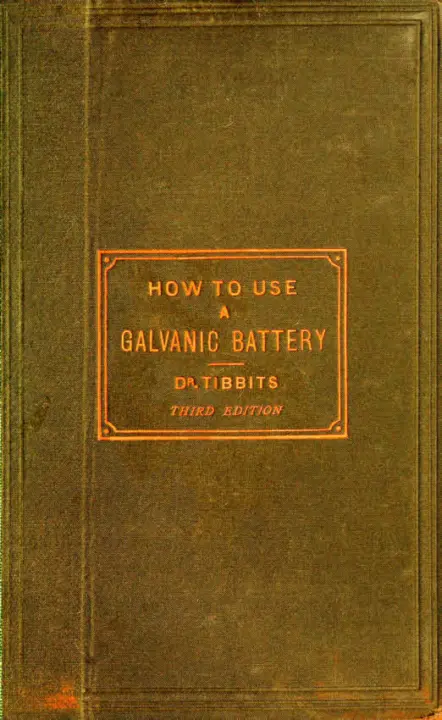
"How to Use a Galvanic Battery in Medicine and Surgery" by Herbert Tibbits is a scientific publication written in the late 19th century. This work addresses the therapeutic applications of galvanic electricity in medical practice, detailing its use in diagnosis, treatment, and the operation of various electrical apparatus. The text aims to provide practitioners with knowledge on how to effectively and safely use galvanic batteries for a range of medical conditions. The opening of the text introduces the author’s motivation to present practical knowledge on electro-therapeutics to medical practitioners. Tibbits acknowledges the growing interest and importance of electricity in medicine while addressing the lack of adequate training in medical schools regarding its application. He contrasts the responsible use of electricity in a medical setting against careless applications by the lay public, emphasizing the need for practitioners to familiarize themselves with the instruments and methods of application. The initial lecture focuses on the different types of electrical instruments, their construction, and the importance of proper handling, establishing a foundation for future discussions on applications and therapeutics in subsequent chapters.
Introduction adapted from the source catalogue; source summaries may be automatically generated.
Free to read · English · 25,039 words · No account needed
MAKE TIME FOR A GOOD BOOK
On by default. Untick to stop anonymous reading totals. Each page counts after 10 seconds in view. How this works.
Anonymous counting is on unless you have switched it off.
It follows from these experiments that we may, at pleasure, arrest electricity in the skin, and that without puncture or incision we may make the current traverse the skin, and concentrate its action upon subcutaneous organs. It was at one time objected that the muscular contraction was the result--not of irritation limited to the muscle or its motor nerves--but of reflex action; but Duchenne demolished this objection by a vivisection. Having removed the skin from the face of a living rabbit--to whom chloroform had been administered--he divided the facial nerve of one side only, in order that the muscles supplied by it might be cut off from all connection with the cord. He then applied electric excitation to each muscle of the face, alternately, on the two sides. The muscles contracted separately and equally on both sides. He then destroyed the brain of the same animal, in order to place the cord in a condition favourable to the production of reflex action, and again excited the muscles as before. The results were absolutely the same.[11]
Muscular electrization may be produced either--as I have just shown you--by placing the conductors upon the muscle itself, a procedure termed direct or intra-muscular electrization, or by exciting only the motor nerve trunk, which is termed indirect, or extra-muscular electrization, and which we shall consider presently.
[SN: Different kinds of Rheophores.]
For direct excitation of the larger muscles it is convenient to use well-moistened sponges, contained in cylinders of different sizes, or metallic disks, covered with wet leather and having conveniently shaped handles. A useful size of cylinder is one such as this (see Fig. 13), having a depth of about 1-1/2 by 1-1/8 inches, which allows the sponge to fairly fill it, while in such forms as this--6 inches by 1--when the sponge is inserted the lower three-fourths of the cylinder is empty, and the conduction of the current liable to become imperfect. Such a cylinder as this, without any insulating handle at all, is worse than useless, and is a still persisting relic of the barbarous time when the patient was invariably electrized by causing him to hold the conductors one in each hand, a proceeding extremely dangerous in certain pathological conditions, and in other cases not likely to be of benefit to him. The insulating handles should be well hollowed out, that they may be used, lying comfortably between the fingers, when holding two in the same hand. The disk rheophore (see Fig. 14), a metallic button covered with wash-leather, is extremely useful; it has the advantage over the sponge of allowing firm pressure to be made without the inconvenience of water being squeezed out, while by using its edge it may be made to answer in the majority of cases for a pointed conductor, which is fitted chiefly for application to very small muscles, such as the interossei and some of those of the face. The wire is attached to the conductor by being screwed into the socket (see a′, Fig. 14). A conducting cord is very apt to get frayed at the point of juncture, and that the wire which I recommend is not open to this objection is not the least of its advantages. [SN: Direct Electrization.] In direct electrization the rheophores should be firmly pressed down upon all points of the surface of the muscle, that all of its fasciculi may be equally electrized. With the Faradaic current it is convenient to apply the rheophores, held in the same hand (see Fig. 15), for from twenty to thirty seconds, to every part of the surface of the muscle, or group of muscles, promenading them as nearly as may be in lines from the origin to the insertion of the muscles. If the rheophores are not held in the same hand care should be taken to keep them near to one another, for the tension or penetrating power of Faradism is so great, that without this precaution there will be liability to excite reflex action. With the interrupted Voltaic current this liability does not exist, and a better plan when using it is to hold the sponge from the positive pole stationary, near to the origin of the muscles, and to stroke or paint as it were the entire muscular surface with the sponge from the negative pole, gliding it in lines from the position of the positive. In using the constant Voltaic current both sponges must be held quite immovable, and so applied it differs altogether in its effects from the very same strength of current interrupted by moving the conductors. I will demonstrate these different applications upon the extensors of my left wrist and fingers--Faradism--Voltaism--Constant Current.
Your reading position is saved on this browser. Take it to another device with a library code. Reading pages adapt to text, rather than matching a printed edition.
BEHIND THE BOOK
This eBook is for the use of anyone anywhere in the United States and most other parts of the world at no cost and with almost no restrictions whatsoever. You may copy it, give it away or re-use it under the terms of the Project Gutenberg License included with this eBook or online at www.gutenberg.org. If you are not located in the United States, you will have to check the laws of the country where you are located before using this eBook. Read the source licence.
The original source file, including credits and licence, is retained by this library. Request an original-format copy at no charge. Please include the book title and Project Gutenberg identifier #59543.
KEEP YOUR CURIOSITY GOING
Charles G. (Charles Griffith) Ross
Hannah Webster Foster

Emily Lawless
Edwin Hamlin Carr

Charles De Lano Hine
Andrew Ure