
Last letters from the living dead man
David Patterson (Spirit) Hatch
THE CLASSIC COLLECTION · 1893
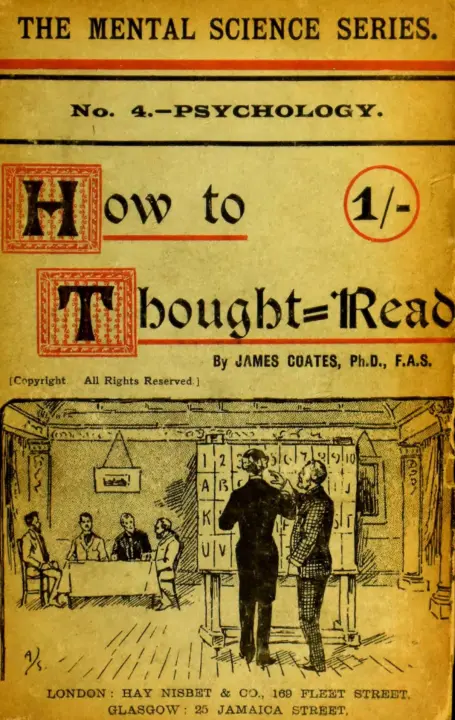
"How to Thought-Read" by F.A.S. Ph.D. James Coates is a manual of instruction on psychic phenomena written in the late 19th century. The book explores a range of topics related to mental science, such as hypnotism, thought transference, clairvoyance, and psychometry, aiming to provide practical insights and techniques for readers interested in developing psychic skills. The opening of the text introduces the author’s intention to elucidate various states of consciousness, particularly focusing on somnambulism, hypnosis, and their relation to thought-reading. Coates explains the factors that influence the manifestation of mental abilities, laying the groundwork for understanding psychic phenomena as a bridge between physical and spiritual dimensions. He suggests that heightened awareness and control over one's psychic abilities could unravel the complex relationship between mind and soul, providing an exciting perspective for readers curious about the uncharted territories of human consciousness.
Introduction adapted from the source catalogue; source summaries may be automatically generated.
Free to read · English · 36,898 words · No account needed
MAKE TIME FOR A GOOD BOOK
On by default. Untick to stop anonymous reading totals. Each page counts after 10 seconds in view. How this works.
Anonymous counting is on unless you have switched it off.
[E] Thought (says Professor Houston) is accompanied by molecular vibrations in the grey matter of the brain, and these brain molecules, like everything else, are immersed in and interpenetrated by ether; this being so, their vibrations must set up wave-motions in the ether, and these must spread out from the brain in all directions. Further, these brain-waves, or thought waves, being thus sent out into space, will produce some phenomena, and, reasoning by analogy we may expect that--as in the case of sound-waves--sympathetic vibrations will be set up in bodies similar to that which generates the waves, if those bodies are attuned to respond. Again, reasoning by analogy, we may expect--as in electric resonance--that such oscillations would be set up as are found when electric waves are sent out and, meeting a circuit in consonance with them, set up in that circuit oscillations like their own.
In view of these facts, which are well ascertained, he (Professor Houston) considers that it does not seem improbable that a brain engaged in intense thought should act as a centre for thought-radiation, nor that these radiations, proceeding outwards in all directions, should affect other brains on which they fall, provided that these other brains are tuned to vibrate in unison with them.
Light waves are etheric vibrations, and it would seem that these brain-waves should “partake of the nature of light.” If so, why should it not be possible to obtain, say, by means of a lens, a photographic impression of them?
Such a thought-record suitably employed might be able to awaken at any subsequent time in the brain of a person submitting himself to its influence thoughts identical to those recorded.--English Mechanic.
[F] The contact is usually made by the agent taking the wrist, or by placing his hand on the brow of the reader.
[G] “The Use of Spiritualism.” By S. C. Hall, F.S.A., late Editor of the Art Journal, author of “The Retrospect of a Long Life,” etc. Price, 1s., Post Free, 1s. 1d. Hay Nisbet & Co., London and Glasgow.
[H] “What is Theosophy?” By Walter R. Old, F.T.S. Price, 1s., Post Free, 1s. 2d., gives an excellent outline of this interesting subject. Hay Nisbet & Co., London and Glasgow.
Most of the inconsistent hyphenation has been retained as in the original, like ‘mind reading’ and ‘mind-reading’, ‘supersensitivity’ and ‘super-sensitivity’, etc.
Obvious punctuation errors have been silently corrected.
Original spelling and grammar have been preserved except for the
following:
page 5: “the ordinary lauguage” changed to “the ordinary language”
page 23: “render she sight” changed to “render the sight”
page 29: “Stanhope, Macclesfield, Charlville” changed to “Stanhope, Macclesfield, Charleville”
Your reading position is saved on this browser. Take it to another device with a library code. Reading pages adapt to text, rather than matching a printed edition.
BEHIND THE BOOK
This eBook is for the use of anyone anywhere in the United States and most other parts of the world at no cost and with almost no restrictions whatsoever. You may copy it, give it away or re-use it under the terms of the Project Gutenberg License included with this eBook or online at www.gutenberg.org. If you are not located in the United States, you will have to check the laws of the country where you are located before using this eBook. Read the source licence.
The original source file, including credits and licence, is retained by this library. Request an original-format copy at no charge. Please include the book title and Project Gutenberg identifier #68388.
KEEP YOUR CURIOSITY GOING
David Patterson (Spirit) Hatch

David Patterson (Spirit) Hatch

David Patterson (Spirit) Hatch

Edwin Abbott Abbott

Richard Watson
T. G. (Theophilus Gould) Steward