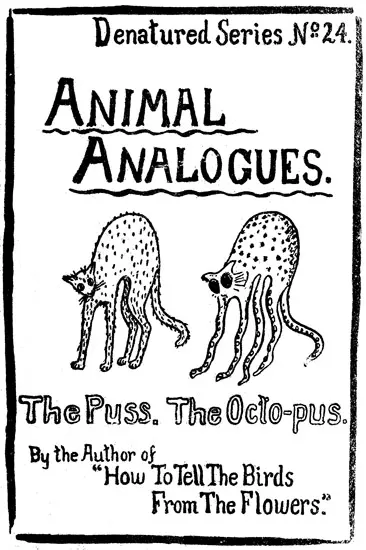
Animal Analogues: Verses and Illustrations
Robert Williams Wood
THE CLASSIC COLLECTION · 1917
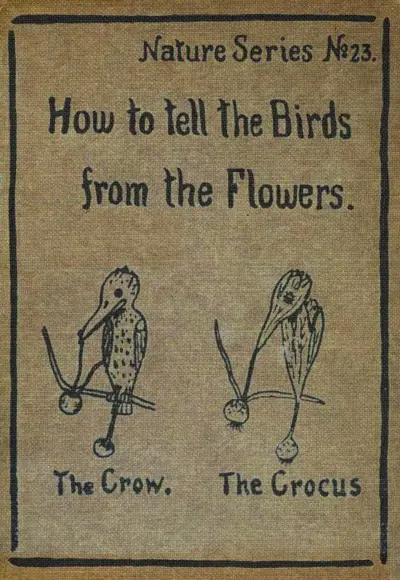
"How to tell the Birds from the Flowers, and other Wood-cuts" by Robert Williams Wood is a whimsical, illustrated manual of flornithology intended for beginners, written in the early 20th century. This unique work merges elements of humor with educational content, focusing on distinguishing various birds from flowers and other botanical elements. It employs a playful tone to explore natural science in a way that is accessible and entertaining. The book consists of a series of delightful verses and illustrations that humorously contrast various birds and plants, highlighting their similarities and differences. Each pairing, such as "The Crow. The Crocus" and "The Pecan. The Toucan," is presented with witty poetry that captures both the essence and folly of common misconceptions about nature. Through this engaging format, Wood not only educates readers about ornithology and botany but also invites them to appreciate the quirks and intricacies of the natural world, making it a charming read for both children and adults.
Introduction adapted from the source catalogue; source summaries may be automatically generated.
Free to read · English · 2,893 words · No account needed
MAKE TIME FOR A GOOD BOOK
On by default. Untick to stop anonymous reading totals. Each page counts after 10 seconds in view. How this works.
Anonymous counting is on unless you have switched it off.
To tell the Turnip from the Tern,
A thing which everyone should learn,
Observe the Tern up in the air,
See how he turns, and now compare
Him with this in-ert veg-et-able,
Who thus to turn is quite unable,
For he is rooted to the spot,
While as we see, the Tern is not:
He is not always doomed to be
Thus bound to earth e-tern-ally
For "cooked to a tern" may be inferred,
To change the Turnip to a bird.
Observe the Turnip in the Pot.
The Tern is glad that he is not!
The Larks. The Larkspur.
You must not make ad-verse remarks,
About my drawing of the Larks.
For, by the minor poet's lore
The Larks--per-pet-ually soar.
While Larkspurs, bordering garden walks,
Are perched securely on their stalks.
Cross Bill. Sweet William.
Nobody but an imbecile
Mistakes Sweet William for Cross Bill:
And even I can scarcely claim,
The skill to make them look the same.
Some other shrubs and vines and trees,
Express emotion much like these,
You've seen the mad-wort plant I guess,
And weeping willows and sigh-press,
The passion-flower, at it's climax,
The glad-iolus and the smile-ax.
The Ibis. The 'Ibiscus.
The sacred Ibis, one might say,
Was classified a "Bird-of-Pray"
His body, after death, was dried,
Embalmed in pitch, and mummyfied,
And thus was handed down to us
In some old King's sarcophagus.
The Mallow, growing in the bogs,
('Ibiscus termed by pedagogues)
Is much opposed to dessication,
And bears no marks of veneration.
The Pipe. The Snipe.
Observe the hybrid Indian Pipe,
Likewise the high-bred English Snipe,
Who is distinguished, as we see,
By his superior pedigree.
The Jay. The Bay.
The Blue Jay, as we clearly see,
Is so much like the green Bay tree
That one might say the only clue,
Lies in their dif-fer-ence of hue,
And if you have a color sense,
You'll see at once this difference.
The Gent-ians. The Lady-bird.
The reason why this beetle gay,
Is called the Lady-bird, they say,
Is just because he wastes his hours,
In running after pretty flowers,
Who, quite regardless of conventions,
Most openly invite attentions.
(And hence are aptly termed the Gent-ians.)
Puffin. Nuffin.
Upon this cake of ice is perched,
The paddle-footed Puffin:
To find his double I have searched,
But have discovered--Nuffin'.
The Bee. The Beet. The Beetle.
Good Mr. Darwin once contended
That Beetles were from Bees descended,
And as my pictures show I think
The Beet must be the missing link.
The sugar-beet and honey-bee
Supply the Beetle's pedigree:
The family is now complete,--
The Bee, the Beetle and the Beet.
The Bunny. The Tunny.
Your reading position is saved on this browser. Take it to another device with a library code. Reading pages adapt to text, rather than matching a printed edition.
Robert Williams Wood
Arthur Cheney Train & Robert Williams Wood
Robert Williams Wood
BEHIND THE BOOK
This eBook is for the use of anyone anywhere in the United States and most other parts of the world at no cost and with almost no restrictions whatsoever. You may copy it, give it away or re-use it under the terms of the Project Gutenberg License included with this eBook or online at www.gutenberg.org. If you are not located in the United States, you will have to check the laws of the country where you are located before using this eBook. Read the source licence.
The original source file, including credits and licence, is retained by this library. Request an original-format copy at no charge. Please include the book title and Project Gutenberg identifier #33346.
KEEP YOUR CURIOSITY GOING

Eric Mackay
Edmund Gosse
Sophia Margaretta Hensley
Gilbert Parker
George MacDonald

Elizabeth Bibesco