
The Writing of News A Handbook with Chapters on Newspaper Correspondence and Copy Reading
Charles G. (Charles Griffith) Ross
THE CLASSIC COLLECTION · 1910
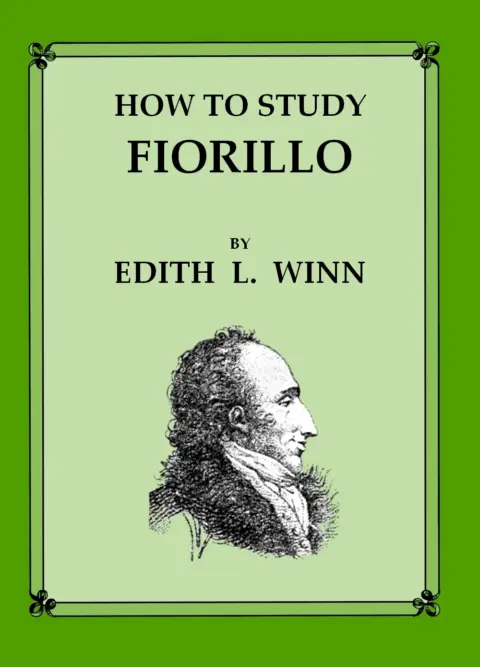
"How to Study Fiorillo" by Edith Lynwood Winn is a specialized instructional guide centered on practicing the violin, written in the early 20th century. This book serves as a detailed analysis of Federigo Fiorillo's 36 Caprices, widely recognized studies for mastering various aspects of violin technique. The book provides insights and practical exercises recommended by the author for enhancing violin skills, focusing on the traditions of both German and French schools of playing. In this comprehensive guide, Winn breaks down each of Fiorillo's études, offering meticulous explanations of bowing techniques, finger placements, and stylistic considerations needed to navigate these complex musical pieces effectively. The text emphasizes the importance of mastery over both left-hand positioning and bow control, advocating for a free and expressive approach to playing. Throughout the book, Winn encourages teachers and students to cultivate an understanding of musical phrasing, intonation, and the technical nuances that define effective violin performance, making it a valuable resource for aspiring violinists seeking to refine their skills and musicality.
Introduction adapted from the source catalogue; source summaries may be automatically generated.
Free to read · English · 16,346 words · No account needed
MAKE TIME FOR A GOOD BOOK
On by default. Untick to stop anonymous reading totals. Each page counts after 10 seconds in view. How this works.
Anonymous counting is on unless you have switched it off.
As far as intonation is concerned, this étude is one of the most difficult of all, yet it is very useful from the standpoint of modulation. The last three lines require a free wrist stroke (legato) at the point of the bow. As more than two strings are included, the stroke is an arm and wrist one. The elbow must move out in the same plane as the forearm and wrist. Absolute freedom of all parts of the arm is necessary.
[23] Hans Sitt, Technical Studies, Op. 92, Part I, Book 3. Price, $1.00. Published by Carl Fischer, New York.
[24] J. Dont, Twenty-four Exercises, Op. 37. Price, 50 cents. Published by Carl Fischer, New York.
No. 36.
[Music]
[Music]
[Music]
[Music]
[Music]
Before beginning this étude, review the chord studies of Sitt[25] and Kreutzer, using with the first Sitt study the following bowings:
1. Whole bow.
2. Lower half.
3. Two notes to a bow, middle, point and heel.
4. Four notes to a bow.
I prefer this study to the Sevcik 4,000 Bowings, Section V. I would, however, use the Sevcik studies for securing a flexible wrist stroke.
Also use Schradieck’s Technical Violin School, Books II and III.[26] I make some changes in the chords of this étude, as follows:
[Music: 1) 7th measure. 2) 16th and 17th measures.]
Use also the following bowing:
Single detached chords down bow, lower half.
[Music]
The wrist must be very flexible. The whole arm is used. Play the three notes simultaneously. Play also thus, whole bow:
[Music]
We now come to the pure legato at the point, middle, and heel of the
bow.
Two notes tied, four and eight. Vary this by playing the first two notes legato, the second two staccato at the point of the bow; the first two legato, lower half, the second two flying staccato.
We will now turn to two styles of legato bowing: eight notes to a bow; two tied notes followed by six tied. Use the whole bow, also upper and lower half. The next bowing is two tied followed by the short staccato at the point of the bow. Then use two tied, two cut, at the middle or point of the bow. Apply the principles of Sevcik, 4,000 Bowings, Sections III, IV, and V.
I would introduce a style of bowing very much used in solo and orchestral work: a running legato at the point in triplets. Same at the middle of the bow. Same at the heel. Three tied legato, followed by three flying staccato, lower half of bow. Three down-stroke middle, spiccato, three up-stroke.
These are all the practical bowings I use, but notes played in one bow, at the point, are useful.
Your reading position is saved on this browser. Take it to another device with a library code. Reading pages adapt to text, rather than matching a printed edition.
BEHIND THE BOOK
This eBook is for the use of anyone anywhere in the United States and most other parts of the world at no cost and with almost no restrictions whatsoever. You may copy it, give it away or re-use it under the terms of the Project Gutenberg License included with this eBook or online at www.gutenberg.org. If you are not located in the United States, you will have to check the laws of the country where you are located before using this eBook. Read the source licence.
The original source file, including credits and licence, is retained by this library. Request an original-format copy at no charge. Please include the book title and Project Gutenberg identifier #65129.
KEEP YOUR CURIOSITY GOING
Charles G. (Charles Griffith) Ross
Hannah Webster Foster

Emily Lawless
Edwin Hamlin Carr

Charles De Lano Hine
Andrew Ure