
The Writing of News A Handbook with Chapters on Newspaper Correspondence and Copy Reading
Charles G. (Charles Griffith) Ross
THE CLASSIC COLLECTION · 1910
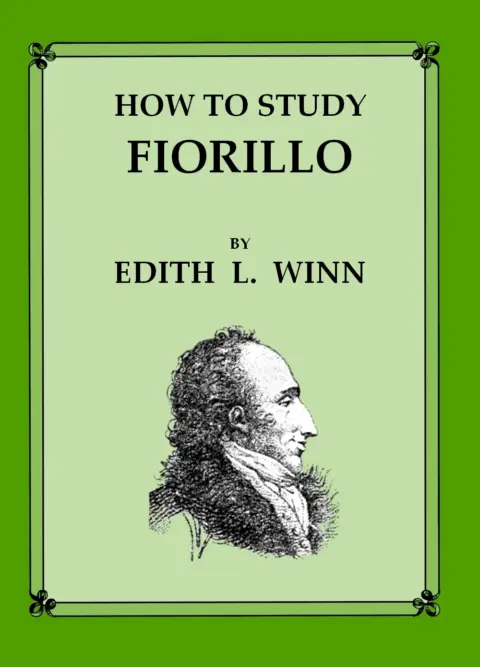
"How to Study Fiorillo" by Edith Lynwood Winn is a specialized instructional guide centered on practicing the violin, written in the early 20th century. This book serves as a detailed analysis of Federigo Fiorillo's 36 Caprices, widely recognized studies for mastering various aspects of violin technique. The book provides insights and practical exercises recommended by the author for enhancing violin skills, focusing on the traditions of both German and French schools of playing. In this comprehensive guide, Winn breaks down each of Fiorillo's études, offering meticulous explanations of bowing techniques, finger placements, and stylistic considerations needed to navigate these complex musical pieces effectively. The text emphasizes the importance of mastery over both left-hand positioning and bow control, advocating for a free and expressive approach to playing. Throughout the book, Winn encourages teachers and students to cultivate an understanding of musical phrasing, intonation, and the technical nuances that define effective violin performance, making it a valuable resource for aspiring violinists seeking to refine their skills and musicality.
Introduction adapted from the source catalogue; source summaries may be automatically generated.
Free to read · English · 16,346 words · No account needed
MAKE TIME FOR A GOOD BOOK
On by default. Untick to stop anonymous reading totals. Each page counts after 10 seconds in view. How this works.
Anonymous counting is on unless you have switched it off.
A perfect legato can only be obtained when the fingers and bow are in perfect sympathy. A somewhat dignified trill is necessary. Maintain the proper tempo. In the last line preserve the legato even if the grace notes seem to disturb it. At the close begin the trill slowly; then increase the rate. If the student fails in the command of the higher positions, use the Halir studies daily. Freedom will soon be secured.
No. 15.
[Music]
You will observe that the older composers of technical works used easy keys. They themselves were players of the violin, and knew how to write in a violinistic manner. You will also observe that two methods of playing this étude are indicated. As a special daily exercise, in connection with this étude, I would suggest Sevcik’s 4,000 Bowings, Op. 2, Part 2, Sections III and IV, two and three string transfers. After playing these exercises for an hour, including the Halir legato studies, pages 1 to 4, Tonleiterstudien, the wrist and forearm are supple for the daily work, while the left hand falls easily into line. In all technical work the left hand must be trained to anticipate the bow-arm. More depends upon the left hand than upon the bow-arm, hence the necessity of strong fingers and an ample technic.
Allegro is an elastic term in the classic études. Play slowly and without stumbling until you master the content of the work, then increase the tempo. The preferred method of playing this étude is the lower one. Play in the upper third of the bow, not forte, at first, until freedom of the bow-arm is assured. A lateral stroke of the wrist is not necessary. The wrist should be flexible and free, however. Play a smooth, running stroke, for a pronounced staccato is likely to make the muscles of the fingers and wrist rigid, unless one has perfect command of the bow-arm and hand. The student should train himself to read ahead of the measure he is playing. Place all the fingers in position at once, whether a new position is to be taught or not. A prevailing tendency in this work is to play with a stiff arm and to use too rapid a tempo. That is not wise. Play slowly until freedom is assured. The sequence of positions should not trouble the player. String-transfers should be made on the edge of the hair, or as nearly so as possible, and there should be no “tilting” of the bow from the outer edge to the middle and then to the inner edge of the hair. Keep the forearm high enough so that the bow lies easily on two strings. Always anticipate string-transfers by practicing arpeggios on four strings, with the entire arm well arched and no break in the curve. While many short string-transfers, especially at or near the point of the bow, require only the use of the wrist, there is an almost perceptible movement of the arm from the shoulder, so that the curve described on the strings may be easy and graceful. This is one of the most important things in connection with the obtaining of a beautiful legato. A study of my Three Octave Scales,[12] with varied bowings, in the upper half of the bow, should be carried on during the entire study of Kreutzer and Fiorillo. Note the difficulty of easy string-transfers in the sixth measure. These are very treacherous, if one has not mastered the two suggested bowings in the first five lines. Now, let us take the passage slowly near the point of the bow, the first note being played lightly staccato, and the next two slurred notes staccato on the up bow. Do not jerk the first note of the group of three. Sometimes teachers prefer to use single detached bowings throughout the exercise. That is not desirable; in fact, all students of this work should have a thorough knowledge of positions. I do not believe in the practice of many and varied bowings in connection with Fiorillo. We have practically fixed the fundamental bowings in the first twelve Kreutzer études. At present many teachers are using the Sevcik 4,000 Bowing Studies, and carefully teaching Mazas’ Études Brilliantes.[13] Sitt and Dont must inevitably aid in the mastery of bowings, as well as of position work. There is so much to learn from standard Concertos that it seems unwise, in our busy American life, to burden the student with too many études. If he can learn the great principles of violin playing from well-known works, or a few well-chosen études, he has time for the study of legitimate classics. The entire Sevcik plan is too extensive and impractical for American violin study; nevertheless, the most progressive teachers are adapting Sevcik to the needs of their pupils. We cannot teach as Sevcik teaches; our entire conditions of life are at variance with European conditions. If the preparatory work for Fiorillo is well done, we may be sure that the student will progress rapidly, and there will be no need of the introduction of many and varied forms of bowing at this point. Review with the flying staccato in the lower half of the bow, also at the middle of the bow spiccato.
Your reading position is saved on this browser. Take it to another device with a library code. Reading pages adapt to text, rather than matching a printed edition.
BEHIND THE BOOK
This eBook is for the use of anyone anywhere in the United States and most other parts of the world at no cost and with almost no restrictions whatsoever. You may copy it, give it away or re-use it under the terms of the Project Gutenberg License included with this eBook or online at www.gutenberg.org. If you are not located in the United States, you will have to check the laws of the country where you are located before using this eBook. Read the source licence.
The original source file, including credits and licence, is retained by this library. Request an original-format copy at no charge. Please include the book title and Project Gutenberg identifier #65129.
KEEP YOUR CURIOSITY GOING
Charles G. (Charles Griffith) Ross
Hannah Webster Foster

Emily Lawless
Edwin Hamlin Carr

Charles De Lano Hine
Andrew Ure