
The Writing of News A Handbook with Chapters on Newspaper Correspondence and Copy Reading
Charles G. (Charles Griffith) Ross
THE CLASSIC COLLECTION · 1912
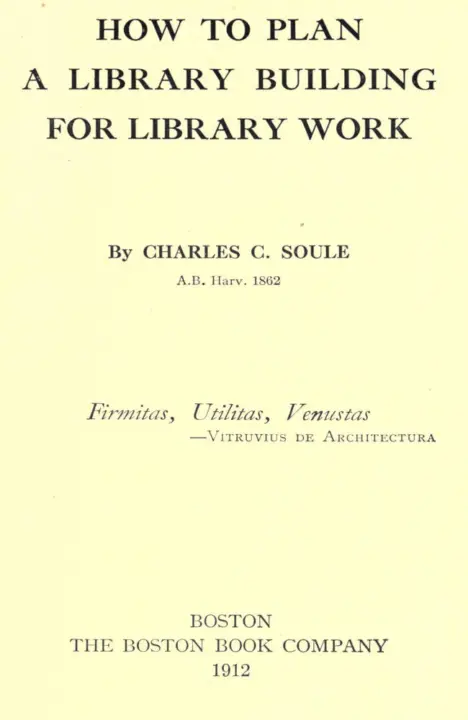
"How to Plan a Library Building for Library Work" by Charles C. Soule is a practical guidebook on library architecture written in the early 20th century. This work provides detailed insights into the essential features, considerations, and methodologies involved in designing and constructing a library. It emphasizes the importance of functionality over aesthetics, underlining that a library should serve its community effectively while being adaptable to future changes. The opening of the guide presents an advocacy for thoughtful library design, stressing the necessity of cooperation among librarians, architects, and building committees to create a library that is not only beautiful but also functional and efficient. It articulates principles about the utility of library spaces, the historical evolution of library building types, and the significance of considering future growth and needs in the planning process. The prelude sets a reflective tone, indicated by the author's ardent belief in libraries as "workshops for the future" rather than relics of the past, aiming to ensure that libraries are built with purpose and practicality at their core.
Introduction adapted from the source catalogue; source summaries may be automatically generated.
Free to read · English · 96,355 words · No account needed
MAKE TIME FOR A GOOD BOOK
On by default. Untick to stop anonymous reading totals. Each page counts after 10 seconds in view. How this works.
Anonymous counting is on unless you have switched it off.
International Library Conference (Second). Int. Lib. Conf.
London, 1907.
Koch, Theodore W. Koch.
Portfolio of Carnegie Libraries.
Ann Arbor, Mich., 1907.
Librarian (The). Libn.
Vols. 1-2.
London, 1910-12.
Library (The). Libr.
I, vols. 1-10; II, 1-10; III, 1-3.
London, 1889-1912.
Library Assistant. Lib. Asst.
Vols. 1-9.
London, 1898-1912.
Library Association Record. Lib. Ass. Rec.
Vols. 1-14.
London, 1899-1912.
Library Chronicle. Lib. Chron.
Vols. 1-5.
London, 1884-1888.
Library Journal. L. J.
Vols. 1-37.
New York, 1876-1912.
Library Notes. Lib. No.
Vols. 1-4.
Boston, 1887-1898.
Library World. L. W.
14 vols.
London, 1898-1912.
Marvin, Miss Cornelia. Marv.
Small Library Buildings.
Boston, 1908.
Massachusetts Free Public Library Commission: Mass. P. L. 1899.
Ninth Report.
Boston, 1899.
Public Libraries. P. L.
Vols. 1-17.
Chicago, 1896-1912.
Public Libraries in the United States. P. L., 1876. Special Report, Superintendent of Education. Part 1. Washington, 1876.
Report of Oculists and Electricians. Bost. Sc. Doc. No. 14.
School Board Document, No. 14.
Boston, 1907.
Sturgis’s Dictionary of Architecture, etc. Sturgis.
New York, 1901.
[For the first chapters of this book, I am largely indebted to an interesting and scholarly volume by John Willis Clark, entitled “The Care of Books,” published in the year 1901 at Cambridge, Eng. I am emboldened to quote from it by noting how much later books and cyclopedias rely on it as their chief authority, and I commend to all readers both text and illustrations of this fascinating work.]
The Dawn of History
No precedents of buildings or fixtures loom out of the farthest past. Archæological excavations have found relics of libraries in early ruins, libraries of baked clay tablets, evidently once housed in separate rooms on upper stories of palaces or temples. This literature must have seemed imperishable. There were no fading inks, no crumbling paper, no danger from moisture or worms. But an older foe, still threatening libraries, lurked in that brick era of literature. Fire, both worshiped and feared, was finally fatal. Fire following conquest attacked the oldest libraries and dropped them in shattered fragments into prehistoric cellars, to lie for centuries awaiting exhumation. But even as now resurrected, they tell no tales of their housing or shelving or circulation. It would seem hopeless to grope among these shards for lessons in library science. And yet Dr. Richard Garnett[1] deduced from an Assyrian hexagonal book tablet the idea of hexagonal bookcases for the British Museum.
Ancient History
Your reading position is saved on this browser. Take it to another device with a library code. Reading pages adapt to text, rather than matching a printed edition.
BEHIND THE BOOK
This eBook is for the use of anyone anywhere in the United States and most other parts of the world at no cost and with almost no restrictions whatsoever. You may copy it, give it away or re-use it under the terms of the Project Gutenberg License included with this eBook or online at www.gutenberg.org. If you are not located in the United States, you will have to check the laws of the country where you are located before using this eBook. Read the source licence.
The original source file, including credits and licence, is retained by this library. Request an original-format copy at no charge. Please include the book title and Project Gutenberg identifier #64560.
KEEP YOUR CURIOSITY GOING
Charles G. (Charles Griffith) Ross
Hannah Webster Foster

Emily Lawless
Edwin Hamlin Carr

Charles De Lano Hine
Andrew Ure