
The Writing of News A Handbook with Chapters on Newspaper Correspondence and Copy Reading
Charles G. (Charles Griffith) Ross
THE CLASSIC COLLECTION · 1912
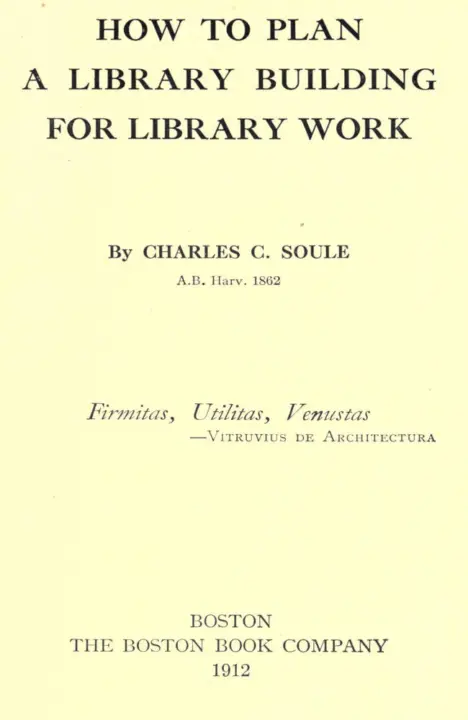
"How to Plan a Library Building for Library Work" by Charles C. Soule is a practical guidebook on library architecture written in the early 20th century. This work provides detailed insights into the essential features, considerations, and methodologies involved in designing and constructing a library. It emphasizes the importance of functionality over aesthetics, underlining that a library should serve its community effectively while being adaptable to future changes. The opening of the guide presents an advocacy for thoughtful library design, stressing the necessity of cooperation among librarians, architects, and building committees to create a library that is not only beautiful but also functional and efficient. It articulates principles about the utility of library spaces, the historical evolution of library building types, and the significance of considering future growth and needs in the planning process. The prelude sets a reflective tone, indicated by the author's ardent belief in libraries as "workshops for the future" rather than relics of the past, aiming to ensure that libraries are built with purpose and practicality at their core.
Introduction adapted from the source catalogue; source summaries may be automatically generated.
Free to read · English · 96,355 words · No account needed
MAKE TIME FOR A GOOD BOOK
On by default. Untick to stop anonymous reading totals. Each page counts after 10 seconds in view. How this works.
Anonymous counting is on unless you have switched it off.
But about this stage it is time to think of a raised cellar or basement, which will about double the available floor space and begin to allow division into departments, the first increase of force being a janitor who can act as supervisor of the lower rooms.
Soon after this a regular trefoil building can be erected with practicable basement, with the introduction of two small rooms at the inner corners of the back ell, where they need not block light from any room.
From this on to a two-story building with stairs, there are many alternatives, and no regular style of building can be prescribed.
When a town has no adviser at hand, it can apply to the state library commission, or if there is none in the state, to the nearest state commission, which at least can advise from what librarian it can get good advice.
Most of the very small libraries described in the 1899 Report of the Mass. Free Public Library Commission occupy a room or rooms in schoolhouses, town halls, churches, the librarian’s house, or public blocks. The smallest grade of separate library buildings seem to me more uniformly appropriate and beautiful than many of higher grades.
As I drive about seashore and mountain resorts and through small country towns, I see many beautiful little library buildings, usually closed at the time I pass, so that I cannot inspect the interiors. In the 1899 Report of the Mass. Free Public Library Commission, I find descriptions of several low-cost library buildings. For instance:—
Old buildings bought: Westbury cost $100. Boxford ” 360. Scituate ” 700. Mendon ” 1,000. West Tisbury ” 1,063. New wooden buildings: Marston’s Mills ” 425. Freetown ” 1,500. Provincetown ” 3,000. North Scituate ” 3,000. Southwick ” 3,000. New brick buildings: Bernardiston ” 2,000. Buckland ” 2,500. Templeton ” 2,500.
with several others costing less than $5,000 and many costing $10,000 or less. Of some of these, exterior views are given in the report. I should much like to see interior views, floor plans, full statistics and comments of local librarians.
In A. L. A. Library Tract No. 4 I said, and still think, that—
“A rough, unpainted, cellarless, one-room wooden building could be put together for say $250, and can be fitted up and made comfortable in all weathers for as much more.
“From $1,000 to $2,500 will pay for a tasteful wooden building amply sufficient for a library of not over 5,000 volumes.
“$2,500 to $5,000 will erect a similar building, to hold 10,000 volumes
or more.
“From $10,000 up will provide for a brick building, and from $15,000 up a stone building for growing libraries of 15,000 volumes or more, with the varied functions that such a collection implies.”
These figures are only an approximation and will vary in different sections, with prices of material and labor, but they will do for rough guess to start with.
Your reading position is saved on this browser. Take it to another device with a library code. Reading pages adapt to text, rather than matching a printed edition.
BEHIND THE BOOK
This eBook is for the use of anyone anywhere in the United States and most other parts of the world at no cost and with almost no restrictions whatsoever. You may copy it, give it away or re-use it under the terms of the Project Gutenberg License included with this eBook or online at www.gutenberg.org. If you are not located in the United States, you will have to check the laws of the country where you are located before using this eBook. Read the source licence.
The original source file, including credits and licence, is retained by this library. Request an original-format copy at no charge. Please include the book title and Project Gutenberg identifier #64560.
KEEP YOUR CURIOSITY GOING
Charles G. (Charles Griffith) Ross
Hannah Webster Foster

Emily Lawless
Edwin Hamlin Carr

Charles De Lano Hine
Andrew Ure