
The Writing of News A Handbook with Chapters on Newspaper Correspondence and Copy Reading
Charles G. (Charles Griffith) Ross
THE CLASSIC COLLECTION · 1912
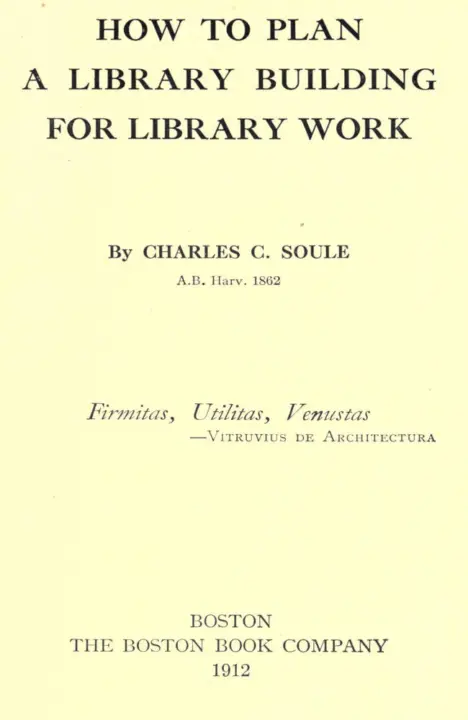
"How to Plan a Library Building for Library Work" by Charles C. Soule is a practical guidebook on library architecture written in the early 20th century. This work provides detailed insights into the essential features, considerations, and methodologies involved in designing and constructing a library. It emphasizes the importance of functionality over aesthetics, underlining that a library should serve its community effectively while being adaptable to future changes. The opening of the guide presents an advocacy for thoughtful library design, stressing the necessity of cooperation among librarians, architects, and building committees to create a library that is not only beautiful but also functional and efficient. It articulates principles about the utility of library spaces, the historical evolution of library building types, and the significance of considering future growth and needs in the planning process. The prelude sets a reflective tone, indicated by the author's ardent belief in libraries as "workshops for the future" rather than relics of the past, aiming to ensure that libraries are built with purpose and practicality at their core.
Introduction adapted from the source catalogue; source summaries may be automatically generated.
Free to read · English · 96,355 words · No account needed
MAKE TIME FOR A GOOD BOOK
On by default. Untick to stop anonymous reading totals. Each page counts after 10 seconds in view. How this works.
Anonymous counting is on unless you have switched it off.
These rooms should be near the Stock and Store Rooms and the Supply
Department.
=Lavatories, see Toilets.=
=Lecture Room, see Auditorium.=
=Librarian’s Office, see Executive Offices.=
=Librarian, Assistant, see Executive Offices.=
=Library for the Blind.= This is intended for the use of the blind readers and their guides. Provision should be made both for the delivery of books for home use, for reading in the library and for “readings.” A small lecture room separated from the Delivery Room should be provided for the latter purpose.
The blind borrowers would be registered at this department rather than at the General Registration Desk.
The best location for this department is on the ground floor, although it may be placed on the top floor. It should be located near a stack accommodating 15,000 volumes.
This is perhaps the one department of the library which might, if necessary, be located at some branch, possibly Montague—instead of in the Central Building without affecting seriously other departments.
=Library of Congress Cards, see Cataloguing Department.=
=Lighting Plant.= Even if the library does not install its own lighting plant, space should at least be provided for it in the sub-basement.
Wherever table lights are used as probably in the Reference and Cataloguing Departments, they should be movable and so arranged that they will not get in the way of readers’ feet.
So far as possible, general illumination is better than individual lights.
=Little Used Books, see Stack—Depository.=
=Lockers.= Clothing lockers, open and well ventilated, with shelves for hats, should be abundantly provided.
Lockers for men and women should be located near the staff entrance, and in addition, a few lockers should be provided in each department.
The lockers should also be near the service elevator. The quarters might be divided so to partially separate men, women, boys and girls.
=Lunch Room for Staff, see Staff Lunch Room.=
=Lunch room—Public, see Public Restaurant.=
=Magazine Room, see Periodical Reading Room.=
=Main Reading Room, see Reference Room.=
=Manuscript Department.= Room where valuable manuscripts would be kept. It might be near Map or Art Book Room and form one of the latter suite.
=Map Room.= Provision should be made in this room for the convenient handling of maps of various sizes and kinds.
This should be near the Reference Room for the sake of supervision.
=Mechanical Service and Equipment, see Book Carriers, Telephones, etc.=
Your reading position is saved on this browser. Take it to another device with a library code. Reading pages adapt to text, rather than matching a printed edition.
BEHIND THE BOOK
This eBook is for the use of anyone anywhere in the United States and most other parts of the world at no cost and with almost no restrictions whatsoever. You may copy it, give it away or re-use it under the terms of the Project Gutenberg License included with this eBook or online at www.gutenberg.org. If you are not located in the United States, you will have to check the laws of the country where you are located before using this eBook. Read the source licence.
The original source file, including credits and licence, is retained by this library. Request an original-format copy at no charge. Please include the book title and Project Gutenberg identifier #64560.
KEEP YOUR CURIOSITY GOING
Charles G. (Charles Griffith) Ross
Hannah Webster Foster

Emily Lawless
Edwin Hamlin Carr

Charles De Lano Hine
Andrew Ure