
The Writing of News A Handbook with Chapters on Newspaper Correspondence and Copy Reading
Charles G. (Charles Griffith) Ross
THE CLASSIC COLLECTION · 1912
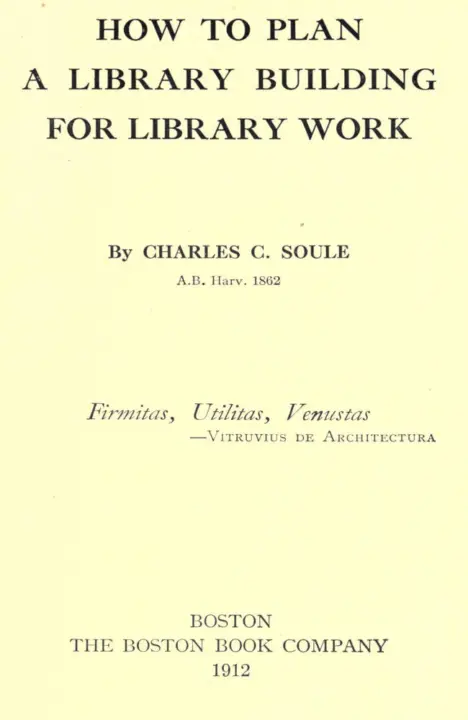
"How to Plan a Library Building for Library Work" by Charles C. Soule is a practical guidebook on library architecture written in the early 20th century. This work provides detailed insights into the essential features, considerations, and methodologies involved in designing and constructing a library. It emphasizes the importance of functionality over aesthetics, underlining that a library should serve its community effectively while being adaptable to future changes. The opening of the guide presents an advocacy for thoughtful library design, stressing the necessity of cooperation among librarians, architects, and building committees to create a library that is not only beautiful but also functional and efficient. It articulates principles about the utility of library spaces, the historical evolution of library building types, and the significance of considering future growth and needs in the planning process. The prelude sets a reflective tone, indicated by the author's ardent belief in libraries as "workshops for the future" rather than relics of the past, aiming to ensure that libraries are built with purpose and practicality at their core.
Introduction adapted from the source catalogue; source summaries may be automatically generated.
Free to read · English · 96,355 words · No account needed
MAKE TIME FOR A GOOD BOOK
On by default. Untick to stop anonymous reading totals. Each page counts after 10 seconds in view. How this works.
Anonymous counting is on unless you have switched it off.
When an architect does such good work as this, as a result of giving proper consideration to the real needs of the library, he surely ought to have credit for it, and all librarians who know about it ought to give him thanks and wide public praise.
Where does the Library Come In?
Architecture, as I have said, deals with a wide range of subjects, from the pure idealism of tombs, monuments and memorial arches, to the pure realism of twentieth century workshops. The former are, so to speak, all outside, and proper themes for competition. The latter are nearly all inside, to be worked out by careful and special study of their uses.
Where, in this wide circle, does the library come in? All librarians will claim, and most architects will allow, that it lies very near the workshop; as near it surely as the schoolhouse. It certainly needs careful study and adequate expert advice.
The tombs, monuments, and memorial arches, are rich subjects for architectural taste and ornament,—for venustas.
For workshops, for schoolhouses, ornament is inappropriate. Good taste, shown in proportion, lines, color, material, is still demanded, but they belong clearly to the domain of utilitas.
The library comes, beyond doubt, in the latter group. There is a vast range of buildings between, more or less proper subjects of decoration and ornamentation.
But the library should incontestably be assigned to the utilitarian
extreme.
What Conflict is Possible?
Are there any points where architect and librarian may clash? There will be many points of course where they will differ at first, and have to get together through argument. But are there any influences toward a deadlock?
On the part of the librarian there should be no prejudice. If he be immature, or conceited and opinionated, and only half informed, he may not deserve to win in such a contest of ideas, but his bias at all events would be professional, not selfish.
On the side of the architect, however, might there not be some bias? In the first place, professional bias toward some style he has got his mind set on? He may be too willing to sacrifice utilitas to venustas on this account. During the Boston Public Library discussion, an architect wrote to a daily journal: “Library buildings should be treated as monuments, not as workshops, and must be made beautiful even at the sacrifice of utility.” But if any architect or any trustees now have such views, the building committee is to blame if it employs him, or even admits him to a competition.
Your reading position is saved on this browser. Take it to another device with a library code. Reading pages adapt to text, rather than matching a printed edition.
BEHIND THE BOOK
This eBook is for the use of anyone anywhere in the United States and most other parts of the world at no cost and with almost no restrictions whatsoever. You may copy it, give it away or re-use it under the terms of the Project Gutenberg License included with this eBook or online at www.gutenberg.org. If you are not located in the United States, you will have to check the laws of the country where you are located before using this eBook. Read the source licence.
The original source file, including credits and licence, is retained by this library. Request an original-format copy at no charge. Please include the book title and Project Gutenberg identifier #64560.
KEEP YOUR CURIOSITY GOING
Charles G. (Charles Griffith) Ross
Hannah Webster Foster

Emily Lawless
Edwin Hamlin Carr

Charles De Lano Hine
Andrew Ure