
The Writing of News A Handbook with Chapters on Newspaper Correspondence and Copy Reading
Charles G. (Charles Griffith) Ross
THE CLASSIC COLLECTION · 1912
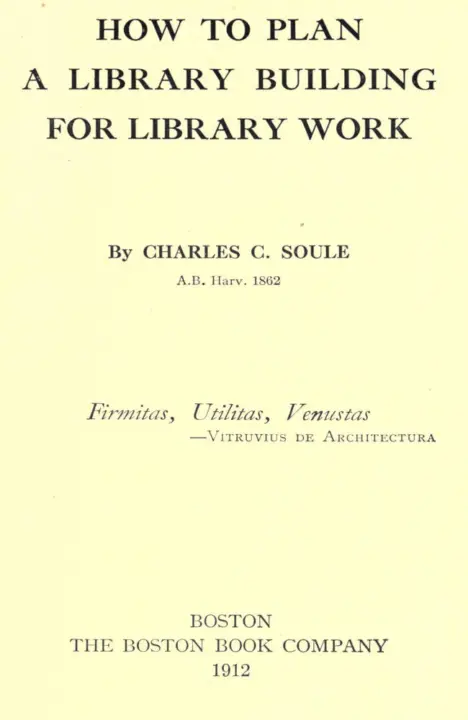
"How to Plan a Library Building for Library Work" by Charles C. Soule is a practical guidebook on library architecture written in the early 20th century. This work provides detailed insights into the essential features, considerations, and methodologies involved in designing and constructing a library. It emphasizes the importance of functionality over aesthetics, underlining that a library should serve its community effectively while being adaptable to future changes. The opening of the guide presents an advocacy for thoughtful library design, stressing the necessity of cooperation among librarians, architects, and building committees to create a library that is not only beautiful but also functional and efficient. It articulates principles about the utility of library spaces, the historical evolution of library building types, and the significance of considering future growth and needs in the planning process. The prelude sets a reflective tone, indicated by the author's ardent belief in libraries as "workshops for the future" rather than relics of the past, aiming to ensure that libraries are built with purpose and practicality at their core.
Introduction adapted from the source catalogue; source summaries may be automatically generated.
Free to read · English · 96,355 words · No account needed
MAKE TIME FOR A GOOD BOOK
On by default. Untick to stop anonymous reading totals. Each page counts after 10 seconds in view. How this works.
Anonymous counting is on unless you have switched it off.
One thing I would never do—consent to such removal until every superfluous architectural area, in vestibules, corridors, staircases, etc., had been eliminated, and the building reduced to its lowest possible denomination for necessary central work.
Room for Service of Branches
In large libraries, room must be provided for laying out, shipping and receiving books for branches, deliveries, traveling libraries and all other kinds of outside activities. How much space these may require may be inferred from the fact that the Travelling Library office of the New York Public Library has a stock of fifty thousand volumes and seventeen employees.
It should either have direct shipping doors, or should open into the packing room, with good access to the shipping facilities there.
Besides tables, desks and shelving for the general use of superintendent and clerks, with corner for telephones to the branches, etc., and to other departments of the main library, there will have to be bins for such dispatch service. As the books come here from the stack, nearness to it, or some form of mechanical connection with it, will save much time. Here, as in so many other departments of every new large library, is opportunity for individual planning.
See Winsor, P. L., 1876, 470.
” Bostwick, L. J., 1898, p. 14.
” L. J., 1898, Conf. 98, 101.
” Cole, U. S. Ed’l Rept., 1892-3, Vol. 1, p. 709.
” Wilson, R. E. P. L., 1901, p. 275.
” Duff-Brown, pp. 350-356.
” Sutton, C. W., 6 L. A. R., 67.
Comfort Rooms
=Rest and Lunch.= In England always, and oftener here than formerly, even in small libraries, a room or rooms are provided for the relaxation of the staff. “Especially for women, humanity and a wise economy prompt comfortable rest rooms, as they are not as uniformly in robust health, and are more subject to sudden indisposition.”—(Bostwick.[250]) In view of the good these can do, in refreshing attendants, and keeping them in the building, as well as the fact that such rooms can be tucked into space not really needed for anything else, and also because of the moderate expense of fitting them up, it seems a great pity to cut them out of plans, as I have known building committees to do from false ideas of economy. A room for rest and lunching, a tiny “kitchenette” adjoining, with gas stove, one room if you can for men, another for women; or in smaller libraries a common room for a library mess, will do a deal toward infusing an esprit de corps into the whole staff. A timely cup of tea will soothe the nerves and stimulate the jaded to renewed vigor. This is so much a matter of housekeeping that the advice of the ladies of the corps can wisely be taken as to equipment, including store closet. They can be trusted to get everything needed into little space, at little cost.
Your reading position is saved on this browser. Take it to another device with a library code. Reading pages adapt to text, rather than matching a printed edition.
BEHIND THE BOOK
This eBook is for the use of anyone anywhere in the United States and most other parts of the world at no cost and with almost no restrictions whatsoever. You may copy it, give it away or re-use it under the terms of the Project Gutenberg License included with this eBook or online at www.gutenberg.org. If you are not located in the United States, you will have to check the laws of the country where you are located before using this eBook. Read the source licence.
The original source file, including credits and licence, is retained by this library. Request an original-format copy at no charge. Please include the book title and Project Gutenberg identifier #64560.
KEEP YOUR CURIOSITY GOING
Charles G. (Charles Griffith) Ross
Hannah Webster Foster

Emily Lawless
Edwin Hamlin Carr

Charles De Lano Hine
Andrew Ure