
The Writing of News A Handbook with Chapters on Newspaper Correspondence and Copy Reading
Charles G. (Charles Griffith) Ross
THE CLASSIC COLLECTION · 1912
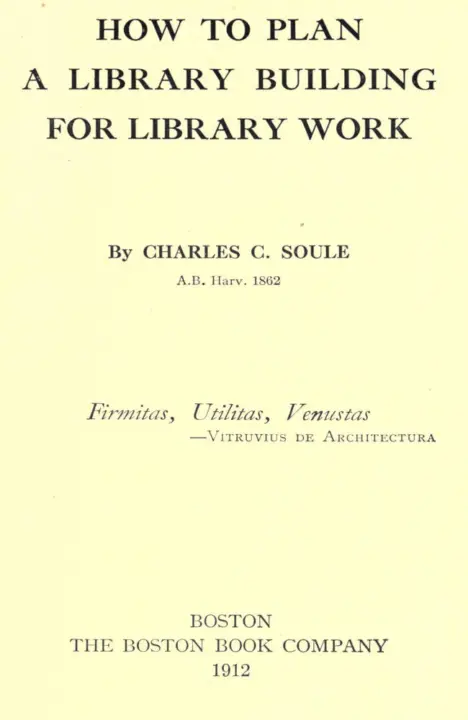
"How to Plan a Library Building for Library Work" by Charles C. Soule is a practical guidebook on library architecture written in the early 20th century. This work provides detailed insights into the essential features, considerations, and methodologies involved in designing and constructing a library. It emphasizes the importance of functionality over aesthetics, underlining that a library should serve its community effectively while being adaptable to future changes. The opening of the guide presents an advocacy for thoughtful library design, stressing the necessity of cooperation among librarians, architects, and building committees to create a library that is not only beautiful but also functional and efficient. It articulates principles about the utility of library spaces, the historical evolution of library building types, and the significance of considering future growth and needs in the planning process. The prelude sets a reflective tone, indicated by the author's ardent belief in libraries as "workshops for the future" rather than relics of the past, aiming to ensure that libraries are built with purpose and practicality at their core.
Introduction adapted from the source catalogue; source summaries may be automatically generated.
Free to read · English · 96,355 words · No account needed
MAKE TIME FOR A GOOD BOOK
On by default. Untick to stop anonymous reading totals. Each page counts after 10 seconds in view. How this works.
Anonymous counting is on unless you have switched it off.
=Electricity.= But the use of electricity has become so general all over the country, even in small towns, the light is so good, so safe, and considering the advantages, so cheap, that you are likely to arrive soon at the electrical stage, and remain in it permanently through the various steps of your growth. It is unnecessary in these days, to warn against defective installation; any architect should be able to arrange that; but watch it carefully, in planning and as the contractors put their wires in.
With either form of gas, or with electricity, the choosing and placing of lights will be one of the most important of your joint problems.
As far back as 1886, J. E. L. Pickering contributed a paper on the electric light, to The Library Chronicle[208] which is so sound that it is worth reading now—a generation later.
=Location.= In placing your lamps of all kinds, do not think first of symmetry or appearance, but try to find where the fewest bulbs, of the kind you determine to use, will bring the best light most directly on the places where it is wanted, with the smallest expense.
The kinds of illumination required are:—
=Diffused.= This is the general light in corridors and rooms, sufficient for moving about, usually got from chandeliers, sometimes from wall brackets.
=Shelves and service desks.= In usual systems, these are lighted, the desks by different kinds of fixed or hanging desk-lights, the shelves by a goose-neck protruding at the top, from the cornice between every two ranges.
=Readers’.= Usually lighted by rows of lights, shades down the center of the tables; or movable individual standards near the readers’ chairs, or by hanging lamps, six or eight feet from the floor.
=In stacks.= By bulbs at the ceiling of each desk, either hanging down,
or doubled up.
=Colors.= As elsewhere noted, light colors in walls, ceilings, shelving and furniture, aid any system of lighting by reflection.
=Switches.= The location of switches is most important both for
effectiveness and for economy.
=Systems.= I do not propose to discuss here all the systems of lighting or makes of lamps and fixtures, but I wish to record a very deliberate opinion as to the proper trend of experiments in library lighting.
Seeing a book advertised on “Practical Illumination,” by Cravath and Lansingh, I bought and have carefully looked it over. The seven pages it gives to libraries have not helped me at all, but I have found on other pages matter of interest. This, for instance:—
“The object of artificial illumination is to enable us to see things.”
Your reading position is saved on this browser. Take it to another device with a library code. Reading pages adapt to text, rather than matching a printed edition.
BEHIND THE BOOK
This eBook is for the use of anyone anywhere in the United States and most other parts of the world at no cost and with almost no restrictions whatsoever. You may copy it, give it away or re-use it under the terms of the Project Gutenberg License included with this eBook or online at www.gutenberg.org. If you are not located in the United States, you will have to check the laws of the country where you are located before using this eBook. Read the source licence.
The original source file, including credits and licence, is retained by this library. Request an original-format copy at no charge. Please include the book title and Project Gutenberg identifier #64560.
KEEP YOUR CURIOSITY GOING
Charles G. (Charles Griffith) Ross
Hannah Webster Foster

Emily Lawless
Edwin Hamlin Carr

Charles De Lano Hine
Andrew Ure