Enoch Crane
Francis Hopkinson Smith & F. Berkeley (Frank Berkeley) Smith
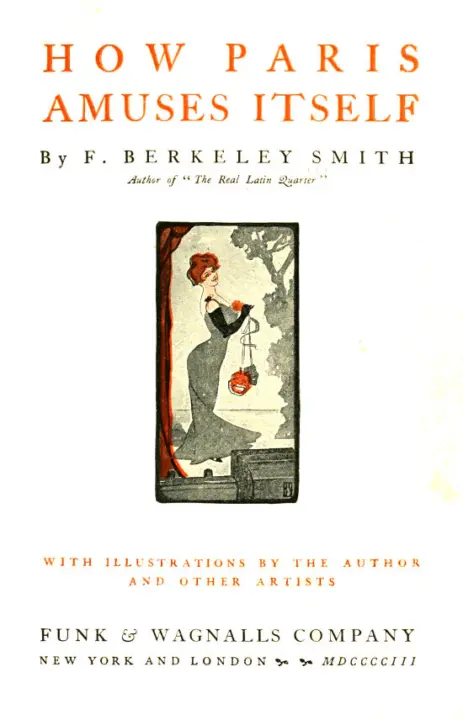
THE CLASSIC COLLECTION · 1903
"How Paris Amuses Itself" by F. Berkeley Smith is a travelogue and cultural commentary written in the early 20th century. The work explores the vibrant and multifaceted entertainment landscape of Paris, detailing the various shows, cafés, and leisurely pursuits that define the city's charm. Through rich descriptions and engaging narratives, Smith showcases the myriad ways that Parisians seek enjoyment, from lavish theaters to casual street performances. The opening of the book establishes a lively scene in Paris, depicting the city's attractions under both sunny and rainy conditions. It paints a picture of ordinary life infused with color and excitement, illustrating bustling cafés filled with a diverse cast of characters and lively interactions. Smith captures the essence of Parisian life, where joy is encountered in both grand spectacles and simple moments, inviting readers to immerse themselves in the celebrations and cultural experiences that make the city a perpetual delight for its inhabitants and visitors alike.
Introduction adapted from the source catalogue; source summaries may be automatically generated.
Free to read · English · 52,475 words · No account needed
MAKE TIME FOR A GOOD BOOK
On by default. Untick to stop anonymous reading totals. Each page counts after 10 seconds in view. How this works.
Anonymous counting is on unless you have switched it off.
The pathway now ran through a short thicket. Beyond it lay the crest of the lane, an expanse of blue sky, and, nestling in the prettiest of tiny gardens, the “Villa Polichinelle.”
Marcelle, who had been watching me find my way, now called to me from an upper window, and came down to greet me in a sunbonnet and a calico wrapper.
“I am so glad you have come,” she said, cheerily. “And did the plan work well?” she added, with a laugh.
“Perfectly,” I replied. “Only you did not put in the dog.”
“Ah! Cerbère—yes, I know. He growled at you because you were a stranger. He is not a bad old fellow, tho, when you know him; you see he seems to feel responsible for us.”
I could not help shivering at the thought that Marcelle came home long after midnight, often alone, through rain, snow and slush, passing, to get to this mountain retreat, through one of the worst quarters of Paris, inhabited for the most part by gentlemen and their consorts whose records are as black as the ace of spades.
“Now,” said my hostess, “you must see all of my modest kingdom. First my garden, then my family, and then my house.”
“Good,” said I, “the garden shall come first.”
“Ah! I am glad you love flowers,” cried Marcelle, growing enthusiastic as I complimented her upon the beauty of her roses. She threw aside her sunbonnet and led me triumphantly to a bed of red and yellow tulips, which was edged by a row of box skirting the neatly-raked gravel path, so characteristic of French gardens.
“I planted them all myself,” said Marcelle, “except this last row, which the poet helped me to do. You see they are jumbled—as I told him, like some of his verses. He is a symbolist, you know. Nothing the poet writes can one ever understand. But he says we all will do so some day—that the cheap realism of the present will soon sink into oblivion and be forgotten.”
There were beds of giroflees, masses of pinks, odd corners of velvety pansies, and bower-like arbors covered with Jacqueminot roses. We descended some stepping-stones to a smaller lower garden and entered a thatched kiosk lined with turkey red, upon which were hung bas-reliefs and pen-and-ink drawings, souvenirs from those who loved the good-fellowship of this Arcadian nook.
And now Juliette, Marcelle’s bonne, her sleeves rolled over the elbows of her plump arms, came to the kiosk with vermouth and cigarettes. Following her, a green parrot pigeontoed his way down the gravel walk, muttering to himself a jumble of phrases.
Your reading position is saved on this browser. Take it to another device with a library code. Reading pages adapt to text, rather than matching a printed edition.
Francis Hopkinson Smith & F. Berkeley (Frank Berkeley) Smith
F. Berkeley (Frank Berkeley) Smith
F. Berkeley (Frank Berkeley) Smith
BEHIND THE BOOK
This eBook is for the use of anyone anywhere in the United States and most other parts of the world at no cost and with almost no restrictions whatsoever. You may copy it, give it away or re-use it under the terms of the Project Gutenberg License included with this eBook or online at www.gutenberg.org. If you are not located in the United States, you will have to check the laws of the country where you are located before using this eBook. Read the source licence.
The original source file, including credits and licence, is retained by this library. Request an original-format copy at no charge. Please include the book title and Project Gutenberg identifier #46893.
KEEP YOUR CURIOSITY GOING
Wilfrid Scawen Blunt
Wilfrid Scawen Blunt

E. W. (Edgar Watson) Howe
Francis Greenleaf Allinson & Anne C. E. (Anne Crosby Emery) Allinson
Cyrenus Cole

John Martineau