READ · DISCOVER · ENJOYClassic literature · Always free
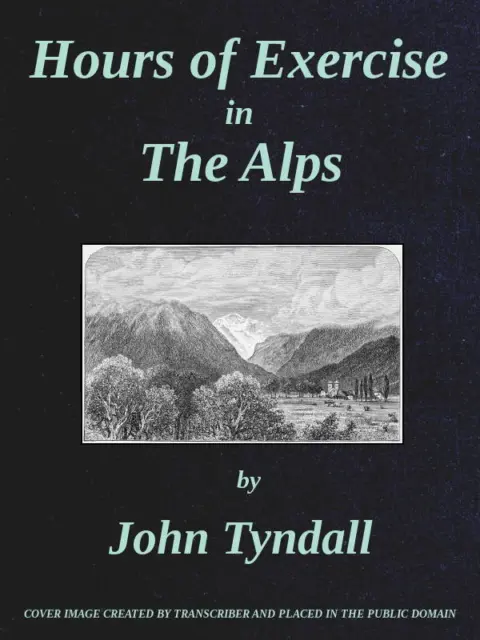
Hours of Exercise in the Alps — digital edition cover

THE CLASSIC COLLECTION · 1871

Hours of Exercise in the Alps

"Hours of Exercise in the Alps" by John Tyndall is a collection of travel narratives and reflections on mountaineering written in the late 19th century. The work recounts the author’s personal adventures in the majestic alpine landscape while exploring both the physical challenges of climbing and the profound connection with nature that these experiences foster. Through a series of essays, Tyndall invites readers to partake in his exhilarations and the contemplations born from the breathtaking beauty and dangers of the mountains. The opening of the text sets the stage for Tyndall’s journey back to the Alps after a period away, highlighting his yearning for the invigorating alpine air and the joy of climbing. He details his preparations to meet up with his old guide, Lauener, for an ascent, underscoring the camaraderie vital to such endeavors. The narrative conveys not just the physical exertion experienced during the climbs but also the mental struggles and triumphs. Tyndall reflects on the beauty of nature, the importance of respect, caution, and knowledge in mountaineering, while framing these reflections against the backdrop of his friendships and the challenges faced in the unforgiving alpine environment.

Introduction adapted from the source catalogue; source summaries may be automatically generated.

Start reading ↓

Free to read · English · 108,518 words · No account needed

MAKE TIME FOR A GOOD BOOK

Hours of Exercise in the Alps

On by default. Untick to stop anonymous reading totals. Each page counts after 10 seconds in view. How this works.

Anonymous counting is on unless you have switched it off.

Hours of Exercise in the Alps

The Haut de Cry has four arêtes, the first running towards the W., the second SE., the third E., and the fourth NE. We were between the two last-named arêtes. Our plan was to go up between them to the foot of the peak, and mount it by the arête running NE. As we had expected, the snow was in much better state when once we were above the woods. For some time we advanced pretty rapidly. The peak was glistening before us, and the idea of success put us in high spirits. Our good fortune did not last long; we soon came to snow frozen on the surface, and capable of bearing for a few steps and then giving way. But this was nothing compared to the trouble of pulling up through the pine wood, so instead of making us grumble it only excited our hilarity. Bennen was in a particularly good humour, and laughed aloud at our combined efforts to get out of the holes we every now and then made in the snow. Judging from appearances, the snow-field over which we were walking covered a gradually rising Alp. We made a second observation with our aneroid, and found, rather to our astonishment and dismay, that we had only risen 1,000 feet in the last three hours. It was 10 o’clock: we were at the height of about 8,000 feet; temperature = -1.5 C. During the last half-hour we had found a little hard snow, so we had all hope of success. Thinking we might advance better on the arête, we took to it, and rose along it for some time. It soon became cut up by rocks, so we took to the snow again. It turned out to be here hard frozen, so that we reached the real foot of the peak without the slightest difficulty. It was steeper than I had expected it would be, judging from the valley of the Rhone. Bennen looked at it with decided pleasure; having completed his survey, he proposed to take the eastern arête, as in doing so we should gain at least two hours. Rebot had been over this last-named arête in summer, and was of Bennen’s opinion. Two or three of the party did not like the idea much, so there was a discussion on the probable advantages and disadvantages of the NE. and E. arêtes. We were losing time; so Bennen cut matters short by saying: ‘Ich will der Erste über die arête!’ Thus saying, he made for the E. arête; it looked very narrow, and, what was worse, it was considerably cut up by high rocks, the intervals between the teeth of the arête being filled up with snow. To gain this arête, we had to go up a steep snow-field, about 800 feet high, as well as I remember. It was about 150 feet broad at the top, and 400 or 500 at the bottom. It was a sort of couloir on a large scale. During the ascent we sank about one foot deep at every step. Bennen did not seem to like the look of the snow very much. He asked the local guides whether avalanches ever came down this couloir, to which they answered that our position was perfectly safe. We had mounted on the northern side of the couloir, and having arrived at 150 feet from the top, we began crossing it on a horizontal curve, so as to gain the E. arête. The inflexion or dip of the couloir was slight, not above 25 feet, the inclination near 35°. We were walking in the following order: Bevard, Nance, Bennen, myself, Boissonnet, and Rebot. Having crossed over about three-quarters of the breadth of the couloir, the two leading men suddenly sank considerably above their waists. Bennen tightened the rope. The snow was too deep to think of getting out of the hole they had made, so they advanced one or two steps, dividing the snow with their bodies. Bennen turned round and told us he was afraid of starting an avalanche; we asked whether it would not be better to return and cross the couloir higher up. To this the three Ardon men opposed themselves; they mistook the proposed precaution for fear, and the two leading men continued their work. After three or four steps gained in the aforesaid manner, the snow became hard again. Bennen had not moved--he was evidently undecided what he should do; as soon, however, as he saw hard snow again, he advanced and crossed parallel to, but above, the furrow the Ardon men had made. Strange to say, the snow supported him. While he was passing I observed that the leader, Bevard, had about twenty feet of rope coiled round his shoulder. I of course at once told him to uncoil it and get on the arête, from which he was not more than fifteen feet distant. Bennen then told me to follow. I tried his steps, but sank up to my waist in the very first. So I went through the furrows, holding my elbows close to my body, so as not to touch the sides. This furrow was about twelve feet long, and, as the snow was good on the other side, we had all come to the false conclusion that the snow was accidentally softer there than elsewhere. Boissonet then advanced; he had made but a few steps when we heard a deep, cutting sound. The snow-field split in two about fourteen or fifteen feet above us. The cleft was at first quite narrow, not more than an inch broad. An awful silence ensued; it lasted but a few seconds, and then it was broken by Bennen’s voice, ‘Wir sind alle verloren.’ His words were slow and solemn, and those who knew him felt what they really meant when spoken by such a man as Bennen. They were his last words. I drove my alpenstock into the snow, and brought the weight of my body to bear on it; it went in to within three inches of the top. I then waited. It was an awful moment of suspense. I turned my head towards Bennen to see whether he had done the same thing. To my astonishment, I saw him turn round, face the valley, and stretch out both arms. The ground on which we stood began to move slowly, and I felt the utter uselessness of any alpenstock. I soon sank up to my shoulders and began descending backwards. From this moment I saw nothing of what had happened to the rest of the party. With a good deal of trouble I succeeded in turning round. The speed of the avalanche increased rapidly, and before long I was covered up with snow and in utter darkness. I was suffocating, when with a jerk I suddenly came to the surface again. The rope had caught most probably on a rock, and this was evidently the moment when it broke. I was on a wave of the avalanche, and saw it before me as I was carried down. It was the most awful sight I ever witnessed. The head of the avalanche was already at the spot where we had made our last halt. The head alone was preceded by a thick cloud of snow-dust; the rest of the avalanche was clear. Around me I heard the horrid hissing of the snow, and far before me the thundering of the foremost part of the avalanche. To prevent myself sinking again, I made use of my arms much in the same way as when swimming in a standing position. At last I noticed that I was moving slower; then I saw the pieces of snow in front of me stop at some yards’ distance; then the snow straight before me stopped, and I heard on a large scale the same creaking sound that is produced when a heavy cart passes over hard-frozen snow in winter. I felt that I also had stopped, and instantly threw up both arms to protect my head in case I should again be covered up. I had stopped, but the snow behind me was still in motion; its pressure on my body was so strong that I thought I should be crushed to death. This tremendous pressure lasted but a short time, and ceased as suddenly as it had begun. I was then covered up by snow coming from behind me. My first impulse was to try and uncover my head--but this I could not do: the avalanche had frozen by pressure the moment it stopped, and I was frozen in. Whilst trying vainly to move my arms, I suddenly became aware that the hands as far as the wrist had the faculty of motion. The conclusion was easy, they must be above the snow. I set to work as well as I could; it was time, for I could not have held out much longer. At last I saw a faint glimmer of light. The crust above my head was getting thinner, and it let a little air pass, but I could not reach it any more with my hands; the idea struck me that I might pierce it with my breath. After several efforts I succeeded in doing so, and felt suddenly a rush of air towards my mouth; I saw the sky again through a little round hole. A dead silence reigned around me; I was so surprised to be still alive, and so persuaded at the first moment that none of my fellow-sufferers had survived, that I did not even think of shouting for them. I then made vain efforts to extricate my arms, but found it impossible; the most I could do was to join the ends of my fingers, but they could not reach the snow any longer. After a few minutes I heard a man shouting: what a relief it was to know that I was not the sole survivor! to know that perhaps he was not frozen in and could come to my assistance! I answered; the voice approached, but seemed uncertain where to go, and yet it was now quite near. A sudden exclamation of surprise! Rebot had seen my hands. He cleared my head in an instant, and was about to try and cut me out completely, when I saw a foot above the snow, and so near to me that I could touch it with my arms, although they were not quite free yet. I at once tried to move the foot; it was my poor friend’s. A pang of agony shot through me as I saw that the foot did not move. Poor Boissonnet had lost sensation, and was perhaps already dead. Rebot did his best: after some time he wished me to help him, so he freed my arms a little more, so that I could make use of them. I could do but little, for Rebot had torn the axe from my shoulder as soon as he had cleared my head (I generally carry an axe separate from my alpenstock--the blade tied to the belt, and the handle attached to the left shoulder). Before coming to me Rebot had helped Nance out of the snow; he was lying nearly horizontally, and was not much covered over. Nance found Bevard, who was upright in the snow, but covered up to the head. After about twenty minutes the two last-named guides came up. I was at length taken out; the snow had to be cut with the axe down to my feet before I could be pulled out. A few minutes after 1 o’clock P.M. we came to my poor friend’s face.... I wished the body to be taken out completely, but nothing could induce the three guides to work any longer, from the moment they saw that it was too late to save him. I acknowledge that they were nearly as incapable of doing anything as I was. When I was taken out of the snow the cord had to be cut. We tried the end going towards Bennen, but could not move it; it went nearly straight down and showed us that there was the grave of the bravest guide the Valais ever had, and ever will have. The cold had done its work on us; we could stand it no longer, and began the descent. We followed the frozen avalanche for about twenty-five minutes, that being the easiest way of progressing, and then took the track we had made in the morning; in five hours we reached Ardon.

Your reading position is saved on this browser. Take it to another device with a library code. Reading pages adapt to text, rather than matching a printed edition.

More from this author

BEHIND THE WORDS

About John Tyndall

John Tyndall (1820–1893). Explore Address delivered before the British Association assembled at Belfast, Essays on the use and limit of the imagination in science, Half hours with modern scientists and other works in this collection. These books span essays & ideas, history, philosophy.

Explore this author’s books →

THE READERS’ VERDICT

How did this story stay with you?

Not rated yet
Your rating for Hours of Exercise in the Alps

Be the first to share your verdict.

One rating per browser, which you can change or remove. A necessary browser identifier remembers your vote. How ratings work

A GOOD STORY DESERVES COMPANY

Pass this book along.

A great read is even better when it’s shared.

SEND A LITTLE INSPIRATION

Share this book

BEHIND THE BOOK

Edition & source details.

Title
Hours of Exercise in the Alps
Author
John Tyndall
First publication (Open Library catalogue match)
1871
Digital edition publisher
Project Gutenberg
Gutenberg release date
2014-10-27
Language
English
Source edition imprint
Not stated in source catalogue
Source identifier
Project Gutenberg #47209
Contributors
No additional named contributors in source metadata

Public-domain source & licence

This eBook is for the use of anyone anywhere in the United States and most other parts of the world at no cost and with almost no restrictions whatsoever. You may copy it, give it away or re-use it under the terms of the Project Gutenberg License included with this eBook or online at www.gutenberg.org. If you are not located in the United States, you will have to check the laws of the country where you are located before using this eBook. Read the source licence.

Full source licence and obtaining an original copy

The original source file, including credits and licence, is retained by this library. Request an original-format copy at no charge. Please include the book title and Project Gutenberg identifier #47209.

the full Project Gutenberg License must appear
prominently whenever any copy of a Project Gutenberg work (any work
on which the phrase “Project Gutenberg” appears, or with which the
phrase “Project Gutenberg” is associated) is accessed, displayed,
performed, viewed, copied or distributed:

This eBook is for the use of anyone anywhere in the United States and most
other parts of the world at no cost and with almost no restrictions
whatsoever. You may copy it, give it away or re-use it under the terms
of the Project Gutenberg™ License included with this eBook or online
at www.gutenberg.org. If you
are not located in the United States, you will have to check the laws
of the country where you are located before using this eBook.

1.E.2. If an individual Project Gutenberg electronic work is
derived from texts not protected by U.S. copyright law (does not
contain a notice indicating that it is posted with permission of the
copyright holder), the work can be copied and distributed to anyone in
the United States without paying any fees or charges. If you are
redistributing or providing access to a work with the phrase “Project
Gutenberg” associated with or appearing on the work, you must comply
either with the requirements of paragraphs 1.E.1 through 1.E.7 or
obtain permission for the use of the work and the Project Gutenberg
trademark as set forth in paragraphs 1.E.8 or 1.E.9.

1.E.3. If an individual Project Gutenberg electronic work is posted
with the permission of the copyright holder, your use and distribution
must comply with both paragraphs 1.E.1 through 1.E.7 and any
additional terms imposed by the copyright holder. Additional terms
will be linked to the Project Gutenberg License for all works
posted with the permission of the copyright holder found at the
beginning of this work.

1.E.4. Do not unlink or detach or remove the full Project Gutenberg
License terms from this work, or any files containing a part of this
work or any other work associated with Project Gutenberg.

1.E.5. Do not copy, display, perform, distribute or redistribute this
electronic work, or any part of this electronic work, without
prominently displaying the sentence set forth in paragraph 1.E.1 with
active links or immediate access to the full terms of the Project
Gutenberg License.

1.E.6. You may convert to and distribute this work in any binary,
compressed, marked up, nonproprietary or proprietary form, including
any word processing or hypertext form. However, if you provide access
to or distribute copies of a Project Gutenberg work in a format
other than “Plain Vanilla ASCII” or other format used in the official
version posted on the official Project Gutenberg website
(www.gutenberg.org), you must, at no additional cost, fee or expense
to the user, provide a copy, a means of exporting a copy, or a means
of obtaining a copy upon request, of the work in its original “Plain
Vanilla ASCII” or other form. Any alternate format must include the
full Project Gutenberg License as specified in paragraph 1.E.1.

1.E.7. Do not charge a fee for access to, viewing, displaying,
performing, copying or distributing any Project Gutenberg works
unless you comply with paragraph 1.E.8 or 1.E.9.

1.E.8. You may charge a reasonable fee for copies of or providing
access to or distributing Project Gutenberg electronic works
provided that:

• You pay a royalty fee of 20% of the gross profits you derive from
the use of Project Gutenberg works calculated using the method
you already use to calculate your applicable taxes. The fee is owed
to the owner of the Project Gutenberg trademark, but he has
agreed to donate royalties under this paragraph to the Project
Gutenberg Literary Archive Foundation. Royalty payments must be paid
within 60 days following each date on which you prepare (or are
legally required to prepare) your periodic tax returns. Royalty
payments should be clearly marked as such and sent to the Project
Gutenberg Literary Archive Foundation at the address specified in
Section 4, “Information about donations to the Project Gutenberg
Literary Archive Foundation.”

• You provide a full refund of any money paid by a user who notifies
you in writing (or by e-mail) within 30 days of receipt that s/he
does not agree to the terms of the full Project Gutenberg™
License. You must require such a user to return or destroy all
copies of the works possessed in a physical medium and discontinue
all use of and all access to other copies of Project Gutenberg™
works.

• You provide, in accordance with paragraph 1.F.3, a full refund of
any money paid for a work or a replacement copy, if a defect in the
electronic work is discovered and reported to you within 90 days of
receipt of the work.

• You comply with all other terms of this agreement for free
distribution of Project Gutenberg™ works.


1.E.9. If you wish to charge a fee or distribute a Project
Gutenberg™ electronic work or group of works on different terms than
are set forth in this agreement, you must obtain permission in writing
from the Project Gutenberg Literary Archive Foundation, the manager of
the Project Gutenberg™ trademark. Contact the Foundation as set
forth in Section 3 below.

1.F.

1.F.1. Project Gutenberg volunteers and employees expend considerable
effort to identify, do copyright research on, transcribe and proofread
works not protected by U.S. copyright law in creating the Project
Gutenberg™ collection. Despite these efforts, Project Gutenberg™
electronic works, and the medium on which they may be stored, may
contain “Defects,” such as, but not limited to, incomplete, inaccurate
or corrupt data, transcription errors, a copyright or other
intellectual property infringement, a defective or damaged disk or
other medium, a computer virus, or computer codes that damage or
cannot be read by your equipment.

1.F.2. LIMITED WARRANTY, DISCLAIMER OF DAMAGES - Except for the “Right
of Replacement or Refund” described in paragraph 1.F.3, the Project
Gutenberg Literary Archive Foundation, the owner of the Project
Gutenberg™ trademark, and any other party distributing a Project
Gutenberg™ electronic work under this agreement, disclaim all
liability to you for damages, costs and expenses, including legal
fees. YOU AGREE THAT YOU HAVE NO REMEDIES FOR NEGLIGENCE, STRICT
LIABILITY, BREACH OF WARRANTY OR BREACH OF CONTRACT EXCEPT THOSE
PROVIDED IN PARAGRAPH 1.F.3. YOU AGREE THAT THE FOUNDATION, THE
TRADEMARK OWNER, AND ANY DISTRIBUTOR UNDER THIS AGREEMENT WILL NOT BE
LIABLE TO YOU FOR ACTUAL, DIRECT, INDIRECT, CONSEQUENTIAL, PUNITIVE OR
INCIDENTAL DAMAGES EVEN IF YOU GIVE NOTICE OF THE POSSIBILITY OF SUCH
DAMAGE.

1.F.3. LIMITED RIGHT OF REPLACEMENT OR REFUND - If you discover a
defect in this electronic work within 90 days of receiving it, you can
receive a refund of the money (if any) you paid for it by sending a
written explanation to the person you received the work from. If you
received the work on a physical medium, you must return the medium
with your written explanation. The person or entity that provided you
with the defective work may elect to provide a replacement copy in
lieu of a refund. If you received the work electronically, the person
or entity providing it to you may choose to give you a second
opportunity to receive the work electronically in lieu of a refund. If
the second copy is also defective, you may demand a refund in writing
without further opportunities to fix the problem.

1.F.4. Except for the limited right of replacement or refund set forth
in paragraph 1.F.3, this work is provided to you ‘AS-IS’, WITH NO
OTHER WARRANTIES OF ANY KIND, EXPRESS OR IMPLIED, INCLUDING BUT NOT
LIMITED TO WARRANTIES OF MERCHANTABILITY OR FITNESS FOR ANY PURPOSE.

1.F.5. Some states do not allow disclaimers of certain implied
warranties or the exclusion or limitation of certain types of
damages. If any disclaimer or limitation set forth in this agreement
violates the law of the state applicable to this agreement, the
agreement shall be interpreted to make the maximum disclaimer or
limitation permitted by the applicable state law. The invalidity or
unenforceability of any provision of this agreement shall not void the
remaining provisions.

1.F.6. INDEMNITY - You agree to indemnify and hold the Foundation, the
trademark owner, any agent or employee of the Foundation, anyone
providing copies of Project Gutenberg™ electronic works in
accordance with this agreement, and any volunteers associated with the
production, promotion and distribution of Project Gutenberg™
electronic works, harmless from all liability, costs and expenses,
including legal fees, that arise directly or indirectly from any of
the following which you do or cause to occur: (a) distribution of this
or any Project Gutenberg work, (b) alteration, modification, or
additions or deletions to any Project Gutenberg work, and (c) any
Defect you cause.

Section 2. Information about the Mission of Project Gutenberg

Project Gutenberg is synonymous with the free distribution of
electronic works in formats readable by the widest variety of
computers including obsolete, old, middle-aged and new computers. It
exists because of the efforts of hundreds of volunteers and donations
from people in all walks of life.

Volunteers and financial support to provide volunteers with the
assistance they need are critical to reaching Project Gutenberg’s
goals and ensuring that the Project Gutenberg collection will
remain freely available for generations to come. In 2001, the Project
Gutenberg Literary Archive Foundation was created to provide a secure
and permanent future for Project Gutenberg and future
generations. To learn more about the Project Gutenberg Literary
Archive Foundation and how your efforts and donations can help, see
Sections 3 and 4 and the Foundation information page at www.gutenberg.org.

Section 3. Information about the Project Gutenberg Literary Archive Foundation

The Project Gutenberg Literary Archive Foundation is a non-profit
501(c)(3) educational corporation organized under the laws of the
state of Mississippi and granted tax exempt status by the Internal
Revenue Service. The Foundation’s EIN or federal tax identification
number is 64-6221541. Contributions to the Project Gutenberg Literary
Archive Foundation are tax deductible to the full extent permitted by
U.S. federal laws and your state’s laws.

The Foundation’s business office is located at 41 Watchung Plaza #516,
Montclair NJ 07042, USA, +1 (862) 621-9288. Email contact links and up
to date contact information can be found at the Foundation’s website
and official page at www.gutenberg.org/contact

Section 4. Information about Donations to the Project Gutenberg
Literary Archive Foundation

Project Gutenberg™ depends upon and cannot survive without widespread
public support and donations to carry out its mission of
increasing the number of public domain and licensed works that can be
freely distributed in machine-readable form accessible by the widest
array of equipment including outdated equipment. Many small donations
($1 to $5,000) are particularly important to maintaining tax exempt
status with the IRS.

The Foundation is committed to complying with the laws regulating
charities and charitable donations in all 50 states of the United
States. Compliance requirements are not uniform and it takes a
considerable effort, much paperwork and many fees to meet and keep up
with these requirements. We do not solicit donations in locations
where we have not received written confirmation of compliance. To SEND
DONATIONS or determine the status of compliance for any particular state
visit www.gutenberg.org/donate.

While we cannot and do not solicit contributions from states where we
have not met the solicitation requirements, we know of no prohibition
against accepting unsolicited donations from donors in such states who
approach us with offers to donate.

International donations are gratefully accepted, but we cannot make
any statements concerning tax treatment of donations received from
outside the United States. U.S. laws alone swamp our small staff.

Please check the Project Gutenberg web pages for current donation
methods and addresses. Donations are accepted in a number of other
ways including checks, online payments and credit card donations. To
donate, please visit: www.gutenberg.org/donate.

Section 5. General Information About Project Gutenberg electronic works

Professor Michael S. Hart was the originator of the Project
Gutenberg concept of a library of electronic works that could be
freely shared with anyone. For forty years, he produced and
distributed Project Gutenberg eBooks with only a loose network of
volunteer support.

Project Gutenberg eBooks are often created from several printed
editions, all of which are confirmed as not protected by copyright in
the U.S. unless a copyright notice is included. Thus, we do not
necessarily keep eBooks in compliance with any particular paper
edition.

Most people start at our website which has the main PG search
facility: www.gutenberg.org.

This website includes information about Project Gutenberg,
including how to make donations to the Project Gutenberg Literary
Archive Foundation, how to help produce our new eBooks, and how to
subscribe to our email newsletter to hear about new eBooks.


KEEP YOUR CURIOSITY GOING

Your next chapter awaits.