THE CLASSIC COLLECTION✦When I was your ageCLASSIC FREE BOOKS
When I was your age
Laura Elizabeth Howe Richards
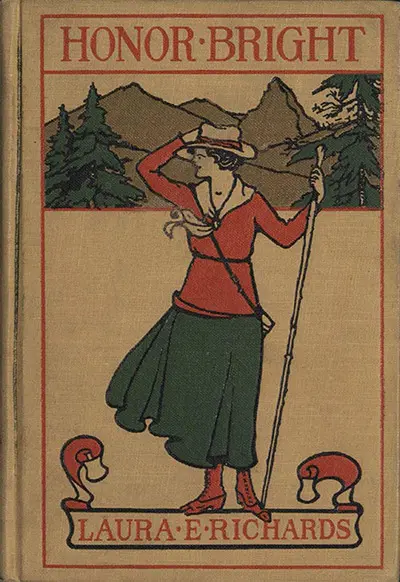
THE CLASSIC COLLECTION · 1920
"Honor Bright: A Story for Girls" by Laura Elizabeth Howe Richards is a novel written in the early 20th century. This tale centers on the life of a young girl named Honor Bright, who faces the devastating loss of her parents and finds herself navigating her new life at a school in Switzerland, the Pension Madeleine. As she learns to cope with her feelings of loss and longing for her childhood, the narrative promises to explore her friendships, personal growth, and the unique experiences that come from living in a communal and foreign setting. The opening of the novel introduces us to Honor at age twelve, just after she becomes an orphan. While she mourns the loss of her parents, she is also depicted as a reflective and imaginative child, vividly remembering the few moments she spent with them. The story presents her immediate environment in the schoolhouse, populated with a varied cast of characters, including both friends and authority figures who influence her life. The tone suggests a blend of melancholy and hope, hinting at the difficulties Honor will face as she matures and learns to embrace her identity amid the challenges of adolescence and grief.
Introduction adapted from the source catalogue; source summaries may be automatically generated.
Free to read · English · 52,608 words · No account needed
MAKE TIME FOR A GOOD BOOK
On by default. Untick to stop anonymous reading totals. Each page counts after 10 seconds in view. How this works.
Anonymous counting is on unless you have switched it off.
“I will not repeat it, Mrs. Damian,” replied Miss Folly, who had not
opened her lips.
“See that you don’t! Look! They are going to start. Folly, I--I hope
the child will win!”
“I hope she will. It is between her and the Desmond girl, certainly.”
“Trip up the Desmond girl! Throw a stone in front of her, can’t you? You have no invention, Folly. My Indian Amma would have had a snake up her sleeve, at the very least. Western civilization--so-called--is abhorrent to me, do you hear? There they go!”
The girls were ranged at the head of the broad allée; five of them: Patricia, Honor, Stephanie, Vivette, and Desirée de Laval, who, though only thirteen, was tall and long-legged. A pretty sight they were, in their white tunics and sandals. A silver whistle sounded a single clear note; they stood at attention, tense as a strung bow, waiting for the start; a second note, and with a flutter of white garments, a shimmer of bright hair, they were off.
The allée was one hundred yards long; the course was twice the length of it. For the first fifty yards the girls kept well together; after that, practice, weight, and form began to tell. Vivette had no chance from the first, and knew it; she “went in” for every prize as a matter of principle and policy, and pounded along doggedly, bent on doing her best, whatever might be the result. Stephanie made a dash for the lead, but not attaining it, soon lost courage.
Oliver Wendell Holmes, usually the kindliest of writers, has shot one
barbed arrow at my sex.
“The cow began to run,” he says, “as only cows and--it would not be safe to say it--can run.”
I wish the dear Doctor could have seen Honor and Patricia run. Vivette was cow-like, if you will; Stephanie was swift, but jerky, and with “not one particle of style!” as Helena Desmond murmured to herself. As they came down the allée on the first lap, these two were already dropping behind. Desirée, who was to make in time a notable runner, had not yet found herself, and was leaping like a colt, arms and legs flying like the sails of a windmill.
“But the other two,” said Imperia; “my word, they can run!”
Heads high, arms held close at the side, every muscle in play, yet in perfect control--Patricia and Honor sped down the course, side by side, light as thistle-down, swift as flying arrows, a lovely sight. So Atalanta herself ran, with
“... feet
That make the blown foam neither swift nor white
Though the wind winnow and whirl it.”
Your reading position is saved on this browser. Take it to another device with a library code. Reading pages adapt to text, rather than matching a printed edition.
Laura Elizabeth Howe Richards
Laura Elizabeth Howe Richards
Laura Elizabeth Howe Richards
Laura Elizabeth Howe Richards
BEHIND THE BOOK
This eBook is for the use of anyone anywhere in the United States and most other parts of the world at no cost and with almost no restrictions whatsoever. You may copy it, give it away or re-use it under the terms of the Project Gutenberg License included with this eBook or online at www.gutenberg.org. If you are not located in the United States, you will have to check the laws of the country where you are located before using this eBook. Read the source licence.
The original source file, including credits and licence, is retained by this library. Request an original-format copy at no charge. Please include the book title and Project Gutenberg identifier #52579.
KEEP YOUR CURIOSITY GOING
Coulson Kernahan

Maurice Baring
Frances Wright
Cécile Tormay

Frederic Jesup Stimson

W. H. P. (William Henry Pope) Jarvis