THE CLASSIC COLLECTION✦An outlaw’s diary: the CommuneCLASSIC FREE BOOKS
An outlaw’s diary: the Commune
Cécile Tormay
THE CLASSIC COLLECTION · 1893
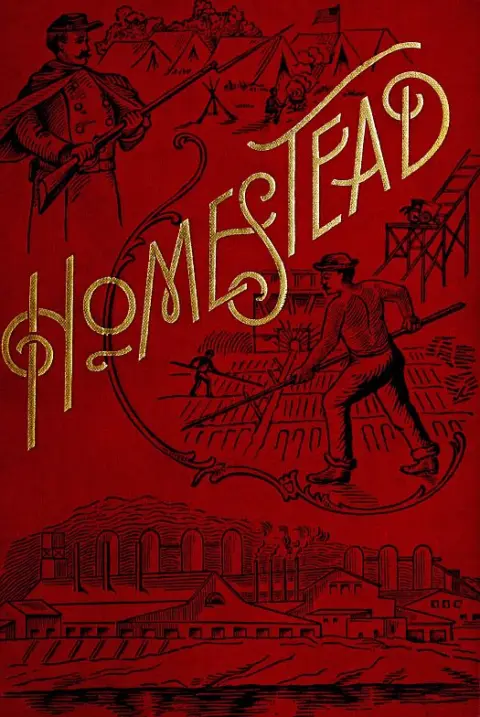
"Homestead" by Arthur Gordon Burgoyne is a historical account written in the late 19th century. The book chronicles the pivotal 1892 conflict between the Carnegie Steel Company and the Amalgamated Association of Iron and Steel Workers, capturing a significant moment in American labor history. The narrative focuses on the experiences of the steelworkers, especially the struggle they faced against the formidable power of industrial capital represented by figures like Andrew Carnegie and Henry Clay Frick." "The opening of "Homestead" sets the stage for the intense labor struggle that unfolds, detailing the background of Homestead, a town built around the Carnegie Steel mill. It introduces key figures like Andrew Carnegie and Henry Clay Frick, outlining their roles in both industry and labor relations. Burgoyne emphasizes the expectations of the workers as they prepare for a negotiation over wage scales, unaware of the impending conflict and the aggressive tactics that Frick intends to employ against them. The narrative captures a moment steeped in tension, highlighting the precarious situation of the laborers as they confront looming threats to their livelihoods and dignity."
Introduction adapted from the source catalogue; source summaries may be automatically generated.
Free to read · English · 78,242 words · No account needed
MAKE TIME FOR A GOOD BOOK
On by default. Untick to stop anonymous reading totals. Each page counts after 10 seconds in view. How this works.
Anonymous counting is on unless you have switched it off.
ATTORNEY BURLEIGH--We don't attempt to show it.
MR. ERWIN--I don't know what you don't attempt to show.
Attorney Erwin then read the law in definition of riot.
Continuing he said: "There is no proof here that they were assembled as riotors; not the least scintilla of such a gathering. But on the other side I will show a riotous gathering."
MR. BURLEIGH--We object. Your honor has already ruled against such
proceedings.
COURT--Yes.
MR. ERWIN--I know your honor has, and I therefore offer an exception that you will not permit me to speak of it. I will not speak of it. As I understand, Justice is represented blindfolded, with a scale in her hand equally weighing in both pans and with a sword in her hand. It is a sad thing that one of her exponents should----
COURT--Stop that. I won't allow any such line of argument.
MR. ERWIN--I am limited by the court and can't discuss the material necessary to be introduced in this case, but I will say that, through the objections of the district attorney, we have been denied a fair trial for our client.
Attorney Anderson followed Mr. Erwin. After outlining the case in a few
graphic words, he said:
"Mr. Robb has attempted to tell you while he depicted that horrible act of the people on the bank that there was another side to that story. He forgot to tell you that a man from a foreign state raised and leveled his rifle and in spite of earnest pleadings shot a young man down. He forgot to tell you that not a shot was fired from the river bank until that young man lay weltering in his life blood. I will try to show you that the trouble did not come from the men on the shore, but from the men in the barges sent there. I want to see, and so do you, what the commonwealth of Pennsylvania wants to prove. It does not claim, because there is no evidence to prove it, that Jack Clifford fired that shot that killed Connors. Because Clifford was there they want to hold him responsible for an act committed by another party. Before they do it they must prove that he was acting and assisting those men to acts of violence. It matters not what was done after 12 o'clock. It matters not if he threw that dynamite or the can of powder. Because before that you must be convinced that Jack Clifford was there when Connors was shot. You might wonder at that; that it is not a crime to throw burning oil or dynamite, but the prosecution specifies a particular charge against Jack Clifford. They claim that he was on the bank of the river in the forenoon when Connors was killed. How have they proved it. Let us look at the forenoon. They prove it by three detectives and three persons residing around Homestead--but six witnesses; purely identification. Three of these men saw Clifford before that morning. It is well for the jury to consider these men and the prisoner. Men gathered from the slums of the cities of New York, Chicago and Philadelphia; men without employment, men without character, men who can be impeached by their testimony. Suppose a difficulty arose in Chicago and a person came here to employ a body of men to go there and suppress it, what sort of men would go there? Would a lawyer have the cinch? Oh, no. Would the banker leave his duties? Oh, no. Would the business man? Oh, no. But the idlers--the scrub of your city--would be the ones who would go. Then I say to you is this not sufficient to show the character of these people who invaded your state and are attempting to swear away the life of Jack Clifford? Upon whose testimony is this crime to be fixed upon Clifford? By three Pinkertons who, in the excitement of that battle and having never seen him before, swear that they saw him there. How do they prove it? By, as they say, a pink shirt on Clifford. Think of it, looking out in a crowd of 500 people and picking out a man with his coat buttoned up, could they be so collected in their thoughts as to distinguish him by a small portion of a pink shirt visible? I say they never did identify him there. But they did not fix this point of identification until brave Jack Clifford, in spite of the hail of bullets, went down and saved these men's lives. It was then, if at all, this pink shirt identification was fixed in their minds. These brave, true, honest men of your community with as keen perceptions as these Pinkertons, were in that boat, and yet they come on the stand and swear they did not see Clifford there. Captain Coon, who knew Clifford for years and was standing at the gangway watching what was going on, swears that Jack Clifford was not there. Then again, there is the old man Gray, a watchman at that mill, with an eye as keen as any Pinkerton's, who swears that Jack Clifford was not there that morning. Then, I say, is it just in this commonwealth where a man is on trial for his liberty and his life, that the testimony of reputable witnesses of your state is of no more weight than that of the Pinkertons? I know not what effect the testimony of these employees may have upon you; but I do know that the employer has held the lash over his employees and forced them to testify in their interest. I do not know whether it has been done in this case."
Your reading position is saved on this browser. Take it to another device with a library code. Reading pages adapt to text, rather than matching a printed edition.
BEHIND THE BOOK
This eBook is for the use of anyone anywhere in the United States and most other parts of the world at no cost and with almost no restrictions whatsoever. You may copy it, give it away or re-use it under the terms of the Project Gutenberg License included with this eBook or online at www.gutenberg.org. If you are not located in the United States, you will have to check the laws of the country where you are located before using this eBook. Read the source licence.
The original source file, including credits and licence, is retained by this library. Request an original-format copy at no charge. Please include the book title and Project Gutenberg identifier #42589.
KEEP YOUR CURIOSITY GOING
Cécile Tormay

Moritz Busch
John L. Ransom
Frances Wright
Cécile Tormay

Mabel Potter Daggett