THE CLASSIC COLLECTION✦An outlaw’s diary: the CommuneCLASSIC FREE BOOKS
An outlaw’s diary: the Commune
Cécile Tormay
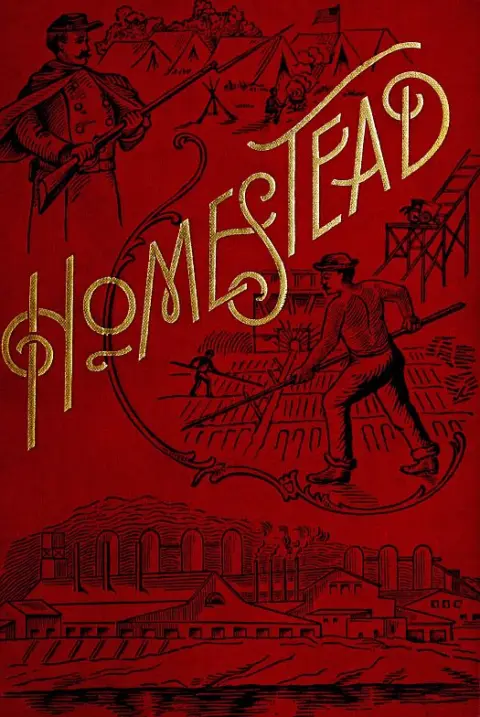
THE CLASSIC COLLECTION · 1893
"Homestead" by Arthur Gordon Burgoyne is a historical account written in the late 19th century. The book chronicles the pivotal 1892 conflict between the Carnegie Steel Company and the Amalgamated Association of Iron and Steel Workers, capturing a significant moment in American labor history. The narrative focuses on the experiences of the steelworkers, especially the struggle they faced against the formidable power of industrial capital represented by figures like Andrew Carnegie and Henry Clay Frick." "The opening of "Homestead" sets the stage for the intense labor struggle that unfolds, detailing the background of Homestead, a town built around the Carnegie Steel mill. It introduces key figures like Andrew Carnegie and Henry Clay Frick, outlining their roles in both industry and labor relations. Burgoyne emphasizes the expectations of the workers as they prepare for a negotiation over wage scales, unaware of the impending conflict and the aggressive tactics that Frick intends to employ against them. The narrative captures a moment steeped in tension, highlighting the precarious situation of the laborers as they confront looming threats to their livelihoods and dignity."
Introduction adapted from the source catalogue; source summaries may be automatically generated.
Free to read · English · 78,242 words · No account needed
MAKE TIME FOR A GOOD BOOK
On by default. Untick to stop anonymous reading totals. Each page counts after 10 seconds in view. How this works.
Anonymous counting is on unless you have switched it off.
Gallagher deposed that late in August, he was approached by Beatty with a proposition to put in the tea and coffee made by him for the Carnegie Company's men, something which would render the men sick and unfit for work; that Beatty took him, in company with J. M. Davidson, to see Hugh F. Dempsey, who was to furnish the preparation to be used; that about the 7th or 8th of September affiant received from Dempsey a bottle containing a yellow powder, which, Dempsey said, contained three doses, each being sufficient for a pot of tea or coffee containing thirty gallons; that affiant used the powder with the result of making workmen sick and unable to work; that additional powders were given him by Dempsey and Beatty and administered by him to the workmen, and that affiant received for his services $3 from Beatty and $25 from Dempsey, with the assurance of $23.85 more from the latter.
Despite the plausibility and coherency of the charges and the prima facie evidence in support of them, the Amalgamated men unanimously set down this new move of the company as a scheme devised in order to prejudice their cause. It was urged, in particular, that the relations between the Association and the K. of L. were not such as to render it probable that Dempsey would jeopardize his liberty and perhaps his life by engaging in a villainous plot in the interest of the former. Dempsey himself stoutly denied the charges, and his denial was supported by Beatty.
At the hearing before Alderman McMasters, Beatty was defended by William J. Brennen, Esq. Captain Breck appeared for the prosecution. J. M. Davidson was the first witness examined. A summary of his testimony is appended:
"I am 50 years of age, reside in the Seventeenth ward, Pittsburgh, and have been a river cook nearly all my life. I have known Beatty two or three years. In the latter part of August, Patrick Gallagher and I met Beatty on Wood street, and Beatty recognized me as "Jimmy" Davidson. I have known Gallagher for fifteen years. It was understood that we were all to go to Homestead as cooks and that we were to take something with us to put in the food given the non-union men in order to make them sick and unfit for work. When we met Beatty he took us to the office of the K. of L., on Third Avenue. There we met Hugh Dempsey, who, I understand, is master workman for this district. I am not a member of the K. of L. While we were in the office, Gallagher and Dempsey did most of the talking. Beatty suggested that it would be well for us to dose the men at Homestead with croton oil. He said croton oil could be used safely; that we could carry bottles of it in our pockets and when we were at work in the cook-houses we could put it on our fingers and rub it on the inside of the soup bowls and coffee cups. I objected to the use of croton oil on the ground that it was a deadly drug, and I did not want to run the risk of killing any one. Dempsey said he could furnish us with powders that would do the work effectively and safely; that the powders had been used on non-union men in Chicago, and that by their use a strike had been broken in four days. He said that while it would make the men sick, it was not dangerous. Dempsey said that if we would go to Homestead and administer these powders he would guarantee us $50 each and our expenses. We did not get any powders from Dempsey that day. Gallagher, Beatty and myself then left Dempsey's office. We took a walk about town discussing our plans and the contract we had undertaken. Beatty told us that if we did the work well there would be a gold watch and chain in it for each of us in addition to the money we were to receive. I did not go to Homestead until September 30. Gallagher, who had been there for some time, left the day before I arrived. Two days later he returned and worked about the restaurant in the mill. Before Gallagher went to Homestead the first time we called on Mr. Dempsey. He gave us a small jar of some kind of powder. He said there was enough of the stuff in the jar for three powders, each one sufficient to 'fix' thirty gallons of tea or coffee. I suppose there was nine or ten teaspoonsful of the stuff in the bottle. Dempsey told Gallagher to divide it into three equal parts. This Gallagher took with him to Homestead. The day before I went to Homestead Beatty gave me some powders to deliver to Gallagher. This was in Dempsey's office, or K. of L. hall. I met Gallagher on the street and gave him the package. He opened it and told me there were nine powders in the package. The bottle containing some of the stuff was given to Gallagher by Dempsey in my presence. This was in K. of L. hall and Beatty was present. Gallagher was to use his own discretion whether he put it in the tea or coffee. I next saw Beatty about September 30.
Your reading position is saved on this browser. Take it to another device with a library code. Reading pages adapt to text, rather than matching a printed edition.
BEHIND THE BOOK
This eBook is for the use of anyone anywhere in the United States and most other parts of the world at no cost and with almost no restrictions whatsoever. You may copy it, give it away or re-use it under the terms of the Project Gutenberg License included with this eBook or online at www.gutenberg.org. If you are not located in the United States, you will have to check the laws of the country where you are located before using this eBook. Read the source licence.
The original source file, including credits and licence, is retained by this library. Request an original-format copy at no charge. Please include the book title and Project Gutenberg identifier #42589.
KEEP YOUR CURIOSITY GOING
Cécile Tormay

Moritz Busch
John L. Ransom
Frances Wright
Cécile Tormay

Mabel Potter Daggett