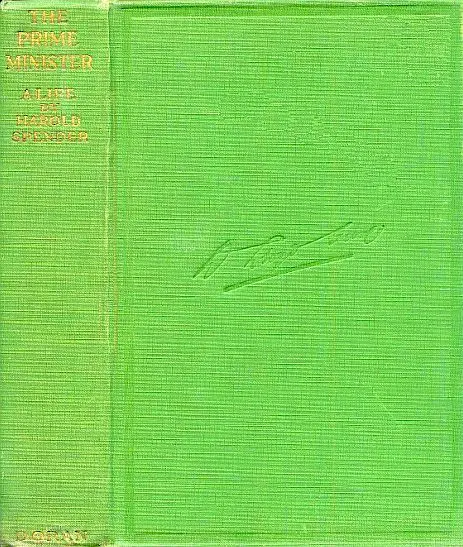
The Prime Minister
Harold Spender
THE CLASSIC COLLECTION · 1912
"Home Rule" by Harold Spender is a political account written in the early 20th century. The book addresses the contentious issue of Irish self-governance, focusing on the Home Rule Bills, particularly one proposed in 1912. It discusses the historical context leading to the need for an Irish Parliament and examines the arguments for and against the notion of granting Ireland its own legislative authority, highlighting the interplay of race, religion, and politics. The opening of the book sets the scene by referencing the various Home Rule Bills introduced over the years, specifically Mr. Gladstone's initiatives and their historical significance. It outlines the enduring challenges faced by Ireland, emphasizing the physical and cultural divides shaped by the sea, differing races, and religious beliefs. Harold Spender introduces the key arguments for Home Rule — that it would help heal the growing disaffection in Ireland, streamline the workloads of the British Parliament, and allow for self-governance in a nation that has long yearned for autonomy. The tone suggests an urgency and necessity for change, setting the stage for a deeper exploration of the complexities surrounding the Home Rule question.
Introduction adapted from the source catalogue; source summaries may be automatically generated.
Free to read · English · 48,705 words · No account needed
MAKE TIME FOR A GOOD BOOK
On by default. Untick to stop anonymous reading totals. Each page counts after 10 seconds in view. How this works.
Anonymous counting is on unless you have switched it off.
The second--Clause 42--provides that Irish laws shall be interpreted always in legal subordination to Acts of the Imperial Parliament:--
"(2) Where any Act of the Irish Parliament deals with any matter with respect to which the Irish Parliament have power to make laws which is dealt with by any Act of the Parliament of the United Kingdom passed after the passing of this Act and extending to Ireland, the Act of the Irish Parliament shall be read subject to the Act of the Parliament of the United Kingdom, and so far as it is repugnant to that Act, but no further, shall be void."
------+--------------+-----------+-----------+------------------------ Year. | Population. | Decrease. | Decrease | Great Britain. | | | per cent. | Increase per cent. | | | +-----------+------------ | | | | England. | Scotland. ------+--------------+-----------+-----------+-----------+------------ 1841 | 8,196,597 | -- | -- | -- | -- 1851 | 6,574,278 | 1,622,319 | 19.8 | 12.65 | 10.2 1861 | 5,798,967 | 775,311 | 11.8 | 11.9 | 6.0 1871 | 5,412,377 | 386,590 | 6.7 | 13.21 | 9.7 1881 | 5,174,836 | 237,541 | 4.4 | 14.36 | 11.2 1891 | 4,704,750 | 470,086 | 9.1 | 11.65 | 7.8 1901 | 4,458,775 | 245,975 | 5.2 | 12.17 | 11.1 1911 | 4,381,951 | 76,824 | 1.7 | 10.9 | 6.4 ------+--------------+-----------+-----------+-----------+------------
N.B.--This Table is compiled from the Preliminary Reports of the Census of 1911, which give the population returns only as far back as 1841. There was, of course, a Census of the United Kingdom as early as 1801, but the official returns extended at first only to England and Scotland, and it was not until 1813 that there was any official census of Ireland. Even then it was far from correct. The first trustworthy Irish Census was that of 1821. For 1821 and 1831 the Census figures are given in "Whitaker" as follows:--
It is probable that the apparent rise of the population from 1821 to 1841 amounts to little more than the more correct taking of the Census among an illiterate population. But on the whole subject of the rise of population between 1821 and 1841, see my remarks in Chapter VIII. p. 105. It was due of course very largely to the creation of faggot votes by Protestant landlords desirous of being returned to Parliament under the old law before the passing of Catholic Emancipation in 1829. It was an artificial rise in the poorest section of the population going along with a steady decline in the general material prosperity of Ireland. Hence the great collapse of the famine period.
(From Preliminary Census Report, 1911.)
----------------+----------------------------------------
Year. | Number of Families.
----------------+----------------------------------------
1841 | 1,472,787
1851 | 1,204,319
1861 | 1,128,300
1871 | 1,067,598
1881 | 995,074
1891 | 932,113
1901 | 910,256
1911 | 912,711 First Increase since 1841.
----------------+----------------------------------------
(From same source.)
----------------+----------------------------------------
Year. | Number of Inhabited Houses.
----------------+----------------------------------------
1841 | 1,328,839
1851 | 1,046,223
1861 | 995,156
1871 | 961,380
1881 | 914,108
1891 | 870,578
1901 | 858,158
1911 | 861,057 First Increase since 1841.
----------------+----------------------------------------
For Decennial Periods, 1852-1910.
----------+----------------------+-------------------
Period. | Average Number of | Per 1,000 of
| Emigrants, per year. | Population.
----------+----------------------+-------------------
1852-9 | 115,842 | 15.2
1860-9 | 85,960 | 15.2
1870-9 | 60,327 | 11.2
1880-9 | 80,491 | 16.0
1890-9 | 44,955 | 9.7
1900-9 | 35,886 | 8.1
1910 | 32,457 | 7.4
1911 | 31,058 | 7.
----------+----------------------+-------------------
An Act for the Union of Great Britain and Ireland.--[2d July 1800.]
Your reading position is saved on this browser. Take it to another device with a library code. Reading pages adapt to text, rather than matching a printed edition.
Harold Spender
BEHIND THE BOOK
This eBook is for the use of anyone anywhere in the United States and most other parts of the world at no cost and with almost no restrictions whatsoever. You may copy it, give it away or re-use it under the terms of the Project Gutenberg License included with this eBook or online at www.gutenberg.org. If you are not located in the United States, you will have to check the laws of the country where you are located before using this eBook. Read the source licence.
The original source file, including credits and licence, is retained by this library. Request an original-format copy at no charge. Please include the book title and Project Gutenberg identifier #20016.
KEEP YOUR CURIOSITY GOING
Cécile Tormay

Moritz Busch
John L. Ransom
Frances Wright
Cécile Tormay

Mabel Potter Daggett