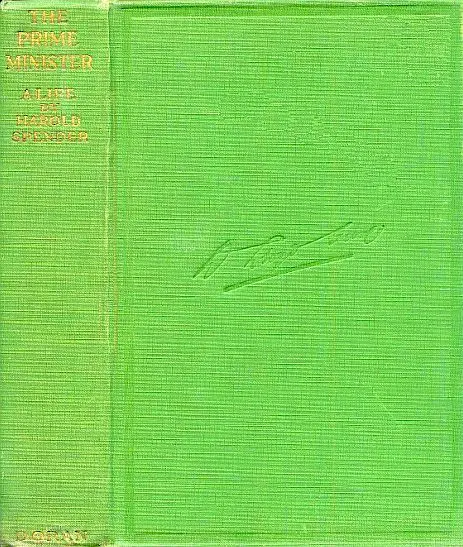
The Prime Minister
Harold Spender
THE CLASSIC COLLECTION · 1912
"Home Rule" by Harold Spender is a political account written in the early 20th century. The book addresses the contentious issue of Irish self-governance, focusing on the Home Rule Bills, particularly one proposed in 1912. It discusses the historical context leading to the need for an Irish Parliament and examines the arguments for and against the notion of granting Ireland its own legislative authority, highlighting the interplay of race, religion, and politics. The opening of the book sets the scene by referencing the various Home Rule Bills introduced over the years, specifically Mr. Gladstone's initiatives and their historical significance. It outlines the enduring challenges faced by Ireland, emphasizing the physical and cultural divides shaped by the sea, differing races, and religious beliefs. Harold Spender introduces the key arguments for Home Rule — that it would help heal the growing disaffection in Ireland, streamline the workloads of the British Parliament, and allow for self-governance in a nation that has long yearned for autonomy. The tone suggests an urgency and necessity for change, setting the stage for a deeper exploration of the complexities surrounding the Home Rule question.
Introduction adapted from the source catalogue; source summaries may be automatically generated.
Free to read · English · 48,705 words · No account needed
MAKE TIME FOR A GOOD BOOK
On by default. Untick to stop anonymous reading totals. Each page counts after 10 seconds in view. How this works.
Anonymous counting is on unless you have switched it off.
13. Unless and until the Parliament of the United Kingdom otherwise determine, the following provisions shall have effect:--
(1) After the appointed day the number of members returned by constituencies in Ireland to serve in the Parliament of the United Kingdom shall be forty-two and the constituencies returning those members shall (in lieu of the existing constituencies) be the constituencies named in the second Part of the First Schedule to this Act, and no University in Ireland shall return a member to the Parliament of the United Kingdom.
(2) The election laws and the laws relating to the qualification of parliamentary electors shall not, so far as they relate to elections of members returned by constituencies in Ireland to serve in the Parliament of the United Kingdom, be altered by the Irish Parliament, but this enactment shall not prevent the Irish Parliament from dealing with any officers concerned with the issue of writs of election, and if any officers are so dealt with, it shall be lawful for His Majesty by Order in Council to arrange for the issue of any such writs, and the writs issued in pursuance of the Order shall be of the same effect as if issued in manner heretofore accustomed.
So far for the constitutional clauses. The clauses from 14 to 26 are occupied with finance. They are so technical that it will be more convenient to substitute the terms of the very clear Memorandum issued by the Government:--
Present Irish Revenue and Expenditure.
It is estimated that the revenue to be derived from Ireland in the year 1912-13 will be as follows:--
L Customs 3,230,000 Excise 3,320,000 Income tax 1,512,000 Estate duties 939,000 Stamps 347,000 Miscellaneous 137,000 Post Office 1,354,000 ----------- Total 10,839,000 -----------
It is estimated that the expenditure for Irish purposes in the year 1912-13 will amount to L12,354,000. The expenditure may be divided for the purposes of this Memorandum as follows:--
L All purposes not separately specified 5,462,000 Post Office 1,600,000 Old Age Pensions 2,664,000 Charges under the Land Purchase Acts 761,000 National Insurance and Labour Exchanges 191,500 Royal Irish Constabulary 1,377,500 Collection of revenue 298,000 ---------- Total 12,354,000 ----------
The expenditure therefore exceeds the revenue by L1,515,000.
It is anticipated that in a period of ten or fifteen years the charges under the existing Land Purchase Acts will increase by L450,000, and under the National Insurance Act by L300,000. On the other hand, it is estimated that within twenty years the cost of Old Age Pensions will decrease by L200,000.
Charges upon the Irish Exchequer.
The Bill provides for the establishment of an Irish Exchequer and an
Irish Consolidated Fund.
Your reading position is saved on this browser. Take it to another device with a library code. Reading pages adapt to text, rather than matching a printed edition.
Harold Spender
BEHIND THE BOOK
This eBook is for the use of anyone anywhere in the United States and most other parts of the world at no cost and with almost no restrictions whatsoever. You may copy it, give it away or re-use it under the terms of the Project Gutenberg License included with this eBook or online at www.gutenberg.org. If you are not located in the United States, you will have to check the laws of the country where you are located before using this eBook. Read the source licence.
The original source file, including credits and licence, is retained by this library. Request an original-format copy at no charge. Please include the book title and Project Gutenberg identifier #20016.
KEEP YOUR CURIOSITY GOING
Cécile Tormay

Moritz Busch
John L. Ransom
Frances Wright
Cécile Tormay

Mabel Potter Daggett