
The lost dirigible
Ralph Henry Barbour
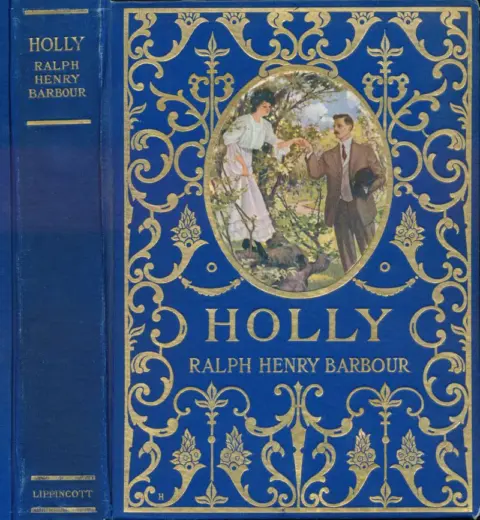
THE CLASSIC COLLECTION · 1907
"Holly: The Romance of a Southern Girl" by Ralph Henry Barbour is a novel written in the early 20th century. It centers around Holly Wayne, an 18-year-old girl living in the South, who faces the transition from childhood to adulthood just as her mundane world is disrupted by the arrival of new circumstances and a stranger. The story unfolds in a rich Southern setting filled with descriptions of nature and family dynamics, capturing Holly's complex emotions as she navigates loss, affection, and societal expectations. The opening of the book introduces us to Holly, who is grappling with the loss of her father while living with her Aunt India at Waynewood, their family estate. As the narrative progresses, we learn that Holly is about to undergo significant changes in her life—her sheltered existence is primed for disruption. The arrival of Robert Winthrop, the new owner of Waynewood, brings both mystery and excitement. Holly's initial responses intertwine curiosity and caution, setting the stage for deepening relationships and the possibilities of romance. Through stylish prose, the author hints at Holly’s youthful innocence and her evolving understanding of love and life against a backdrop of Southern culture and charm.
Introduction adapted from the source catalogue; source summaries may be automatically generated.
Free to read · English · 45,478 words · No account needed
MAKE TIME FOR A GOOD BOOK
On by default. Untick to stop anonymous reading totals. Each page counts after 10 seconds in view. How this works.
Anonymous counting is on unless you have switched it off.
“Pray don’t,” begged Winthrop. “He doubtless already dislikes me quite heartily enough.”
“He has no right to be rude to you.”
Winthrop smiled ruefully.
“But he isn’t; that’s the worst of it! He’s scrupulously polite――just as one would be polite to the butler or the man from the butcher’s! No, don’t call him to account, please; we shall get on well enough, he and I. Maybe when he discovers that I am not really trying to steal you away from him he will come off his high horse. I suppose, however, that the real reason for it all is that he resents my intrusion at Waynewood――quite in the popular manner.”
He regretted the latter remark the instant he had made it, for Holly turned a distressed countenance toward him.
“Oh, have we been as bad as all that?” she cried, softly. “I’m so sorry! But really and really you mustn’t think that we don’t like you to be at Waynewood! You won’t, will you? Please don’t! Why, I――I have been so happy since you came!”
“Bless you,” answered Winthrop, lightly, “I really meant nothing. And if you are willing to put up with me, why, the others don’t matter at all. But I’m awfully glad to know that you haven’t found me a bother, Miss Holly.”
“How could I? You’ve been so nice and――and chummy! I shan’t want you to go away,” she added, sorrowfully. “I feel just as though you were a nice, big elder brother.”
“That’s just what I am,” replied Winthrop, heartily, “a big elder brother――and a slave――and always an admirer.”
“And I shall tell Julian so,” added Holly.
“I wouldn’t, really.”
“But why?”
“Oh, well, you’ll just make him more jealous and unhappy, my dear. Or, at least, that’s the effect it would have on me were I in his place, and I fancy lovers are much the same North and South.”
“Jealousy is nasty,” said Holly, sententiously.
“Many of our most human sentiments are,” responded Winthrop dryly, “but we can’t help them.”
Holly was silent a moment. Then――――
“Would you mind not calling me ‘my dear’?” she asked.
“Have I done that? I believe I have. I beg your pardon, Miss Holly! Really, I had no intention of being――what shall I say?――familiar.”
“Oh, it isn’t that,” replied Holly earnestly, “but it makes me feel so terribly young! If you’d like to call me Holly, you may.”
Your reading position is saved on this browser. Take it to another device with a library code. Reading pages adapt to text, rather than matching a printed edition.
Ralph Henry Barbour
Ralph Henry Barbour

Ralph Henry Barbour

Ralph Henry Barbour
BEHIND THE BOOK
This eBook is for the use of anyone anywhere in the United States and most other parts of the world at no cost and with almost no restrictions whatsoever. You may copy it, give it away or re-use it under the terms of the Project Gutenberg License included with this eBook or online at www.gutenberg.org. If you are not located in the United States, you will have to check the laws of the country where you are located before using this eBook. Read the source licence.
The original source file, including credits and licence, is retained by this library. Request an original-format copy at no charge. Please include the book title and Project Gutenberg identifier #69920.
KEEP YOUR CURIOSITY GOING
Coulson Kernahan

Maurice Baring
Frances Wright
Cécile Tormay

Frederic Jesup Stimson

W. H. P. (William Henry Pope) Jarvis