
The lost dirigible
Ralph Henry Barbour
THE CLASSIC COLLECTION · 1907
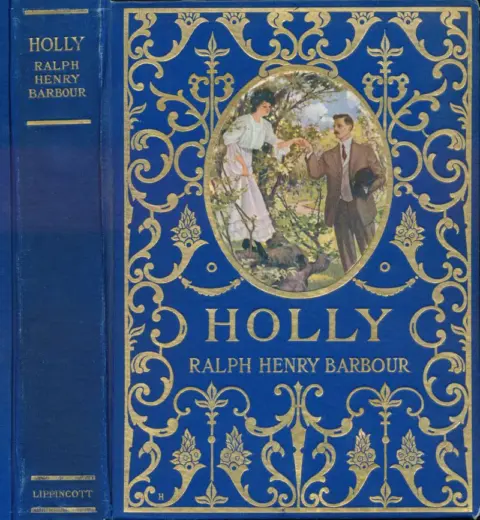
"Holly: The Romance of a Southern Girl" by Ralph Henry Barbour is a novel written in the early 20th century. It centers around Holly Wayne, an 18-year-old girl living in the South, who faces the transition from childhood to adulthood just as her mundane world is disrupted by the arrival of new circumstances and a stranger. The story unfolds in a rich Southern setting filled with descriptions of nature and family dynamics, capturing Holly's complex emotions as she navigates loss, affection, and societal expectations. The opening of the book introduces us to Holly, who is grappling with the loss of her father while living with her Aunt India at Waynewood, their family estate. As the narrative progresses, we learn that Holly is about to undergo significant changes in her life—her sheltered existence is primed for disruption. The arrival of Robert Winthrop, the new owner of Waynewood, brings both mystery and excitement. Holly's initial responses intertwine curiosity and caution, setting the stage for deepening relationships and the possibilities of romance. Through stylish prose, the author hints at Holly’s youthful innocence and her evolving understanding of love and life against a backdrop of Southern culture and charm.
Introduction adapted from the source catalogue; source summaries may be automatically generated.
Free to read · English · 45,478 words · No account needed
MAKE TIME FOR A GOOD BOOK
On by default. Untick to stop anonymous reading totals. Each page counts after 10 seconds in view. How this works.
Anonymous counting is on unless you have switched it off.
“Punishment,” answered Holly, gravely, the chastised hand held against her lips. “You see there are three words that Auntie doesn’t like me to use, and when I do use them I rap my knuckles.”
“Oh,” smiled Winthrop, “and does it help?”
“I don’t reckon it’s helped much yet,” said Holly, “but maybe it will. It sure does hurt, though.”
“And may I ask what the words are?”
“One is ‘Fiddle.’ Does that sound very bad to you?”
“N-no, I think not. What does it signify, please?”
“Oh, you just say ‘Fiddle’ when――when something happens you don’t like.”
“I see; ‘Fiddle;’ yes, quite expressive. And the others?”
“‘Shucks’ is one of them.”
“Used, I fancy, in much the same sense as ‘Fiddle’?”
Holly nodded.
“Only――only not so much so,” she added.
“Certainly not,” replied Winthrop. “I understand. For instance, if you fell down stairs you’d say ‘Fiddle!’ but if you merely bumped your head you’d say ‘Shucks!’”
“Yes,” laughed Holly.
“And the third prohibited word?” asked Winthrop.
“That’s――that’s――――” Holly bent her head very meekly over her plate――“that’s ‘Darnation!’”
“Expressive, at least,” laughed Winthrop. “That is reserved, I suppose, for such extraordinary occasions as when you fall from a sixth-story window?”
“No; I say that when I stick a needle into my finger,” answered Holly. “It seems to suit better than ‘Fiddle’ or ‘Shucks;’ don’t you think so, Mr. Winthrop?”
“Well, I don’t remember ever having stuck a needle into my finger, but I’ll try it some time and give you my candid opinion on the question.”
After breakfast Winthrop wandered out into the garden and from thence into the grove beyond. There were pines and cedars here, and oaks, and other trees which he didn’t know the names of. The gray-green Spanish moss draped an occasional limb, and at times there was some underbrush. Finding the drive, he followed it toward the gate, but before reaching the latter he struck off again through a clearing and climbed a little knoll on the summit of which a small brick-walled enclosure guarded by three huge oaks attracted his attention and aroused his curiosity. But he didn’t open the little iron gate when he reached it. Within the square enclosure were three graves, two close together near at hand, one somewhat removed. From where he leaned across the crumbling wall Winthrop could read the inscriptions on the three simple headstones. The farther grave was that of “John Wayne, born Fairfield, Kentucky, Feb. 1, 1835; fell at Malvern Hill, July 1, 1862; interred in this spot July 28, 1862.”
Your reading position is saved on this browser. Take it to another device with a library code. Reading pages adapt to text, rather than matching a printed edition.
Ralph Henry Barbour
Ralph Henry Barbour

Ralph Henry Barbour

Ralph Henry Barbour
BEHIND THE BOOK
This eBook is for the use of anyone anywhere in the United States and most other parts of the world at no cost and with almost no restrictions whatsoever. You may copy it, give it away or re-use it under the terms of the Project Gutenberg License included with this eBook or online at www.gutenberg.org. If you are not located in the United States, you will have to check the laws of the country where you are located before using this eBook. Read the source licence.
The original source file, including credits and licence, is retained by this library. Request an original-format copy at no charge. Please include the book title and Project Gutenberg identifier #69920.
KEEP YOUR CURIOSITY GOING
Coulson Kernahan

Maurice Baring
Frances Wright
Cécile Tormay

Frederic Jesup Stimson

W. H. P. (William Henry Pope) Jarvis