
The lost dirigible
Ralph Henry Barbour
THE CLASSIC COLLECTION · 1907
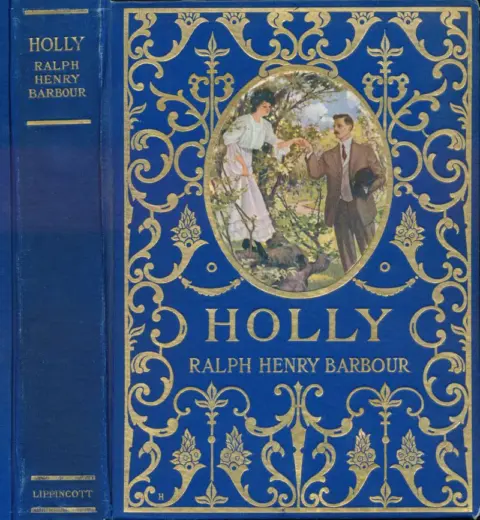
"Holly: The Romance of a Southern Girl" by Ralph Henry Barbour is a novel written in the early 20th century. It centers around Holly Wayne, an 18-year-old girl living in the South, who faces the transition from childhood to adulthood just as her mundane world is disrupted by the arrival of new circumstances and a stranger. The story unfolds in a rich Southern setting filled with descriptions of nature and family dynamics, capturing Holly's complex emotions as she navigates loss, affection, and societal expectations. The opening of the book introduces us to Holly, who is grappling with the loss of her father while living with her Aunt India at Waynewood, their family estate. As the narrative progresses, we learn that Holly is about to undergo significant changes in her life—her sheltered existence is primed for disruption. The arrival of Robert Winthrop, the new owner of Waynewood, brings both mystery and excitement. Holly's initial responses intertwine curiosity and caution, setting the stage for deepening relationships and the possibilities of romance. Through stylish prose, the author hints at Holly’s youthful innocence and her evolving understanding of love and life against a backdrop of Southern culture and charm.
Introduction adapted from the source catalogue; source summaries may be automatically generated.
Free to read · English · 45,478 words · No account needed
MAKE TIME FOR A GOOD BOOK
On by default. Untick to stop anonymous reading totals. Each page counts after 10 seconds in view. How this works.
Anonymous counting is on unless you have switched it off.
“I don’t reckon he’s as much of an invalid as all that.”
“Oh, I wasn’t thinking about his health then,” answered Holly. “I’d be afraid he’d meet someone he liked better than me and I wouldn’t see him again.”
“Holly, where do you get such deplorable notions?” asked her Aunt severely. “It must be the books you read. You read altogether too much. At your age, my dear, I assure you I――――”
“I shall be eighteen in just twelve days,” interrupted Holly. “And eighteen is grown-up. Besides, you know very well that wives do lose their husbands sometimes. There was Cousin Maybird Fairleigh――――”
“I decline to discuss such vulgar subjects,” said Miss India, decisively. “Under the circumstances I think it just as well to forget the relationship, which is of the very slightest, my dear.”
“But it wasn’t Cousin Maybird’s fault,” protested Holly. “She didn’t want to lose him, Aunt India. He was a very nice husband; very handsome and distinguished, you know. It was all the fault of that other woman, the one he married after the divorce.”
“Holly!”
“Yes?”
“We will drop the subject, if you please.”
“Yes, Auntie.”
Holly smiled at her plate. Presently:
“When is this Mr. Winthrop coming?” she asked.
“He didn’t announce the exact date of arrival,” replied Miss India. “But probably within a day or two. I have ordered Phœbe to prepare the West Chamber for him. He will, of course, require a warm room and a good bed.”
“But, Auntie, the carpet is so awful in the West Room,” deplored Holly.
“That is his affair,” replied Aunt India, serenely, as she arose from the table. “It is his carpet.”
Holly looked surprised, then startled.
“Do you mean that everything here belongs to him?” she asked, incredulously. “The furniture and pictures and books and――and everything?”
“Waynewood was sold just as it stood at the time, my dear. Everything except what is our personal property belongs to Mr. Winthrop.”
“Then I shall hate him,” said Holly, with calm decision.
“You must do nothing of the sort, my dear. The place and the furnishings belong to him legally.”
“I don’t care, Auntie. He has no right to them. I shall hate him. Why, he owns the very bed I sleep in and my maple bureau and――――”
“You forget, Holly, that those things were bought after your father died and do not belong to his estate.”
“Then they’re really mine, after all? Very well, Auntie dear, I shan’t hate him, then; at least, not so much.”
Your reading position is saved on this browser. Take it to another device with a library code. Reading pages adapt to text, rather than matching a printed edition.
Ralph Henry Barbour
Ralph Henry Barbour

Ralph Henry Barbour

Ralph Henry Barbour
BEHIND THE BOOK
This eBook is for the use of anyone anywhere in the United States and most other parts of the world at no cost and with almost no restrictions whatsoever. You may copy it, give it away or re-use it under the terms of the Project Gutenberg License included with this eBook or online at www.gutenberg.org. If you are not located in the United States, you will have to check the laws of the country where you are located before using this eBook. Read the source licence.
The original source file, including credits and licence, is retained by this library. Request an original-format copy at no charge. Please include the book title and Project Gutenberg identifier #69920.
KEEP YOUR CURIOSITY GOING
Coulson Kernahan

Maurice Baring
Frances Wright
Cécile Tormay

Frederic Jesup Stimson

W. H. P. (William Henry Pope) Jarvis