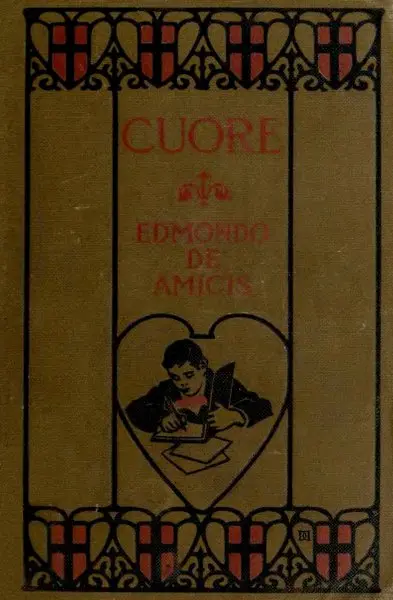
Cuore (Heart): An Italian Schoolboy’s Journal
Edmondo De Amicis

THE CLASSIC COLLECTION · 1894
"Holland, v. 1 (of 2)" by Edmondo De Amicis is a travel narrative written in the late 19th century. The book explores the unique geography and rich history of the Netherlands, with an emphasis on the Dutch people's remarkable relationship with their environment and the persistent struggle against the sea. De Amicis illustrates how the Dutch transformed a landscape marked by water and marsh into fertile land, revealing both the physical and cultural intricacies of the nation. The opening of the work introduces readers to the paradox of Holland's geography, where land and water coexist intricately. It captures the author's awe at the Dutch landscape, with its numerous rivers, lakes, and marshes, and discusses the historical context in which the Dutch fought against nature to claim their territory. De Amicis reflects on the toil of the Dutch people, describing how their ingenuity turned an inhospitable landscape into a thriving agricultural haven, while also hinting at the ongoing challenges posed by the sea. As he prepares to travel through Zealand, the author emphasizes the blend of beauty and mystery that characterizes the journey ahead, setting the stage for a deeper exploration of the region's culture and history.
Introduction adapted from the source catalogue; source summaries may be automatically generated.
Free to read · English · 63,556 words · No account needed
MAKE TIME FOR A GOOD BOOK
On by default. Untick to stop anonymous reading totals. Each page counts after 10 seconds in view. How this works.
Anonymous counting is on unless you have switched it off.
Shortly after this another plot against the life of the Prince was discovered. A French nobleman, an Italian, and a Walloon, who had followed him for some time with the intention of murdering him, were suspected and arrested. One of them killed himself in prison with a knife, another was strangled in France, and the third escaped, after he had confessed that the movements of all three had been directed by the Duke of Parma.
Meanwhile Philip's agents were overrunning the country instigating rogues to perpetrate this deed with promises of treasures in reward, while priests and monks were instigating fanatics to the same end by the assurance of help and reward from Heaven. Other assassins made the attempt. A Spaniard was discovered, arrested, and quartered at Antwerp; a rich trader called Hans Jansen was put to death at Flushing. Many offered their services to Prince Alexander Farnese and were encouraged by gifts of money. The Prince of Orange, who knew all this, felt a vague presentiment of his approaching death, and spoke of it to his intimate friends, but he refused to take any precautions to protect his life, and replied to all who gave him such counsel, "It is useless: God has numbered my years. Let it be according to His will. If there is any wretch who does not fear death, my life is in his power, however I may guard it."
Eight attempts were made upon his life before an assassin fired the
fatal shot.
When the deed was at last committed, in 1584, four scoundrels, an Englishman, a Scotchman, a Frenchman, and a man of Lorraine, unknown to each other, were all awaiting at Delft their opportunity to assassinate him.
Besides these, there was a young conspirator, twenty-seven years of age, from Franche-Comte, a Catholic, who passed himself off as a Protestant, Guyon by name, the son of a certain Peter Guyon who was executed at Besancon for embracing Calvinism. This Guyon, whose real name was Balthazar Gerard, was believed to be a fugitive from the persecutions of the Catholics. He led an austere life and took part in all the services of the Evangelical Church, and in a short time acquired a reputation for especial piety. Saying that he had come to Delft to beg for the honor of serving the Prince of Orange, he was recommended and introduced by a Protestant clergyman: he inspired the Prince with confidence, and was sent by him to accompany Herr Van Schonewalle, the envoy of the States of Holland to the court of France. In a short time he returned to Delft, bringing to William the tidings of the death of the Duke of Anjou, and presented himself at the convent of St. Agatha, where the Prince was staying with his court. It was the second Sunday in July. William received him in his chamber, being in bed. They were alone. Balthazar Gerard was probably tempted to assassinate him at that moment, but he was unarmed and restrained himself. Disguising his impatience, he quietly answered all the questions he was asked. William gave him some money, told him to prepare to return to Paris, and ordered him to come back the next day to get his letters and passport. With the money he received from the Prince, Gerard bought two pistols from a soldier, who killed himself when he knew to what end they had been used, and the next day, the 10th of July, he again presented himself at the convent of St. Agatha. William, accompanied by several ladies and gentlemen of his family, was descending the staircase to dine in a room on the ground floor. On his arm was the Princess of Orange, his fourth wife, that gentle and unfortunate Louisa de Coligny, who had seen her father, the admiral, and her husband, Seigneur de Teligny, killed at her feet on the eve of St. Bartholomew. Balthazar stepped forward, stopped the Prince, and asked him to sign his passport. The Prince told him to return later, and entered the dining-room. No shade of suspicion had passed through his mind. Louisa de Coligny, however, grown cautious and suspicious by her misfortunes, became anxious. That pale man, wrapped in a long mantle, had a sinister look; his voice sounded unnatural and his face was convulsed. During dinner she confided her suspicions to William, and asked him who that man was "who had the wickedest face she had ever seen." The Prince smiled, told her it was Guyon, reassured her, and was as gay as ever during the dinner. When he had finished he quietly left the room to go up stairs to his apartments. Gerard was waiting for him at a dark turning near the staircase, hidden in the shadow of a door. As soon as he saw the Prince approaching he advanced, and leaped upon him just as he was placing his foot on the second step. He fired his pistol, which was loaded with three bullets, straight at the Prince's breast, and fled. William staggered and fell into the arms of an equerry. All crowded round. "I am wounded," said William in a feeble voice.... "God have mercy on me and on my poor people!" He was all covered with blood. His sister, Catherine of Schwartzburg, asked, "Dost thou commend thy soul to Jesus Christ?" He answered, in a whisper, "I do." It was his last word. They placed him on one of the steps and spoke to him, but he was no longer conscious. They then bore him into a room near by, where he died.
Your reading position is saved on this browser. Take it to another device with a library code. Reading pages adapt to text, rather than matching a printed edition.
Edmondo De Amicis
BEHIND THE BOOK
This eBook is for the use of anyone anywhere in the United States and most other parts of the world at no cost and with almost no restrictions whatsoever. You may copy it, give it away or re-use it under the terms of the Project Gutenberg License included with this eBook or online at www.gutenberg.org. If you are not located in the United States, you will have to check the laws of the country where you are located before using this eBook. Read the source licence.
The original source file, including credits and licence, is retained by this library. Request an original-format copy at no charge. Please include the book title and Project Gutenberg identifier #27799.
KEEP YOUR CURIOSITY GOING
Wilfrid Scawen Blunt
Wilfrid Scawen Blunt

E. W. (Edgar Watson) Howe
Cécile Tormay

Moritz Busch
John L. Ransom