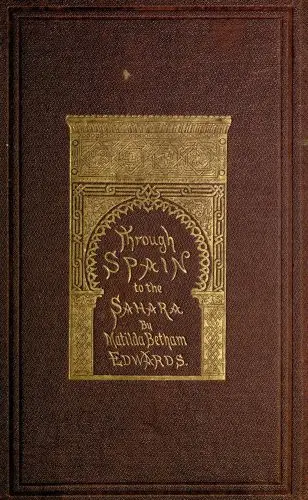
Through Spain to the Sahara
Matilda Betham-Edwards
THE CLASSIC COLLECTION · 1879
"Holidays in Eastern France" by Matilda Betham-Edwards is a travel memoir likely written in the late 19th century. The author recounts her experiences exploring Eastern France, emphasizing visits to less-traveled areas rather than popular tourist spots. Throughout the narrative, she aims to showcase the charm of rural life, the vibrant communities, and the picturesque scenery that defines regions such as the valley of the Marne and the cities of Besançon and Troyes. The opening of the work sets a reflective tone as the author describes her escape from the hectic life of Paris during the summer heat, finding solace in the tranquil countryside. She vividly illustrates the serene landscapes, including lush fields, quaint villages, and the industrious lives of local inhabitants, from peasant farmers to educated citizens. Betham-Edwards navigates through various towns, characterizing the distinct social classes and cultural settings she encounters, while simultaneously critiquing the absence of church attendance and the changing dynamics of rural life. The author emphasizes her interest in not just the places, but the people and their stories, which she finds more compelling than mere tourist attractions.
Introduction adapted from the source catalogue; source summaries may be automatically generated.
Free to read · English · 56,565 words · No account needed
MAKE TIME FOR A GOOD BOOK
On by default. Untick to stop anonymous reading totals. Each page counts after 10 seconds in view. How this works.
Anonymous counting is on unless you have switched it off.
In the Museum is seen a medallion portrait of Courbet, to which my cicerone pointed with an expression, of horror, as that of "the artist who pulled down the Vendôme column."
My next stage was Arbois, a little town travellers should see on account of its charming situation in the winding valley, or "Cluse," of the Cuisance. Nothing can be prettier, or give a greater idea of prosperity, than these rich vine-yards sloping on all sides, the grapes purpling in spite of much bad weather; orchards with their ripening fruit; fields of maize, the seed now bursting the pod, and of buckwheat now in full flower, the delicate pink and white blossom of which is so poetically called by Michelet "la neige d'été." No serenity, no grandeur here, all is verdure, dimples, smiles; abundance of rich foliage and pasture, abundance also of clear limpid water, taking every form, springs, cascades, rivulets, the little river Cuisance winding in and out amid vineyards and pastures over its rocky bed. You must follow this charming babbling river along the narrow valley to its twin sources in tangled glen and rock; the road winding between woods, vine-yards, and fantastic crags. The cluse, a narrow valley, is just paradisiacal, a bit of Eden made up of smooth pastures, rippling water, hanging woods, and golden glens, all this bright afternoon sparkling amid dew and sunshine. At one of these river sources, you see the tufa in course of formation in the river bed; in the other, the reverse process takes place, the tufa there being dissolved. Both sites are poetic and lovely in the extreme. I was sorry to hear of the devastation committed here by the oïdium, or vine blight, and the dreaded phylloxera, which has already ruined thousands, causing a loss of just half the amount of the German war indemnity. This redoubtable foe is not many leagues off! Measures are taken against the phylloxera, as against an invading army, but, at present, no remedy has been discovered; and, meantime, many once rich and happy wine-growers are reduced to beggary. It was heart-breaking to gaze on the sickly appearance of the vines already attacked by the oïdium, and to hear the harrowing accounts of the misery caused by an enemy more redoubtable still. Arbois, though so charming to look at, is far from being a little Eden. It is eminently a Catholic place; atheism and immorality abound; bigotry among the women, scepticism among the men, a looseness in domestic morality among all classes characterize the population, whilst we need no information on the subject of dissipation generally. The numbers of cafés and cabarets speak volumes. There is, of course, in this townling, of not six thousand souls, a theatre, which is greatly resorted to. One old church has been turned into a theatre at Arbois, and another into the Halles, a third into the Hôtel-de-Ville, a desecration we Protestants can but behold with aversion. Protestantism is a young and tender plant as yet in Arbois, the church and school, or so called culte, dating from ten years back only. The congregation consists of about fifty persons, all belonging to the poorer classes, and the position of a pastor there must be a sad one. He is constantly importuned for help, which, out of his slender income, he can ill afford to bestow, and he is surrounded by spies, detractors, and adversaries on every side. That clericalism dominates here, we need not be told. The booksellers' shops are filled with tracts about the miracles of Lourdes, rosaries, and rubrics; the streets swarm with nuns, Jesuits, and Frères Ignorantins. If you ask an intelligent lad of twelve if he can read and write, he shakes his head and says no. The town itself, which might be so attractive if a little attention were paid to hygienic and sanitary matters, is neglected and dirty. The people are talkative and amiable, and are richly endowed by nature, especially in the mathematical faculty. It is said that every peasant in these parts is a born mathematician, and curiously enough the distinguished names of Arbois are those of military engineers and lawyers, notably Generals David, Delort, and Baudrand, and the celebrated jurisconsult Courvoisier. Here, as in other towns of Franche-Comté, traces of the Spanish occupation remain in the street architecture, the arcades and picture-galleries lending character. Arbois, after Salins, is like an April glimpse of sunshine following a black thunder-cloud, so contrasted is the grace of the one with the severity of the other. Tourists never come here, and in these wayside inns the master acts as waiter and porter, the mistress as cook; they give you plenty of good food, for which they hardly like to receive anything at all, talk to you as if you were an old friend during your stay, and, at your departure, are ready to embrace you out of pure cordiality.
Your reading position is saved on this browser. Take it to another device with a library code. Reading pages adapt to text, rather than matching a printed edition.
Matilda Betham-Edwards
Matilda Betham-Edwards
Matilda Betham-Edwards
Matilda Betham-Edwards
BEHIND THE BOOK
This eBook is for the use of anyone anywhere in the United States and most other parts of the world at no cost and with almost no restrictions whatsoever. You may copy it, give it away or re-use it under the terms of the Project Gutenberg License included with this eBook or online at www.gutenberg.org. If you are not located in the United States, you will have to check the laws of the country where you are located before using this eBook. Read the source licence.
The original source file, including credits and licence, is retained by this library. Request an original-format copy at no charge. Please include the book title and Project Gutenberg identifier #8936.
KEEP YOUR CURIOSITY GOING
Wilfrid Scawen Blunt
Wilfrid Scawen Blunt

E. W. (Edgar Watson) Howe
Francis Greenleaf Allinson & Anne C. E. (Anne Crosby Emery) Allinson
Cyrenus Cole

John Martineau