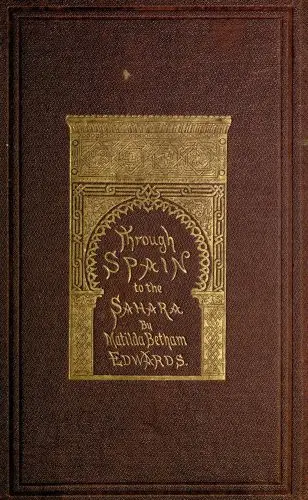
Through Spain to the Sahara
Matilda Betham-Edwards
THE CLASSIC COLLECTION · 1879
"Holidays in Eastern France" by Matilda Betham-Edwards is a travel memoir likely written in the late 19th century. The author recounts her experiences exploring Eastern France, emphasizing visits to less-traveled areas rather than popular tourist spots. Throughout the narrative, she aims to showcase the charm of rural life, the vibrant communities, and the picturesque scenery that defines regions such as the valley of the Marne and the cities of Besançon and Troyes. The opening of the work sets a reflective tone as the author describes her escape from the hectic life of Paris during the summer heat, finding solace in the tranquil countryside. She vividly illustrates the serene landscapes, including lush fields, quaint villages, and the industrious lives of local inhabitants, from peasant farmers to educated citizens. Betham-Edwards navigates through various towns, characterizing the distinct social classes and cultural settings she encounters, while simultaneously critiquing the absence of church attendance and the changing dynamics of rural life. The author emphasizes her interest in not just the places, but the people and their stories, which she finds more compelling than mere tourist attractions.
Introduction adapted from the source catalogue; source summaries may be automatically generated.
Free to read · English · 56,565 words · No account needed
MAKE TIME FOR A GOOD BOOK
On by default. Untick to stop anonymous reading totals. Each page counts after 10 seconds in view. How this works.
Anonymous counting is on unless you have switched it off.
Before quitting these mausoleums and their exquisite possessions of pleureuses, geniuses, Sibyls, and the rest, it may be worth while to remind the reader that, according to the most learned of the Romans, there were ten Sibyls, viz.:--1. Persica, 2. Libyssa, 3. Delphica, 4. Cumaea, 5. Erythraea, 6. Samia, 7. Cumana, who brought the book to Tarquin, 8. Hellespontica, 9. Phrygia, 10. Tiburs, by name Albunea, worshipped at Tiber as a goddess. Thus Varro categorizes the Sibyls, and besides these we hear of a Hebrew, a Chaldaean, a Babylonian, an Egyptian, a Sardian Sibyl, and some others. Other writers considerably reduce this number, three being that most usually accepted, and Salmasius, the most learned man that ever lived, summed up the various theories concerning these mysterious beings with the words: "There is nothing on which ancient writers more widely differ than as to the age, number, and country of the Sibyls."
There is little to see in the Church of Brou besides these mausoleums, and nothing in Bourg itself, except the fine bronze statue to Bichat, by David d'Angers. The great anatomist is represented in the act of oscultation, the patient being a child, standing between his knees. It is a monument alike worthy of the artist and his subject, another instance of that dignified realism for which David d'Angers was so remarkable. There is, however, some doubt as to Bichat's birth-place; Lons-le-Saunier, as I have before mentioned, contesting the honour with Bourg. On the principle that two monuments to a great man are better than none at all, each place claims the honour.
The night mail-express from Geneva whirled me in about ten hours to Paris, and the next morning I found myself in what, after the matchless atmosphere of the Jura, seemed murkiness, although the day was fine and the sky cloudless. I had thus, with hardly an important deviation from the plan originally laid down, accomplished my journey in Eastern France, but with a success, in one respect, impossible to anticipate. Accustomed as I am to French amiability and hospitality, I was yet unprepared for such a reception as that accorded to me throughout every stage of my travels. All hearts were open to me; everyone wanted to do the honours of his beloved "patrie"--using the word in its local rather than national sense--to be serviceable, kind, accommodating. Thus it happened that my holiday rambles in Franche-Comté were so far novel, that they may be said to have been accomplished without hotels or guidebooks; for the most part, my time being spent in friends' houses, and my itineraries being the best possible, namely, the oral information of interested natives of every place I passed through. This is, indeed, the way in which all countries, and especially France, should be seen, for, without a sympathetic knowledge of her people and their ways of life, we lose the most interesting feature in French travel. Travellers who only see the outside of things in foreign countries, indeed, may be compared to those who gaze upon a skeleton, instead of the living form, warm with life, sympathy, and beauty. Old France, as studied in her glorious monuments, whether Gallic, Merovingian, Mediaeval, or Renaissance, pales in interest before the New, that France which alone has taught the world the lesson of Equality, and is teaching us every day what misfortunes may be overcome by a noble people, inspired with true patriotism, allied to democratic feeling. In Republican France, now, who can doubt? and I am all the more thankful here to be able to bear witness to the unanimity, prosperity, and marvellous development found in the different strata of French social life. There are, without doubt, blots on this bright picture; but none can deny that the more we learn to know France the more we admire and love her, and that, if the richest and most beautiful country in the world, it is also the one in which happiness and well-being are most generally diffused. We are accustomed to regard France in the light of a parable to other nations, but, if her sorrows and retributions have taught them much, at least her successes and triumphs have taught them more. She has lately shown herself greater even in the hour of her prosperity than in that of evil fortune, the highest praise to be accorded alike to nations as to individuals. Honour then to all who have helped in bringing about these great results, whether in the humblest or loftiest walks of life, and may I be the means of inducing scores of travellers to follow in my footsteps, and judge for themselves whether I have drawn too glowing a picture! Of one thing they may be certain--namely, that they will be welcomed wherever they go, if led thither in a sympathetic spirit, although, perhaps, not many may have the like good fortune with myself, each stage of my journey being marked by delightful acquaintances and friendships, binding me still closer to La Belle France and her glorious Republic!
Your reading position is saved on this browser. Take it to another device with a library code. Reading pages adapt to text, rather than matching a printed edition.
Matilda Betham-Edwards
Matilda Betham-Edwards
Matilda Betham-Edwards
Matilda Betham-Edwards
BEHIND THE BOOK
This eBook is for the use of anyone anywhere in the United States and most other parts of the world at no cost and with almost no restrictions whatsoever. You may copy it, give it away or re-use it under the terms of the Project Gutenberg License included with this eBook or online at www.gutenberg.org. If you are not located in the United States, you will have to check the laws of the country where you are located before using this eBook. Read the source licence.
The original source file, including credits and licence, is retained by this library. Request an original-format copy at no charge. Please include the book title and Project Gutenberg identifier #8936.
KEEP YOUR CURIOSITY GOING
Wilfrid Scawen Blunt
Wilfrid Scawen Blunt

E. W. (Edgar Watson) Howe
Francis Greenleaf Allinson & Anne C. E. (Anne Crosby Emery) Allinson
Cyrenus Cole

John Martineau