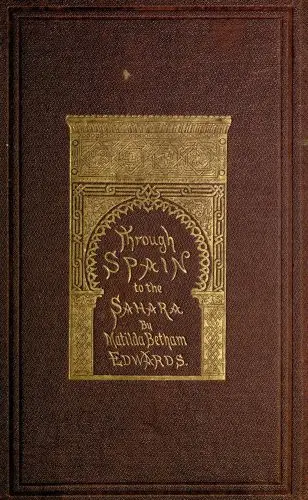
Through Spain to the Sahara
Matilda Betham-Edwards
THE CLASSIC COLLECTION · 1879
"Holidays in Eastern France" by Matilda Betham-Edwards is a travel memoir likely written in the late 19th century. The author recounts her experiences exploring Eastern France, emphasizing visits to less-traveled areas rather than popular tourist spots. Throughout the narrative, she aims to showcase the charm of rural life, the vibrant communities, and the picturesque scenery that defines regions such as the valley of the Marne and the cities of Besançon and Troyes. The opening of the work sets a reflective tone as the author describes her escape from the hectic life of Paris during the summer heat, finding solace in the tranquil countryside. She vividly illustrates the serene landscapes, including lush fields, quaint villages, and the industrious lives of local inhabitants, from peasant farmers to educated citizens. Betham-Edwards navigates through various towns, characterizing the distinct social classes and cultural settings she encounters, while simultaneously critiquing the absence of church attendance and the changing dynamics of rural life. The author emphasizes her interest in not just the places, but the people and their stories, which she finds more compelling than mere tourist attractions.
Introduction adapted from the source catalogue; source summaries may be automatically generated.
Free to read · English · 56,565 words · No account needed
MAKE TIME FOR A GOOD BOOK
On by default. Untick to stop anonymous reading totals. Each page counts after 10 seconds in view. How this works.
Anonymous counting is on unless you have switched it off.
There is no Protestant organization at St. Claude, but most likely it will soon come. English Protestants must never forget that money is sorely needed by the struggling Protestant communities in France; and that, without money, schools, hospitals, and churches cannot be built. At present, as I have before mentioned, trade is at a low ebb, but the projected railway connecting St. Claude with Nantua will give new development to its industries, and also throw open a new and beautiful pleasure-ground to travellers. My friends entrusted me to the care of an intelligent workman in order to see the manufactures of the "articles de St. Claude," viz.: pipes, toys, inlaid work, and carved objects in bone, ivory, &c. We saw small blocks of the so called bois de bruyère, as they come straight from the Pyrenees, which are cut about the length of pipes, and are worked up partly by hand and partly by machinery. Women, girls, and children are largely employed with the turning lathes, and in many other processes; I saw a woman polishing handles of the toys known as cup and ball; also box-wood tops being turned, and rules and measures being made; the thin blades of folding rules are made with marvellous rapidity, as had need to be the case, seeing how low is the price at which these and other goods of this kind are sold by the gross for foreign markets. Having gone through the various workshops of a large manufactory, my companion conducted me to see the handwork done at home. We found a young artist, for so we must call him, at work in a clean little room opening into a garden, and much he told us of interest. He said that he could only earn five francs a day, and this by dint of hard work, carving two dozen pipes a day, at the rate of two and a half francs per dozen. These vine-leaves, flowers, arabesques, and other patterns are done with marvellous swiftness and dexterity, and entirely according to the fancy of the moment, and for his artistic education he had paid high. All the best workmen, he told me, were going to Paris in order to get better pay and shorter hours of labour. Strikes here are out of the question, as there are no Trades' Unions and associations in order to raise the price of labour. Meantime wages decrease, and the cost of living augments. A gloomy picture he drew of trade prospects at St. Claude, that is to say, from the workman's point of view. The arts of turnery, inlaid work, carving in wood and ivory, have long been peculiar to St. Claude, though when first they were introduced is not exactly known. First of all, it was the box-wood of the Jura that these rustic artists put into requisition, then buffalo and stags' horns, lastly, ivory, vegetable ivory, and foreign woods. The part of the box-wood used chiefly is an intermediate part between the root and the stem called la loupe, or racine de bruyère; whilst the red wood used for pipes is the root of a heath common in the Pyrenees, which has the peculiar quality of resisting heat, and is free from odour or taste. So great is the division of labour in the manufacture of the St. Claude wares that it is said there are three thousand different processes in turnery alone! A child's top, even though of the simplest, goes through a great number of stages before being finished for the markets. Chaplets are also manufactured largely, and is the earliest branch of industry, dating from the Middle Ages. Snuff-boxes in inlaid wood, ivory, and bone are made in great quantities, also rules and measures, spectacle cases, napkin rings, salad spoons and forks, and other articles of the kind. Four-fifths of the St. Claude wares are exported; an especial kind of pipes being made expressly for the English market. It is stated that, during the general Exhibition at Hyde Park in 1862, many Frenchmen brought home, as English curiosities, the elegantly carved pipes of St. Claude! The United States of America also import great quantities of these pipes. In the last American war, there was hardly a soldier who did not possess a pipe manufactured in the little city in the Jura mountains. There is also another branch of industry more fascinating still, which is peculiar to St. Claude and the neighbouring village of Septmoncel; but, perhaps, I am indiscreet in speaking of it, so dire is the temptation it holds out to the traveller. As you stroll along these quiet streets, your eyes are attracted here and there by open boxes of what appears, at first sight, to be large beads, but which are in reality gems and precious stones; amethysts, emeralds, sapphires, topazes, and diamonds, lie here in dazzling little heaps, and if you are a connoisseur in such matters, and have not spent all your money on the way, you may carry home with you one of the most delightful of all souvenirs to be set at pleasure. Diamond polishing and gem-cutting are largely carried on here, but form, more especially, the industry of Septmoncel, a little village in the mountains, a few miles distant from St. Claude. Several thousand souls depend for daily bread on this delicate occupation, which none know how long has been peculiar to the inhabitants of Septmoncel, and their monopoly is only rivalled by the diamond polishers of Amsterdam. These ateliers are well worth visiting. Besides diamonds and precious stones, rock crystal, and various kinds of imitations, and paste jewellery are here worked up; also jasper, agate, malachite, cornelian, lapis-lazuli, jet, &c. The work is done by the piece, and the whole family of the lapidary is generally employed.
Your reading position is saved on this browser. Take it to another device with a library code. Reading pages adapt to text, rather than matching a printed edition.
Matilda Betham-Edwards
Matilda Betham-Edwards
Matilda Betham-Edwards
Matilda Betham-Edwards
BEHIND THE BOOK
This eBook is for the use of anyone anywhere in the United States and most other parts of the world at no cost and with almost no restrictions whatsoever. You may copy it, give it away or re-use it under the terms of the Project Gutenberg License included with this eBook or online at www.gutenberg.org. If you are not located in the United States, you will have to check the laws of the country where you are located before using this eBook. Read the source licence.
The original source file, including credits and licence, is retained by this library. Request an original-format copy at no charge. Please include the book title and Project Gutenberg identifier #8936.
KEEP YOUR CURIOSITY GOING
Wilfrid Scawen Blunt
Wilfrid Scawen Blunt

E. W. (Edgar Watson) Howe
Francis Greenleaf Allinson & Anne C. E. (Anne Crosby Emery) Allinson
Cyrenus Cole

John Martineau