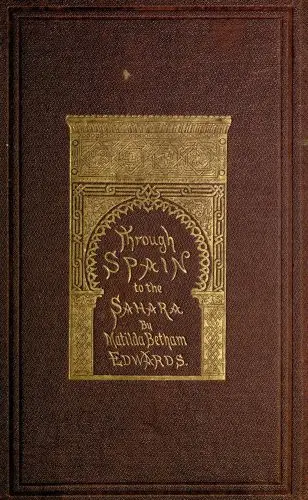
Through Spain to the Sahara
Matilda Betham-Edwards
THE CLASSIC COLLECTION · 1879
"Holidays in Eastern France" by Matilda Betham-Edwards is a travel memoir likely written in the late 19th century. The author recounts her experiences exploring Eastern France, emphasizing visits to less-traveled areas rather than popular tourist spots. Throughout the narrative, she aims to showcase the charm of rural life, the vibrant communities, and the picturesque scenery that defines regions such as the valley of the Marne and the cities of Besançon and Troyes. The opening of the work sets a reflective tone as the author describes her escape from the hectic life of Paris during the summer heat, finding solace in the tranquil countryside. She vividly illustrates the serene landscapes, including lush fields, quaint villages, and the industrious lives of local inhabitants, from peasant farmers to educated citizens. Betham-Edwards navigates through various towns, characterizing the distinct social classes and cultural settings she encounters, while simultaneously critiquing the absence of church attendance and the changing dynamics of rural life. The author emphasizes her interest in not just the places, but the people and their stories, which she finds more compelling than mere tourist attractions.
Introduction adapted from the source catalogue; source summaries may be automatically generated.
Free to read · English · 56,565 words · No account needed
MAKE TIME FOR A GOOD BOOK
On by default. Untick to stop anonymous reading totals. Each page counts after 10 seconds in view. How this works.
Anonymous counting is on unless you have switched it off.
What lovely things did I see during an hour and a half's walk to the so-called Pont du Diable! Taking one winding mountain road of many, and following the clear winding deep green river, though high above it, I came to a scene as wild, beautiful, and solitary as the mind can picture, above bare grey cliffs, lower down fairy-like little lawns of brightest green, deeper down still, the river making a dozen cascades over its stony bed, and round about the glorious autumn foliage, under a cloudless sky. All the way I had heard, mingled with the roar of the impetuous river, the sound of mill-wheels, and I passed I know not how many manufactories, most of which lie so deep down in the heart of the gorges that they do not spoil the scenery. The ugly blot is hidden, or at least inconspicuous. As I turn back, I have on one side a vast velvety slope, sweeping from mountain to river, terrace upon terrace of golden-green pasture, where a dozen little girls are keeping their kine; on the other steep limestone precipices, all a tangle of brushwood, with only here and there a bit of scant pasturage. The air is transparent and reviving, a south wind caresses us as we go, nothing can be more heavenly beautiful. The blue gentian grows everywhere, and, as I pursue my way, the peasant-folks I meet with pause to say good-day and stare. They evidently find in me an outlandish look, and are quite unaccustomed to the sight of strangers.
I had pleasant acquaintances provided for me here by my friend, the schoolmaster's wife at Morez, and a very agreeable glimpse I thus obtained of French middle-class life; Catholic life, moreover, but free alike from bigotry and intolerance. Very light-hearted, lively, and well-informed were these companions of my walks at St. Claude, among them a government official, his young wife, sister, and another relation, who delighted in showing me everything. We set off one lovely afternoon for what turned out to be a four hours' walk, but not a moment too long, seeing the splendour of weather and scenery, and the amiability of my companions. We took a road that led from the back of the Cathedral by the Valley of the Tacon, a little river that has its rise in the mountain near, and falls into the Flumen close by. It is necessary to take this walk to the falls of the Flumen in order to realize fully the wonderful site of St. Claude, and the amazing variety of the surrounding scenery. Every turn we take of the upward curling road gives us a new and more beautiful picture. The valley grows deeper and deeper, the mountains on either side higher and higher, little chalets peeping amid the grey and the green, here perched on an apparently unapproachable mountain-top, there in the inmost recess of some rocky dell. As we get near the falls, we are reaching one of the most romantic points of view in all the Jura, and one of the most striking I have ever seen, so imposingly do the mountains close around us as we enter the gorge, so lovely the scene shut in by the impenetrable natural wall; for within the framework of rock, peak, and precipice are little farms, gardens, and orchards--gems of dazzling green bathed in ripest sunshine, pine-forests frowning close above these islets of luxuriance and cultivation, dells, glades, and open, lawny spaces between the ramparts of fantastically formed crags and solitary peaks, a scene recalling Kabylia, in the Atlas mountains, but unlike anything except itself. All was still, except for the roar of the tiny river and the occasional sound of timber sliding from some mountain slope into the valley below. The timber is thus transported in these parts, the woodman cutting the planks on some convenient ledge of rock, then letting it find its way to the bottom as best it can. All day long you see the trunk-cutters at work on their airy perches, now bright stairs of gold-green turf, soon to be enveloped in impenetrable masses of snow, and hear the falling planks. As we climb, we are overtaken by two timber carts, and the drivers, peasant-folks from the mountains, are old acquaintances of my companions, and suggest that the ladies should mount. We gladly do so, to the great satisfaction of the peasants, who on no account would themselves add to their horses' burden. It would have been an affront to offer these good people anything in return for their kindness. They were delighted to chat behind with Monsieur, whilst their horses, sure-footed as mules, made their way beside the winding precipice. These peasants had intelligent, good countenances, and were excellent types of the Jura mountaineer.
Your reading position is saved on this browser. Take it to another device with a library code. Reading pages adapt to text, rather than matching a printed edition.
Matilda Betham-Edwards
Matilda Betham-Edwards
Matilda Betham-Edwards
Matilda Betham-Edwards
BEHIND THE BOOK
This eBook is for the use of anyone anywhere in the United States and most other parts of the world at no cost and with almost no restrictions whatsoever. You may copy it, give it away or re-use it under the terms of the Project Gutenberg License included with this eBook or online at www.gutenberg.org. If you are not located in the United States, you will have to check the laws of the country where you are located before using this eBook. Read the source licence.
The original source file, including credits and licence, is retained by this library. Request an original-format copy at no charge. Please include the book title and Project Gutenberg identifier #8936.
KEEP YOUR CURIOSITY GOING
Wilfrid Scawen Blunt
Wilfrid Scawen Blunt

E. W. (Edgar Watson) Howe
Francis Greenleaf Allinson & Anne C. E. (Anne Crosby Emery) Allinson
Cyrenus Cole

John Martineau