
Last letters from the living dead man
David Patterson (Spirit) Hatch
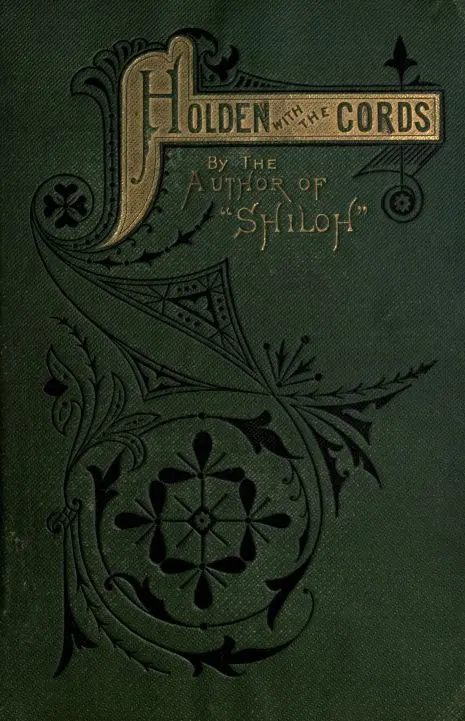
THE CLASSIC COLLECTION · 1874
"Holden with the Cords" by W. M. L. Jay is a religious novel written in the late 19th century. This work delves into themes of morality, social responsibility, and personal struggles, weaving a narrative that connects its characters' lives to deeper spiritual questions. The story seems to intersect the lives of several protagonists, including the medical student Frank Trubie, the troubled Alec Arling, and the enigmatic Edmund Roath. At the start of the novel, readers are introduced to a vivid setting—a medical college characterized by student life and the pressures of imminent examinations. The narrative centers around Frank Trubie's concern for his friend Alec Arling, who has mysteriously gone missing during a time when he was advised to rest due to illness. After failing to locate Alex, a dramatic turn occurs when Arling is discovered dead in his locked room, leading to a chilling atmosphere of suspicion and accusations. Amid the unfolding tragedy, the relationships, ambitions, and moral dilemmas faced by the characters come to the forefront, hinting at a gripping exploration of both personal and universal conflicts throughout the book.
Introduction adapted from the source catalogue; source summaries may be automatically generated.
Free to read · English · 161,124 words · No account needed
MAKE TIME FOR A GOOD BOOK
On by default. Untick to stop anonymous reading totals. Each page counts after 10 seconds in view. How this works.
Anonymous counting is on unless you have switched it off.
Neither for the look nor the thought did he pause, but strode straight up two flights of stairs, his firm tread resounding loudly through the empty, uncarpeted halls, and knocked at the door of a front room. There was no response. He knocked again, with a somewhat impatient hand, tried the door and found it locked, waited a moment, beat a third emphatic rat-tat-too upon the panel, without eliciting other reply than a faint and dreary echo from the attic above; and, finally, turned on his heel, and walked down-stairs. At the head of the second flight, a thought seemed to strike him; after a moment of hesitation, he turned and knocked at a door close at hand. Scarcely waiting for the prompt "Come in!" he opened it, with the question,--"Have you seen Arling this morning?"
The occupant of the room was a broad-shouldered young man, sitting at a table covered with books and papers, and deeply absorbed in study. He only half turned his head, showing a regular, clear-cut profile, as he answered,--
"No. I left him so late last night that I overslept this morning, and have thought of nothing but making up lost time. And really, Trubie, a man might be excused for forgetting his best friend--if he had one--in examination week. But, is Arling any worse?"
"That's what I should like to know, Roath," returned Trubie, planting himself a little more firmly on the threshold, but taking no notice of the chair that the other had carelessly pushed toward him. "At any rate, he's out."
Roath started, and turned completely round, giving a view of a square-featured, somewhat moody, but still handsome, face. "Out!" he repeated, looking both amazed and startled.
"So it would seem. The door is locked, and I rapped and rattled loud
enough to wake the dead."
"Oh," said Roath, with a prolonged falling inflection. And after a moment's consideration, he turned back to his books, as if there were no more to be said.
Trubie lingered. Not, evidently, from any special liking for Roath's society, but because he was undecided what to do next. "I don't understand it, Roath," he said slowly. "You know Arling was to have kept his room to-day, by way of gaining strength, and guarding against a relapse. And we were to have gone over 'Barnes' together this morning, so as to be all primed for Professor Beers to-morrow. What can he have done with himself?"
"Perhaps," said Roath, absently, with his eyes on his book, "some of the others may have seen him."
Your reading position is saved on this browser. Take it to another device with a library code. Reading pages adapt to text, rather than matching a printed edition.
BEHIND THE BOOK
This eBook is for the use of anyone anywhere in the United States and most other parts of the world at no cost and with almost no restrictions whatsoever. You may copy it, give it away or re-use it under the terms of the Project Gutenberg License included with this eBook or online at www.gutenberg.org. If you are not located in the United States, you will have to check the laws of the country where you are located before using this eBook. Read the source licence.
The original source file, including credits and licence, is retained by this library. Request an original-format copy at no charge. Please include the book title and Project Gutenberg identifier #56980.
KEEP YOUR CURIOSITY GOING
David Patterson (Spirit) Hatch

David Patterson (Spirit) Hatch

David Patterson (Spirit) Hatch
Coulson Kernahan

Maurice Baring
Frances Wright