
Last letters from the living dead man
David Patterson (Spirit) Hatch
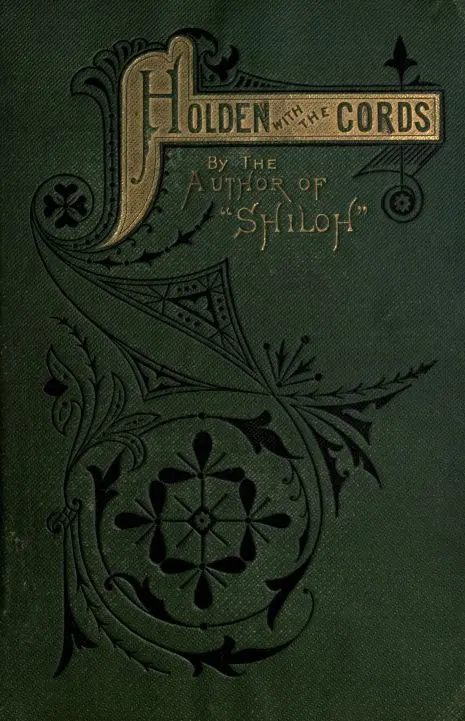
THE CLASSIC COLLECTION · 1874
"Holden with the Cords" by W. M. L. Jay is a religious novel written in the late 19th century. This work delves into themes of morality, social responsibility, and personal struggles, weaving a narrative that connects its characters' lives to deeper spiritual questions. The story seems to intersect the lives of several protagonists, including the medical student Frank Trubie, the troubled Alec Arling, and the enigmatic Edmund Roath. At the start of the novel, readers are introduced to a vivid setting—a medical college characterized by student life and the pressures of imminent examinations. The narrative centers around Frank Trubie's concern for his friend Alec Arling, who has mysteriously gone missing during a time when he was advised to rest due to illness. After failing to locate Alex, a dramatic turn occurs when Arling is discovered dead in his locked room, leading to a chilling atmosphere of suspicion and accusations. Amid the unfolding tragedy, the relationships, ambitions, and moral dilemmas faced by the characters come to the forefront, hinting at a gripping exploration of both personal and universal conflicts throughout the book.
Introduction adapted from the source catalogue; source summaries may be automatically generated.
Free to read · English · 161,124 words · No account needed
MAKE TIME FOR A GOOD BOOK
On by default. Untick to stop anonymous reading totals. Each page counts after 10 seconds in view. How this works.
Anonymous counting is on unless you have switched it off.
Carice shook her head. "You have forgotten," she replied, "that he is not bearing the burden for himself, but for love of that far-off, mighty King of whom he has heard; which feeling ought to strengthen his heart and his sinews, and shine out in his face."
Astra turned away her head. As she had unconsciously wrought her own wretched, despondent moods of the past week into the sensitive clay, so Carice's comments upon the result had their sidelong application to herself.
"As for the Christ-Child," continued Carice, raising her eyes from the Bearer to the Burden, "how did you ever get that look of immitigable fate into a child's rounded face? As a piece of work, it is almost miraculous; but, as a conception of the Christ-Child--I beg your pardon, Astra--it is absolutely dreadful."
"It may stand for Offero's idea of the face which he cannot see," suggested Astra, in a low voice.
"Well, perhaps it might, if he were thinking of the face, which I doubt. That is to say, the true Offero would be thinking of the King whom he was trying to serve, rather than the burthen that he was bearing. At any rate, it is just because he cannot see the face that he has such an idea of it. But to us, who can see it, it ought to show itself most benignant, most pitying, most tender and satisfying in every respect. Else, we miss the only really helpful lesson that your Offero is calculated to teach."
Astra looked at her friend half sadly, half-wonderingly. "Let no one trust your gentle, innocent look, Carice," said she; "you are a sharp-sighted critic, and as severe as you are sharp-sighted."
"On the contrary," returned Carice, "I am not criticising at all; I am merely telling you how your statue looks to me, in its unfinished condition. No doubt every stroke of that magical scraper of yours will take away something of the look which I do not like, and put in something of that which I long to see."
"I do not know," responded Astra drearily, shaking her head. "I have not your singular depth and simplicity of vision, in spiritual things."
"Nay," Carice, "you have something more than that,--the power to create; I have only the power to discern. That cherub yonder, for instance;--I am glad that I am able to see that it is lovely beyond expression, but the power to make it so, ah! that is beyond me!"
And Carice moved away to the object of her admiration, and seemed to forget herself and all around her, in contemplating it.
Doctor Remy remained, looking critically at the clay figure.
Your reading position is saved on this browser. Take it to another device with a library code. Reading pages adapt to text, rather than matching a printed edition.
BEHIND THE BOOK
This eBook is for the use of anyone anywhere in the United States and most other parts of the world at no cost and with almost no restrictions whatsoever. You may copy it, give it away or re-use it under the terms of the Project Gutenberg License included with this eBook or online at www.gutenberg.org. If you are not located in the United States, you will have to check the laws of the country where you are located before using this eBook. Read the source licence.
The original source file, including credits and licence, is retained by this library. Request an original-format copy at no charge. Please include the book title and Project Gutenberg identifier #56980.
KEEP YOUR CURIOSITY GOING
David Patterson (Spirit) Hatch

David Patterson (Spirit) Hatch

David Patterson (Spirit) Hatch
Coulson Kernahan

Maurice Baring
Frances Wright