
Last letters from the living dead man
David Patterson (Spirit) Hatch
THE CLASSIC COLLECTION · 1874
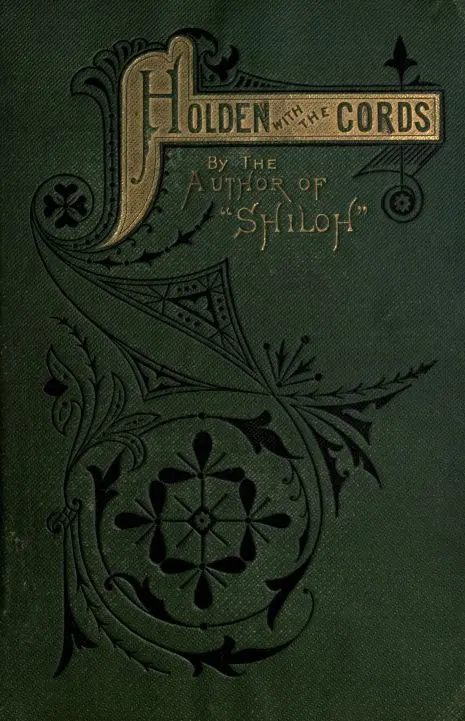
"Holden with the Cords" by W. M. L. Jay is a religious novel written in the late 19th century. This work delves into themes of morality, social responsibility, and personal struggles, weaving a narrative that connects its characters' lives to deeper spiritual questions. The story seems to intersect the lives of several protagonists, including the medical student Frank Trubie, the troubled Alec Arling, and the enigmatic Edmund Roath. At the start of the novel, readers are introduced to a vivid setting—a medical college characterized by student life and the pressures of imminent examinations. The narrative centers around Frank Trubie's concern for his friend Alec Arling, who has mysteriously gone missing during a time when he was advised to rest due to illness. After failing to locate Alex, a dramatic turn occurs when Arling is discovered dead in his locked room, leading to a chilling atmosphere of suspicion and accusations. Amid the unfolding tragedy, the relationships, ambitions, and moral dilemmas faced by the characters come to the forefront, hinting at a gripping exploration of both personal and universal conflicts throughout the book.
Introduction adapted from the source catalogue; source summaries may be automatically generated.
Free to read · English · 161,124 words · No account needed
MAKE TIME FOR A GOOD BOOK
On by default. Untick to stop anonymous reading totals. Each page counts after 10 seconds in view. How this works.
Anonymous counting is on unless you have switched it off.
"Money is one object, of course," answered Bergan, "but I hope it is not the only one, nor even the chief one. When my mind takes a leap into the future, it is not so much fees that I think of, as wrongs to be redressed, and rights to be protected, and influence to be gained and exercised,--yes, and fame and independence to be won."
"All very good things," returned Doctor Remy, smiling; "and all very dependent on those same fees, of which you think so little. Without money, you will not do much for right, nor against wrong; neither can you be independent, or famous, or influential."
"I do not know about that," rejoined Bergan, smiling. "Certainly, it was not his riches that made Diogenes independent. Neither does the name of Howard borrow any of its lustre from gold. Nor--to come down to our own time--is Mr. Islay influential on account of his wealth."
"Mr. Islay influential!" repeated Doctor Remy, contemptuously. "In
what way, let me ask?"
"In a hundred ways. Every week, his words, his thoughts, go into scores of hearts and homes, for warning, for comfort, for inspiration; and reappear constantly in human lives. Certain sentences of his last Sunday's sermon have been ringing in my ears all day. And only three or four days ago, Miss Lyte, under the influence of that suggestive discourse, asked me how far I thought one was justified in a purely negative use of a talent,--that is, in merely refraining from doing harm, rather than trying actively to do good. And these are only two examples, you see, where there are doubtless many."
"Priests easily influence women," said the doctor, scornfully.
"Women!" exclaimed Bergan, stretching out a stalwart arm toward the doctor. "Are not those the muscles and sinews of a man?"
"I beg your pardon," said the Doctor, laughing, "I had forgotten what was the first of your two examples. Still, that sort of influence would never suffice for me. If I cared for anything of the kind, it would be for power,--direct, absolute power over men's acts and lives. But as that belongs only to kings and generals, I am content to do with--"
He hesitated.
"Well, what?" said Bergan.
"Wealth--when I get it," answered the doctor. "Wealth, and what it brings; ease, leisure, unlimited opportunity and means for the cultivation of the intellect."
"The intellect, then, is your final object, your ultimate good?" said
Bergan.
"Yes; it is the one thing which distinguishes man from the brutes,"
replied the doctor.
"With the soul," rejoined Bergan.
Your reading position is saved on this browser. Take it to another device with a library code. Reading pages adapt to text, rather than matching a printed edition.
BEHIND THE BOOK
This eBook is for the use of anyone anywhere in the United States and most other parts of the world at no cost and with almost no restrictions whatsoever. You may copy it, give it away or re-use it under the terms of the Project Gutenberg License included with this eBook or online at www.gutenberg.org. If you are not located in the United States, you will have to check the laws of the country where you are located before using this eBook. Read the source licence.
The original source file, including credits and licence, is retained by this library. Request an original-format copy at no charge. Please include the book title and Project Gutenberg identifier #56980.
KEEP YOUR CURIOSITY GOING
David Patterson (Spirit) Hatch

David Patterson (Spirit) Hatch

David Patterson (Spirit) Hatch
Coulson Kernahan

Maurice Baring
Frances Wright