THE CLASSIC COLLECTION✦A Century of Sail and Steam on the Niagara RiverCLASSIC FREE BOOKS
A Century of Sail and Steam on the Niagara River
Barlow Cumberland
THE CLASSIC COLLECTION · 1909
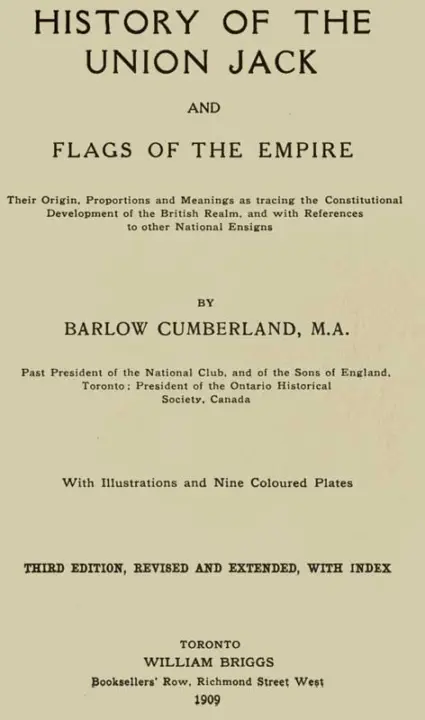
"History of the Union Jack and Flags of the Empire" by Barlow Cumberland is a historical account written in the early 20th century. The book delves into the origins, significance, and evolution of the Union Jack and other flags of the British Empire, tracing their connections to the constitutional development of the British realm. Through a combination of illustrations and detailed commentary, it seeks to deepen readers' understanding of these national symbols and the stories they encapsulate. The opening of the work sets the stage for a comprehensive exploration of flags, emphasizing their role as emblems of national identity and pride throughout history. It begins with a poetic tribute to the Union Jack, articulating the deep allegiance and sacrifices associated with this emblem through its connections to historical figures such as St. George, St. Andrew, and St. Patrick. Cumberland then introduces the concepts of flag etiquette and symbolism, highlighting the importance of flags in reflecting a nation's heritage and values, while preparing the reader for a detailed examination of the Union Jack's development over the centuries.
Introduction adapted from the source catalogue; source summaries may be automatically generated.
Free to read · English · 72,057 words · No account needed
MAKE TIME FOR A GOOD BOOK
On by default. Untick to stop anonymous reading totals. Each page counts after 10 seconds in view. How this works.
Anonymous counting is on unless you have switched it off.
The thirteen colonies of North America were, at the time of Lord Mansfield's decision in 1772, colonies of the British crown, and moved, no doubt, by a desire to emulate their brothers in Great Britain, and following their example, the representatives of the colonies met at Philadelphia, on 27th September, 1774, and in Continental Congress "declared against the slave-trade, and forbade any further importation of slaves into British America." Being supporters of the Union Jack, and following its ideals, they made, as Britons, a first step in the right direction, but no freedom was given to those already in the country.
It was, no doubt, under the influence of this spirit of British freedom, and with British hearts, that, when they were separating from their British allegiance, they stated in their Declaration of Independence (4th July, 1776):
"We hold these truths to be self-evident, that all men are created equal; that they are endowed by their Creator with certain unalienable rights; that among these are life, liberty and the pursuit of happiness."
Yet at the very time when this claim was made, that all men were born equal, well-nigh a million blacks were held in these same States in bondage,[154] and this sounding declaration of "liberty" did not bring freedom to a single slave.
[154] In 1780 there were 1,191,000 slaves in the United States, and as late as 1860 more than 4,000,000.
Indeed, when, eleven years afterwards, in 1787, the representatives of the thirteen States met[155] in federal convention, and adopted the "Constitution of the United States," the existence of slavery under the Stars and Stripes was recognized and its continuance guaranteed.
[155] 25th May, 1787, at Philadelphia.
The framers of the constitution were evidently conscious of the fact that the statements of their "declaration" were not in actual accordance with their actions, and therefore the provisions in their "constitution" concerning slavery were stated in a veiled and secret form, the words "slave" and "slavery" being carefully excluded. In this way the clauses of the American constitution have a different interpretation from that which their wording would apparently convey, for the existence of one class of their population in slavery was duly recognized, although not specifically mentioned.
The leaven of English freedom evinced in 1774 had continued to work among some of the States, even after their separation from the Crown, and emancipation had been begun in Vermont in 1777, in Pennsylvania in 1780, and was impending in some of the others, but had by no means been accepted in all.[156]
[156] Emancipation was effected in New Jersey in 1804; New York, 1827.
Your reading position is saved on this browser. Take it to another device with a library code. Reading pages adapt to text, rather than matching a printed edition.
BEHIND THE BOOK
This eBook is for the use of anyone anywhere in the United States and most other parts of the world at no cost and with almost no restrictions whatsoever. You may copy it, give it away or re-use it under the terms of the Project Gutenberg License included with this eBook or online at www.gutenberg.org. If you are not located in the United States, you will have to check the laws of the country where you are located before using this eBook. Read the source licence.
The original source file, including credits and licence, is retained by this library. Request an original-format copy at no charge. Please include the book title and Project Gutenberg identifier #45498.
KEEP YOUR CURIOSITY GOING
Cécile Tormay

Moritz Busch
John L. Ransom
Frances Wright
Cécile Tormay

Mabel Potter Daggett