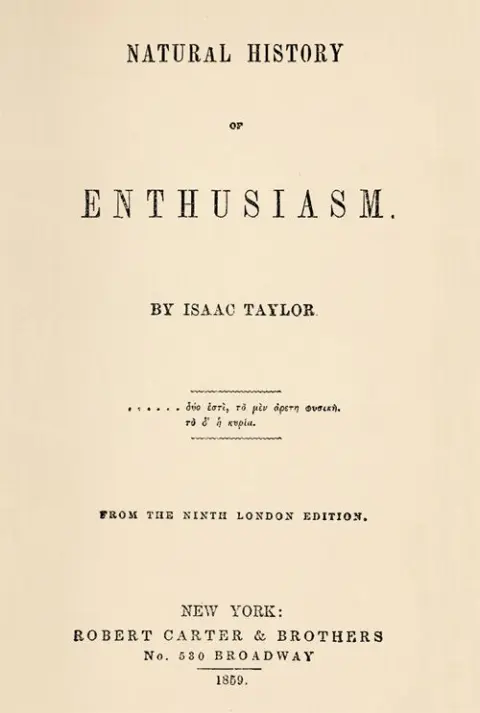
Natural History of Enthusiasm
Isaac Taylor
THE CLASSIC COLLECTION · 1827
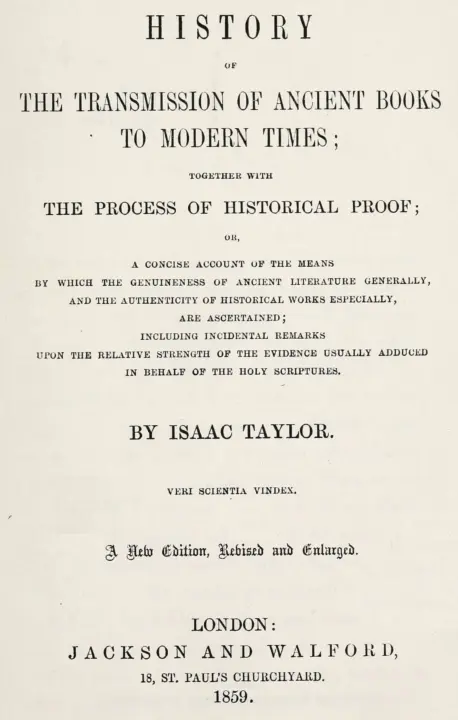
"History of the Transmission of Ancient Books to Modern Times" by Isaac Taylor is a historical account written in the mid-19th century. The work explores the processes and means by which ancient literature has been preserved and authenticated, providing insights into the integrity of historical texts and the authenticity of religious scriptures. The opening of the book outlines Taylor's intention to connect the authenticity of ancient literature with the transmission of texts throughout history. He discusses the importance of observing how the genuineness of both sacred and profane writings can be assessed equally. Taylor introduces the key topics that will be explored, such as the methods of historical proof and the role of copyists, insisting that the understanding of these elements is essential for appreciating both classical and biblical literature. He aims to present these arguments in a clear, organized manner, avoiding unnecessary controversy while appealing to general readers who seek insight into the historical lineage of the texts we study today.
Introduction adapted from the source catalogue; source summaries may be automatically generated.
Free to read · English · 107,019 words · No account needed
MAKE TIME FOR A GOOD BOOK
On by default. Untick to stop anonymous reading totals. Each page counts after 10 seconds in view. How this works.
Anonymous counting is on unless you have switched it off.
The moral treatises of Plutarch are of a practical, more than of a philosophical kind, and they yield therefore abundant indications, as well of the opinions, as of the manners of his age. In truth, the student of history would hardly need other aid in ascertaining the religious and moral sentiments of the times of Trajan, than he may find in the pages of this writer. Among this author’s moral pieces there is one that is curious, and valuable too, as a material of history--namely, the tract on Superstition--the dread of dæmons. With great force of language and aptness of illustration, he depicts the mental torments of the man who believes the gods to be malignant, inexorable, and capricious; and he contrasts this unhappy temper with the comparatively harmless error of those bolder spirits who cast away altogether the belief and fear of supernal beings; and while he recommends “the mean of piety,” he decidedly prefers atheism to superstition.
What say you?--The man who thinks there are no gods is impious? But is not he who thinks them to be cruel and malignant, chargeable with an opinion that is much more impious? For my own part, I would rather that men should say, ‘There is no such person as Plutarch,’ than that they should affirm that Plutarch is a man capricious, instable, prone to wrath, revengeful of accidental affronts, pettish; one who, if you have neglected to invite him with others to a feast, or if, being otherwise engaged, you have failed to salute him at your gate, will devour you, or seize and torture your son; or will send a beast, which he keeps for the purpose, to ravage your fields.
Plutarch speaks of four states of mind, as known and existing in his times--namely, 1. The wise piety, which he recommends, and which forms the medium between superstition and atheism.--2. The joyous or festive worship of the gods, in which he sees nothing to reprehend.--3. A bold rejection of all religion, which he thinks an error, though an innocent error:--and 4. Superstition, which is not merely an error, but a practical evil of the worst kind. Of the first he says almost nothing; nor does he offer a single hint explanatory of the mode in which the gods and goddesses of the Greek mythology might be made the objects of a devout and reasonable piety:--and yet piety without a god, must be an unmeaning term. Plutarch’s piety is a vague sentiment, which he feels to be proper to human nature, and highly beneficial; but which was absolutely destitute of solid ground, or certainty; for no invisible being or beings were known to him whom he could both love and fear. Even if the philosopher, by a course of doubtful reasonings, might work out for himself an idea of the Deity, such as might keep alive the sentiment of piety, no such abstruse notion could be brought within the apprehension of the vulgar. What is there then left to the vulgar?--not atheism--for that is an error:--not superstition; for that is a tormenting mischief:--nothing remains but the festive worship of the gods; and this, with all its impurities, and all its follies, was the only portion that could be assigned to the millions of mankind:--Plutarch knew of no alternative on which to found the religious sentiments of men. Yet on another occasion he expresses his opinion strongly as to the necessity of religion for the support of the social system.--It seems to me that it were easier to build a city without a foundation, than to construct or to preserve a polity, from which all belief of the gods should be removed. Yet how great soever were the evils of atheism, he deemed those arising from superstition to be greater. According to his testimony, when the only theology known to the Greeks took possession of timid minds, it rendered life intolerably burdensome.--Of all kinds of fear, none produces such incurable despondency and perplexity as superstition. He who never goes on board a ship, does not fear the sea; nor he the combat, who is not a soldier; nor he the robbers, who stays at home; nor does the poor man fear informers, nor he who is low, the eye of envy; nor he who inhabits Gaul, earthquakes; nor the Ethiopian, the thunderbolt. But the man who dreads the gods, dreads all things;--the earth, the sea, the air, the heavens, darkness, light, noise, silence, dreams. The slave in slumber forgets his master, the captive his chain, the wounded and the diseased their anguish:--kind sleep, friend of the sufferer, how sweet are thy visits! But superstition admits not even this solace; it accepts no truce, it gives no breathing time to the mind, nor permits the spirits to rally or to dispel its harsh and grievous surmises. But like the very region of the wicked, so the dreams of the superstitious man abound with terrific apparitions, and fatal portents: and this passion, always inflicting punishments upon the distracted spirit, scares the man from sleep by visions. And he--self-tortured, believes himself obliged to comply with fearful and monstrous behests. Such a man, when he awakes, instead of contemning his dreams, or smiling with pleasure in finding that what had disturbed him has no reality, still flies before an innoxious shadow, while at the same time he is substantially deluded by falling into the hands of conjurers and impostors, who strip him of his money, and impose upon him various penances.
Your reading position is saved on this browser. Take it to another device with a library code. Reading pages adapt to text, rather than matching a printed edition.
Isaac Taylor
BEHIND THE BOOK
This eBook is for the use of anyone anywhere in the United States and most other parts of the world at no cost and with almost no restrictions whatsoever. You may copy it, give it away or re-use it under the terms of the Project Gutenberg License included with this eBook or online at www.gutenberg.org. If you are not located in the United States, you will have to check the laws of the country where you are located before using this eBook. Read the source licence.
The original source file, including credits and licence, is retained by this library. Request an original-format copy at no charge. Please include the book title and Project Gutenberg identifier #67778.
KEEP YOUR CURIOSITY GOING
Cécile Tormay

Moritz Busch
John L. Ransom
Frances Wright
Cécile Tormay

Mabel Potter Daggett