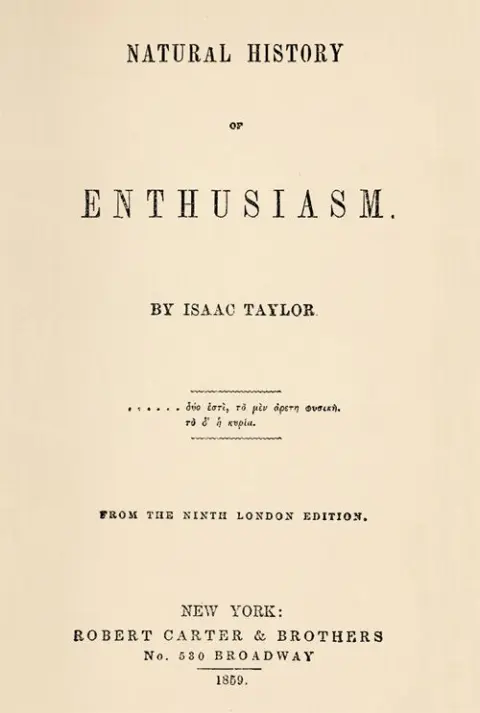
Natural History of Enthusiasm
Isaac Taylor
THE CLASSIC COLLECTION · 1827
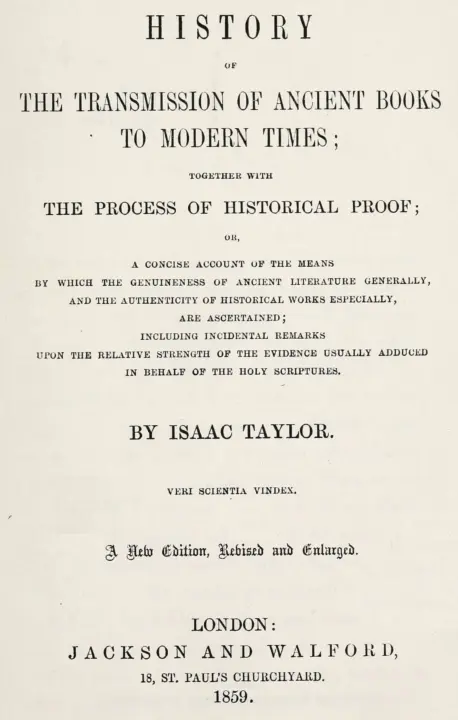
"History of the Transmission of Ancient Books to Modern Times" by Isaac Taylor is a historical account written in the mid-19th century. The work explores the processes and means by which ancient literature has been preserved and authenticated, providing insights into the integrity of historical texts and the authenticity of religious scriptures. The opening of the book outlines Taylor's intention to connect the authenticity of ancient literature with the transmission of texts throughout history. He discusses the importance of observing how the genuineness of both sacred and profane writings can be assessed equally. Taylor introduces the key topics that will be explored, such as the methods of historical proof and the role of copyists, insisting that the understanding of these elements is essential for appreciating both classical and biblical literature. He aims to present these arguments in a clear, organized manner, avoiding unnecessary controversy while appealing to general readers who seek insight into the historical lineage of the texts we study today.
Introduction adapted from the source catalogue; source summaries may be automatically generated.
Free to read · English · 107,019 words · No account needed
MAKE TIME FOR A GOOD BOOK
On by default. Untick to stop anonymous reading totals. Each page counts after 10 seconds in view. How this works.
Anonymous counting is on unless you have switched it off.
And the more, in any instance, the coincidence is slender and remote, or, as one might say, frivolous or unimportant, so much the surer, and the more to be relied upon is it, in what it does affirm: as thus--Look to your Synopsis, page 87, Compartment III.:--“A pig of lead, inscribed with the name of the Emperor Domitian, when he was consul for the eighth year, A.D. 82, weighing 154 lbs. It was discovered in 1731 underground, on Hayshaw Moor, in the West Riding of Yorkshire, half-way between an ancient lead-mine, north of Pately Bridge, and the Roman road from Ilkley (Olicana) to Aldborough (Isurium).” This pig had slept where he was dropped about 1,650 years.
“A pig of lead, inscribed with the name of the Emperor Hadrian, weighing 191 lbs.; found in 1796 or ’97, at Snailbeach Farm, parish of Westbury, 10 miles south-west of Shrewsbury.” Then follow some other pigs, whose slumbers underground have been more or less prolonged and profound.
“A pig of lead, inscribed with the name of L. Aruconius Verecundus, and the letters METAL. LVTVD., probably the mine of Lutudæ. Found near Matlock Bank, in Derbyshire.”
“A pig of lead, inscribed CL. TR. LVT. BR. EX. ARG.; found with three other pigs and some broken Roman pottery, at Broomer’s Hill, in the parish of Pulborough, Sussex, January 31, 1824, close to the Roman Road, Stone Street, from London to Chichester.”
“A pig of lead, inscribed with the name of Britannicus, the son of the Emperor Claudius; found on the Mendip Hills, Somersetshire.”
So much for these pigs. What is it which they might say, if we were to bring them into court? Something of this sort: At this time, in the streets of the stannary towns in Cornwall, there are to be seen blocks--pigs of tin, stamped in a manner similar to the lettering of these pigs of lead in the British Museum. This stamping is effected for the purpose of securing the dues of the Duchy of Cornwall, and the symbols and the letters indicate the political fact that the Prince of Wales, as Duke of Cornwall, lays a hand upon every pound of tin that is smelted in the county; and thus, too, the stamping of the produce of the lead-mines of Britain gives evidence of the fact that the Romans were not merely resident in Britain at the time, but were masters also of the island, and the lords of its mineral products. Then the lettering itself finds its interpretation in the Roman imperial history, and this history comes into our hands, partly as it has been narrated by the Roman historians above mentioned; partly in the form of sculptures, statues, busts, and bas-reliefs; and partly, and very copiously, in the unquestionable form of the coins of the same emperors, which alone would suffice for putting us in possession of the series of events, greater and smaller, through a course of many centuries. But what the reader should here keep in view is this: that as our present thesis is--the safe and sure transmission of ancient books, by the means of often-repeated copyings, through the lapse of ages, an evidence to this effect--and it is the most conclusive that can be imagined or desired, is afforded us when, in passing through collections, such as those treasured in the British Museum, THE BOOKS in question are found to furnish a coherent, and a continuous, and an exact interpretation of these palpable and ponderous antiquities. Yet, it is manifest that, unless the books were in the main genuine, they could not have supplied any interpretations, such as are those which we find in them.
Your reading position is saved on this browser. Take it to another device with a library code. Reading pages adapt to text, rather than matching a printed edition.
Isaac Taylor
BEHIND THE BOOK
This eBook is for the use of anyone anywhere in the United States and most other parts of the world at no cost and with almost no restrictions whatsoever. You may copy it, give it away or re-use it under the terms of the Project Gutenberg License included with this eBook or online at www.gutenberg.org. If you are not located in the United States, you will have to check the laws of the country where you are located before using this eBook. Read the source licence.
The original source file, including credits and licence, is retained by this library. Request an original-format copy at no charge. Please include the book title and Project Gutenberg identifier #67778.
KEEP YOUR CURIOSITY GOING
Cécile Tormay

Moritz Busch
John L. Ransom
Frances Wright
Cécile Tormay

Mabel Potter Daggett