THE CLASSIC COLLECTION✦An outlaw’s diary: the CommuneCLASSIC FREE BOOKS
An outlaw’s diary: the Commune
Cécile Tormay
THE CLASSIC COLLECTION · 1901
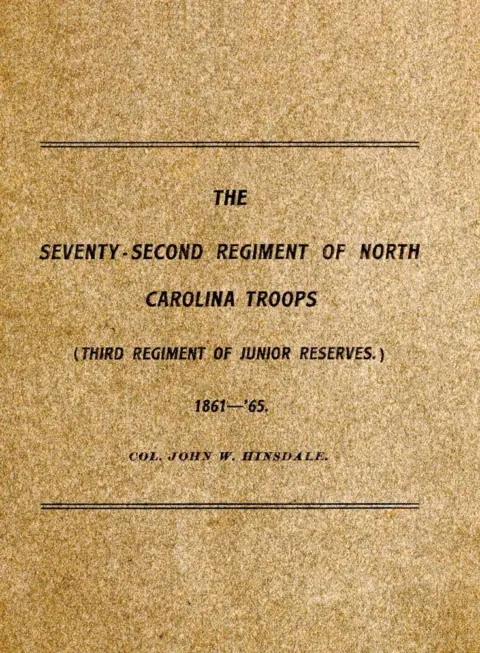
"History of the Seventy-Second Regiment of the North Carolina Troops in the War Between the States, 1861-’65" by Col. John W. Hinsdale is a historical account written in the early 20th century. This book documents the experiences and valor of the Seventy-Second Regiment, composed largely of young soldiers known as the Junior Reserves who served during the American Civil War. The narrative covers their organization, battles, and personal stories, providing a poignant insight into the struggles faced by these young combatants and the broader context of the war. In the book, Hinsdale details the formation of the Seventy-Second Regiment in the context of dire circumstances faced by the Confederacy in 1864. Compiled from historical records and personal accounts, it chronicles their training, key battles including the defense of Fort Fisher, and individual acts of bravery displayed during multiple confrontations with Union forces. The narrative emphasizes the dedication, heroism, and sacrifices made by these young soldiers, often contrasting their youthful innocence with the harsh realities of war. The book serves not only as a tribute to those who served but also as a critical examination of the impact the Civil War had on North Carolina and its people.
Introduction adapted from the source catalogue; source summaries may be automatically generated.
Free to read · English · 10,919 words · No account needed
MAKE TIME FOR A GOOD BOOK
On by default. Untick to stop anonymous reading totals. Each page counts after 10 seconds in view. How this works.
Anonymous counting is on unless you have switched it off.
“He has passed beyond the reach of censure or of praise, after serving his country on many fields wisely and well. I, who knew him from our school boy days, who served with him in garrison and in the field, and with pride watched him as he gallantly led a storming party up the rocky height at Monterey, and was intimately acquainted with his whole career during our sectional war, bear willing testimony to the purity, self abnegation, generosity, fidelity and gallantry which characterized him as a man and as a soldier.”
A truer, braver, purer heart never beat under the Confederate gray.
General Holmes on 28 April, 1864, established his headquarters at Raleigh, N. C., and undertook the task of organizing the Reserves of the State. His staff consisted of:--
Lieutenant-Colonel Frank S. Armistead, a graduate of West Point, as Inspector-General. He was later elected Colonel of the First Regiment of Junior Reserves and was afterwards assigned to the command of the Junior Reserves brigade consisting of the first three regiments. He was recommended by General Holmes for the appointment of Brigadier-General in terms of high praise.
Captain John W. Hinsdale, as Assistant Adjutant-General, who had served in this capacity on the staffs of Generals J. Johnston Pettigrew at Seven Pines, and William D. Pender, through the Seven Days’ Fight around Richmond, and also with General Holmes in the Trans-Mississippi.
First Lieutenants Charles W. Broadfoot and Theophilus H. Holmes, Jr., Aides-de-Camp. The latter, a mere boy, soon afterwards gave his young life to his country while gallantly leading a cavalry charge near Ashland, Virginia. The former, a member of the Bethel Regiment, rose from private to Lieutenant-Colonel of the First Junior Reserves, and is now the first lawyer of the upper Cape Fear.
First Lieutenant Graham Daves, appointed Aide-de-Camp after the death of young Holmes and the promotion of Lieutenant Broadfoot. He was a brave and efficient officer of scholarly attainments and high integrity.
A. W. Lawrence, of Raleigh, Ordnance Officer.
Major Charles S. Stringfellow, now one of Richmond’s most distinguished lawyers, succeeded Captain Hinsdale as Assistant Adjutant-General upon the latter’s promotion to the Colonelcy of the Third regiment of Junior Reserves.
A roster in the writer’s possession shows that the Medical Department of the Reserves was organized as follows:
Dr. Thomas Hill, now an eminent physician of Goldsboro, North
Carolina, Medical Director.
Dr. G. G. Smith, Assistant Surgeon of the First Regiment of
Junior Reserves.
Dr. A. W. Eskridge, Assistant Surgeon of the Second Regiment of
Junior Reserves.
Dr. E. B. Simpson, Assistant Surgeon of the Third Regiment of
Junior Reserves.
First Lieutenant J. M. Strong, Assistant Surgeon of the Fourth
Regiment of Senior Reserves.
Your reading position is saved on this browser. Take it to another device with a library code. Reading pages adapt to text, rather than matching a printed edition.
BEHIND THE BOOK
This eBook is for the use of anyone anywhere in the United States and most other parts of the world at no cost and with almost no restrictions whatsoever. You may copy it, give it away or re-use it under the terms of the Project Gutenberg License included with this eBook or online at www.gutenberg.org. If you are not located in the United States, you will have to check the laws of the country where you are located before using this eBook. Read the source licence.
The original source file, including credits and licence, is retained by this library. Request an original-format copy at no charge. Please include the book title and Project Gutenberg identifier #62649.
KEEP YOUR CURIOSITY GOING
Cécile Tormay

Moritz Busch
John L. Ransom
Frances Wright
Cécile Tormay

Mabel Potter Daggett