History of the Jews in Russia and Poland, Volume 3 [of 3] From the Accession of Nicholas II until the Present Day
Simon Dubnow
![History of the Jews in Russia and Poland, Volume 1 [of 3] From the Beginning until the Death of Alexander I (1825) — digital edition cover](https://classicfreebooks.com/wp-content/uploads/classic-library/41547/cover.webp)
THE CLASSIC COLLECTION · 1916
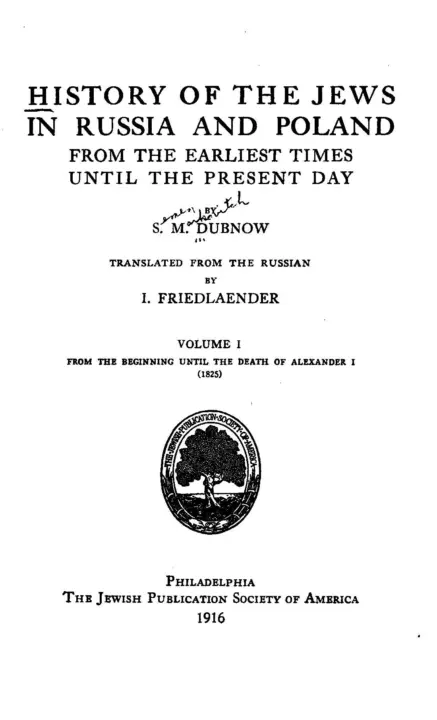
"History of the Jews in Russia and Poland, Volume 1" by Simon Dubnow is a historical account written in the early 20th century. This work delves into the rich and complex history of Jewish communities in Eastern Europe, specifically from the earliest settlements until the death of Alexander I in 1825. It aims to present a comprehensive narrative of the experiences, challenges, and contributions of Jews in these regions against broader historical backdrops, including political changes, religious conflicts, and cultural interactions. The opening of the book introduces readers to the early Jewish diaspora in Eastern Europe, highlighting settlements along the Black Sea and the Kingdom of the Khazars. It discusses the anachronistic development of Jewish life in these areas, suggesting that Jewish communities may have existed there prior to the migration to Western Europe. Through detailed accounts such as inscriptions found within ancient settlements and the dynamics between Jewish and surrounding cultures, the text lays a foundation that underscores the importance of these communities in shaping regional history, setting the stage for the subsequent chapters which promise a deeper exploration into their evolving roles and relationships over the centuries.
Introduction adapted from the source catalogue; source summaries may be automatically generated.
Free to read · English · 119,456 words · No account needed
MAKE TIME FOR A GOOD BOOK
On by default. Untick to stop anonymous reading totals. Each page counts after 10 seconds in view. How this works.
Anonymous counting is on unless you have switched it off.
[52] According to another version, they forged the contents of the royal
warrant.
[53] [With the gradual weakening of the royal power, which, after the extinction of the Yaghello dynasty, in 1572, was transformed into an elective office, the favorite designation for the Polish Empire came to be Rzecz (pronounced Zhech) Pospolita, a literal rendering of the Latin Res Publica. The term comprises Poland as well as Lithuania, which, in 1569, had been united in one Empire.]
[54] They are referred to in his edicts as calumniae.
[55] [The Arian heresy, as modified and preached by Faustus Socinus (1539-1604), an Italian who settled in Poland, became a powerful factor in the Polish intellectual life of that period. Because of its liberal tendency, this doctrine appealed in particular to the educated classes, and its adherents, called Socinians, were largely recruited from the ranks of the Shlakhta. Under Sigismund III. a strong reaction set in, culminating in the law passed by the Diet of 1658, according to which all "Arians" were to leave the country within two years.]
[56] [Arendar, also arendator, from medieval Latin arrendare, "to rent," signifies in Polish and Russian a lessee, originally of a farm, subsequently of the tavern and, as is seen in the text, other sources of revenue on the estate. These arendars being mostly Jews, the name, abbreviated in Yiddish to randar, came practically to mean "village Jew."]
[57] [Literally, lord: the lord of the manor, noble landowner.]
[58] There is reason to believe that he is the hero of the legendary story according to which an influential Polish Jew by the name of Saul Wahl, a favorite of Prince Radziwill, was, during an interregnum, proclaimed Polish king by the Shlakhta, and reigned for one night.
[59] [See pp. 29 et seq. Kiev was captured by the Lithuanians in 1320, and remained, through the union of Lithuania and Poland, a part of the Polish Empire until 1654, when, together with the province of Little Russia, it was ceded to Muscovy.]
[60] See p. 55.
[61] [Stephen Batory instituted two supreme courts for the realm: one for the Crown, i. e. for Poland proper, and another for Lithuania. The former held its sessions in Lublin for Little Poland and in Piotrkov for Great Poland (see p. 164).]
[62] A second edition of the book appeared in 1636.
[63] [In addition to the regular Diets, which assembled every two years (see above, p. 76, n. 1), there were held also Election Diets and Coronation Diets, in connection with the election and the coronation of the new king. The former met on a field near Warsaw; the latter were held in Cracow.]
[64] [Moghilev on the Dnieper, in White Russia, is to be distinguished from Moghilev on the Dniester, a town in the present Government of Podolia.]
Your reading position is saved on this browser. Take it to another device with a library code. Reading pages adapt to text, rather than matching a printed edition.
Simon Dubnow
Simon Dubnow
Simon Dubnow
BEHIND THE BOOK
This eBook is for the use of anyone anywhere in the United States and most other parts of the world at no cost and with almost no restrictions whatsoever. You may copy it, give it away or re-use it under the terms of the Project Gutenberg License included with this eBook or online at www.gutenberg.org. If you are not located in the United States, you will have to check the laws of the country where you are located before using this eBook. Read the source licence.
The original source file, including credits and licence, is retained by this library. Request an original-format copy at no charge. Please include the book title and Project Gutenberg identifier #41547.
KEEP YOUR CURIOSITY GOING
Cécile Tormay

Moritz Busch
John L. Ransom
Frances Wright
Cécile Tormay

Mabel Potter Daggett

