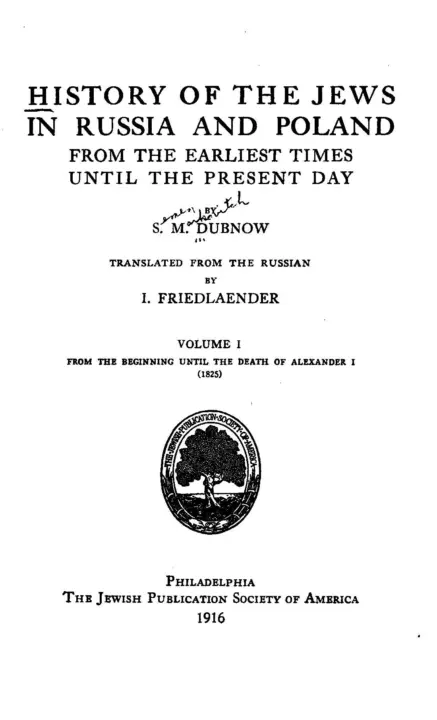
History of the Jews in Russia and Poland, Volume 3 [of 3] From the Accession of Nicholas II until the Present Day
Simon Dubnow
![History of the Jews in Russia and Poland, Volume 1 [of 3] From the Beginning until the Death of Alexander I (1825) — digital edition cover](https://classicfreebooks.com/wp-content/uploads/classic-library/41547/cover.webp)
THE CLASSIC COLLECTION · 1916
"History of the Jews in Russia and Poland, Volume 1" by Simon Dubnow is a historical account written in the early 20th century. This work delves into the rich and complex history of Jewish communities in Eastern Europe, specifically from the earliest settlements until the death of Alexander I in 1825. It aims to present a comprehensive narrative of the experiences, challenges, and contributions of Jews in these regions against broader historical backdrops, including political changes, religious conflicts, and cultural interactions. The opening of the book introduces readers to the early Jewish diaspora in Eastern Europe, highlighting settlements along the Black Sea and the Kingdom of the Khazars. It discusses the anachronistic development of Jewish life in these areas, suggesting that Jewish communities may have existed there prior to the migration to Western Europe. Through detailed accounts such as inscriptions found within ancient settlements and the dynamics between Jewish and surrounding cultures, the text lays a foundation that underscores the importance of these communities in shaping regional history, setting the stage for the subsequent chapters which promise a deeper exploration into their evolving roles and relationships over the centuries.
Introduction adapted from the source catalogue; source summaries may be automatically generated.
Free to read · English · 119,456 words · No account needed
MAKE TIME FOR A GOOD BOOK
On by default. Untick to stop anonymous reading totals. Each page counts after 10 seconds in view. How this works.
Anonymous counting is on unless you have switched it off.
[134] ["Scroll of Darkness" (comp. Amos iv. 13), with a clever allusion to the similarly sounding words in Zech. v. 1.]
[135] [In Polish Szczebrzeszyn, a town in the region of Lublin.]
[136] ["Troublous Times," allusion to Dan. ix. 25.]
[137] ["Door of Repentance."]
[138] [See p. 98, n. 1.]
[139] [I. e. son of Mark, or Mordecai. On "syndics" see p. 111, n. 2.]
[140] [Twenty per cent was the legalized rate of interest in Italy at the end of the fifteenth century. See Israel Abrahams, Jewish Life in the Middle Ages, p. 242.]
[141] We quote the following in abbreviated form. [For the complete text see the article cited in the next note.]
[142] From the Hebrew text it is not clear whether they offered themselves voluntarily as victims, or whether they were picked out by others. According to the local tradition in Ruzhany, the former was the case. [See Dubnow in the Russian Jewish monthly Voskhod, July, 1903, p. 19, n. 1.]
[143] The corresponding word in Hebrew (שלומים), which is marked with dots in the original, represents the year of the event: [5]420 aera mundi, which equals 1659 C. E.
[144] I. e. they tried to convert the martyrs to Catholicism.
[145] [Allusion to Judges ix. 9, where the English version translates differently. The Hebrew word for "tree" also signifies "wood," and is used in polemic literature for "cross."]
[146] [See p. 91, n. 1.]
[147] [See p. 96, n. 1.]
[148] [The Senate formed the upper chamber of the Polish parliament.]
[149] In the "Political Catechism of the Polish Republic," published in 1735, we read the following: "Who is it in this vast country that engages in commerce, in handicrafts, in keeping inns and taverns?"--"The Jews." ... "What may be the reason for it?"--"Because all commerce and handicrafts are prohibited to the Shlakhta on account of the importance of this estate, just as sins are prohibited by the commandments of God and by the law of nature."--"Who imposes and who pays the taxes?"--"The taxes are imposed by the nobility, and they are paid by the peasant, the burgher, and the Jew."
[150] [See above, p. 46, n. 1, and p. 60, n. 1.]
[151] [More exactly, faktor, Polish designation for broker, agent, and
general utility man.]
[152] [Popular Polish form of the Jewish name Baer.]
[153] The last order was subsequently repealed.
[154] [See p. 55.]
[155] [See pp. 164 and 165.]
[156] According to another version, he expressed his willingness to embrace Christianity in order to escape death, but afterwards repented.
[157] [In Podolia.]
[158] [In the province of Kiev.]
[159] [In Volhynia.]
[160] [Near Lublin.]
[161] Another variant of the name is Jelek. [The latter form is declared to be incorrect by A. Berliner, Gutachten Ganganelli's (Berlin, 1888), p. 41.]
Your reading position is saved on this browser. Take it to another device with a library code. Reading pages adapt to text, rather than matching a printed edition.
Simon Dubnow
Simon Dubnow
Simon Dubnow
BEHIND THE BOOK
This eBook is for the use of anyone anywhere in the United States and most other parts of the world at no cost and with almost no restrictions whatsoever. You may copy it, give it away or re-use it under the terms of the Project Gutenberg License included with this eBook or online at www.gutenberg.org. If you are not located in the United States, you will have to check the laws of the country where you are located before using this eBook. Read the source licence.
The original source file, including credits and licence, is retained by this library. Request an original-format copy at no charge. Please include the book title and Project Gutenberg identifier #41547.
KEEP YOUR CURIOSITY GOING
Cécile Tormay

Moritz Busch
John L. Ransom
Frances Wright
Cécile Tormay

Mabel Potter Daggett

