THE CLASSIC COLLECTION✦An outlaw’s diary: the CommuneCLASSIC FREE BOOKS
An outlaw’s diary: the Commune
Cécile Tormay
THE CLASSIC COLLECTION · 1912
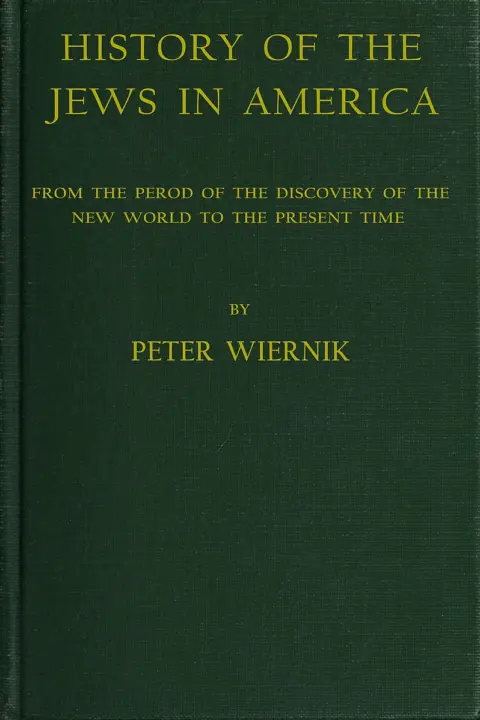
"History of the Jews in America" by Peter Wiernik is a historical account written in the early 20th century. The book chronicles the journey and experiences of Jews from the discovery of the New World through significant events in American history, highlighting their struggles for identity, religious freedom, and acceptance. With a focus on the growth of Jewish communities, it provides insight into their contributions to American society and culture. The opening of this work introduces the significant context of the Jewish presence in America, beginning with their expulsion from Spain and Portugal and the beginnings of Jewish migration to the New World. Wiernik outlines the early experiences of Jews, noting that less than ten thousand Jews resided in the New World three centuries after its discovery. The text emphasizes the transformation of Jewish communities, their struggles against discrimination, and the importance of maintaining their religious identities amidst various economic and social challenges. By establishing a foundation of historical significance, the author sets the stage for a deeper exploration of Jewish history in America throughout the subsequent chapters.
Introduction adapted from the source catalogue; source summaries may be automatically generated.
Free to read · English · 134,713 words · No account needed
MAKE TIME FOR A GOOD BOOK
On by default. Untick to stop anonymous reading totals. Each page counts after 10 seconds in view. How this works.
Anonymous counting is on unless you have switched it off.
12 ‒ Another great American clergyman, Dr. Henry M. Field (1822–1907), who wrote about a century later, also found in the Jewish polity much that was later adopted in the Constitution of the United States. In his work On the Desert (New York, 1883), he says: “Perhaps it does not often occur to readers of the Old Testament that there is much likeness between the Hebrew Commonwealth and the American Republic.... At the bottom there is one radical principle that divides a republic from a monarchy or an aristocracy; it is the natural equality of men――that “all men are born free and equal”――which is fully recognized in the laws of Moses as in the Declaration of Independence. Indeed, the principle is carried further in the Hebrew Commonwealth than in ours; for not only was there equality before the laws, but the laws aimed to produce equality of condition in one point, and that a vital one――the tenure of land, of which even the poorest could not be deprived, so that in this respect the Hebrew Commonwealth approached more nearly to a pure democracy.” See a more extensive quotation in Simon Wolf’s The American Jew as Patriot, Soldier and Citizen, pp. 494–98.
13 ‒ A drawing of this design is printed as the frontispiece of Mr. Straus’s above-named work.
14 ‒ See Dr. M. Kayserling. A Memorial Sent by German Jews to the President of the Continental Congress, in “Publications” VI, pp. 5–8, where it is also stated that the letter was wrongly attributed to Moses Mendelssohn (1729–86).
15 ‒ The American Jew as Patriot, Soldier and Citizen, by
Simon Wolf, edited by Louis Edward Levy, Philadelphia,
1895.
16 ‒ Aaron Levy (b. in Amsterdam, 1742; d. in Philadelphia, 1815), who was also of great assistance to the colonies in their struggle for independence, was a partner of Robert Morris in various enterprises in Pennsylvania. The town of Aaronsburg, Center County, Pa., was founded by Levy and is named after him. (See “Jew. Encyclopedia,” s. v., Aaronsburg and Levy, Aaron.)
17 ‒ A fac-simile of Washington’s reply is found in the “Jewish Encyclopedia,” vol. IX, between pp. 294–95.
18 ‒ See Hyman Polock Rosenbach, The Jews in Philadelphia prior to 1800, pp. 22–23, ff., Philadelphia, 1883.
19 ‒ See Oppenheim, The Jews and Masonry, in “Publications,” vol. XIX, 1–94, for the sources of most of the references to Masonry in this work.
20 ‒ A description of this highly interesting Jewish family, by Gratz Mordecai, is found in “Publications,” VI, pp. 39–48.
21 ‒ See Max J. Kohler, Phases in the History of Religious Liberty in America ... in “Publications,” XI, pp. 53–73, where the subject is extensively treated and the sources are given.
22 ‒ See Jacob Ezekiel, The Jews of Richmond, in “Publications,” IV, pp. 21–27.
Your reading position is saved on this browser. Take it to another device with a library code. Reading pages adapt to text, rather than matching a printed edition.
BEHIND THE BOOK
This eBook is for the use of anyone anywhere in the United States and most other parts of the world at no cost and with almost no restrictions whatsoever. You may copy it, give it away or re-use it under the terms of the Project Gutenberg License included with this eBook or online at www.gutenberg.org. If you are not located in the United States, you will have to check the laws of the country where you are located before using this eBook. Read the source licence.
The original source file, including credits and licence, is retained by this library. Request an original-format copy at no charge. Please include the book title and Project Gutenberg identifier #64574.
KEEP YOUR CURIOSITY GOING
Cécile Tormay

Moritz Busch
John L. Ransom
Frances Wright
Cécile Tormay

Mabel Potter Daggett