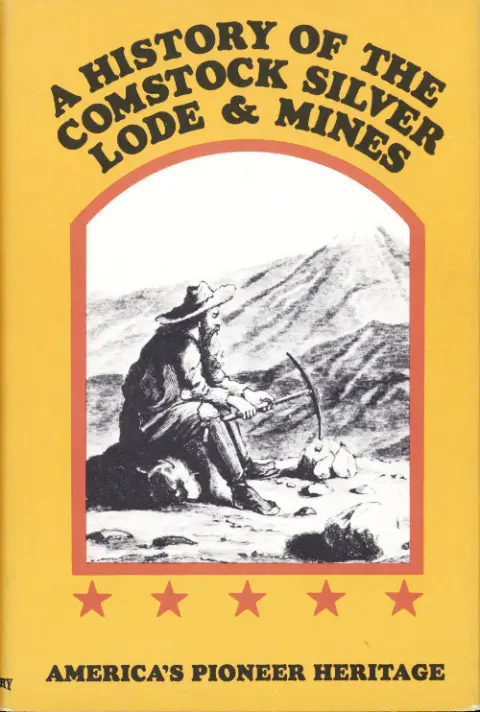
A History of the Comstock Silver Lode & Mines Nevada and the Great Basin Region; Lake Tahoe and the High Sierras
Dan De Quille
THE CLASSIC COLLECTION · 1876
"History of the Big Bonanza: An Authentic Account of the Discovery, History, and Working of the World Renowned Comstock Silver Lode of Nevada" by Dan De Quille is a historical account written in the latter part of the 19th century. This volume chronicles the significant discovery and development of the Comstock Lode, detailing the mining operations, the settlers, and the individuals who played key roles in this transformative era. The narrative not only covers the events surrounding the silver mining boom but also delves into the colorful lives and stories of those involved. The opening of this book sets the stage by examining the early days of settlement in Nevada and the legends that surrounded silver mining. It describes how the land transitioned from little known to being pivotal during the silver rush, emphasizing the contributions of early settlers. The author discusses the challenging environment, the conflict with Native Americans, and the emerging mining culture. Notably, it reveals the misconceptions early miners held about silver mining and introduces characters like "Old Virginia" and others who became significant figures as mining operations escalated. The narrative combines factual history with entertaining anecdotes, highlighting the intrigue and adventure of mining life during that transformative period.
Introduction adapted from the source catalogue; source summaries may be automatically generated.
Free to read · English · 180,009 words · No account needed
MAKE TIME FOR A GOOD BOOK
On by default. Untick to stop anonymous reading totals. Each page counts after 10 seconds in view. How this works.
Anonymous counting is on unless you have switched it off.
The excitement in regard to the grand development in the Consolidated Virginia and California mines had the effect of sending up the price of stocks along the whole line of the Comstock. Mines that could show no manner of improvements in their prospects went up with the rest, under the pressure of the excitement. The aggregate value of mines in Virginia and Gold Hill districts, whose stocks are called in the San Francisco Stock Board, was about $93,000,000 November 22, 1874. On the same day of the following month their market value was as follows:
Andes, $250,000 Arizona and Utah, 18,000 Alpha, 159,000 American Flat, 240,000 Baltimore Consolidated, 450,000 Bacon, 240,000 Belcher, 5,720,000 Best & Belcher, 3,528,000 Bullion, 1,700,000 Caledonia, 520,000 California, 54,000,000 Chollar, 2,464,000 Confidence, 1,123,200 Consolidated Virginia, 54,000,000 Consolidated Gold Hill Quartz, 140,000 Crown Point, 5,200,000 Challenge, 600,000 Crown Point Ravine, 100,000 Dardanelles, 670,000 Eclipse, 250,000 Empire Mill, 800,000 Exchequer, 900,000 Globe, 25,000 Gould and Curry, 2,880,000 Hale and Norcross, 1,024,000 Imperial, 1,900,000 Julia, 210,000 Justice, 1,470,000 Kentuck, 660,000 Knickerbocker, 120,000 Kossuth, 216,000 Lady Washington, 75,000 Leo, 40,000 Mexican, 3,456,000 New York Consolidated, 144,000 Ophir, 18,900,000 Overman, 2,944,000 Rock Island, 125,000 Savage, 2,000,000 Segregated Belcher, 960,000 Silver Hill, 540,000 Sierra Nevada, 340,000 Succor, 114,000 Trench, 50,000 Union Consolidated, 1,400,000 Utah, 160,000 Whitman, 150,000 Woodville, 252,000 Yellow-Jacket, 1,920,000 —————————- Total. $175,147,200
By the above it will be seen that the appreciation in the value of forty-nine mines was over $82,000,000 in thirty days. Besides the mines given in the above list there were a score more that have a market value, all of which were more or less affected by the excitement, and were bought by persons who not having money to purchase bonanza stocks were yet determined to get into mines of some kind.
The body of ore in the California and Consolidated Virginia mines, known as the “Big Bonanza” is by no means the only bonanza found on the Comstock that was worth having. From the first Ophir bonanza was extracted, all told, about $20,000,000; from the Savage, $15,750,000; Hale & Norcross, $8,000,000; Chollar-Potosi, $16,000,000; Gould & Curry, $15,550,000; Yellow-Jacket, $15,000,000; Crown Point, $20,000,000; Belcher, $25,000,000; Overman, $3,000,000; Imperial, $2,500,000, and many other mines sums running into millions, or well up in the hundreds of thousands. The Belcher and Crown Point mines are still yielding about 500 tons of ore each per day. The Belcher mine has paid its stockholders dividends to the amount of $14,135,000; the stockholders of the Crown Point have received $11,588,000; the Consolidated Virginia has paid $9,720,000; Chollar-Potosi, $3,080,000; Gould & Curry, $3,826,800; Hale & Norcross, $1,598,000; Savage, $4,440,000; Yellow-Jacket, $2,184,000; and many others sums ranging from fifty thousand to one million dollars.
Your reading position is saved on this browser. Take it to another device with a library code. Reading pages adapt to text, rather than matching a printed edition.
BEHIND THE BOOK
This eBook is for the use of anyone anywhere in the United States and most other parts of the world at no cost and with almost no restrictions whatsoever. You may copy it, give it away or re-use it under the terms of the Project Gutenberg License included with this eBook or online at www.gutenberg.org. If you are not located in the United States, you will have to check the laws of the country where you are located before using this eBook. Read the source licence.
The original source file, including credits and licence, is retained by this library. Request an original-format copy at no charge. Please include the book title and Project Gutenberg identifier #74667.
KEEP YOUR CURIOSITY GOING
Wilfrid Scawen Blunt
Wilfrid Scawen Blunt

E. W. (Edgar Watson) Howe
Cécile Tormay

Moritz Busch
John L. Ransom